

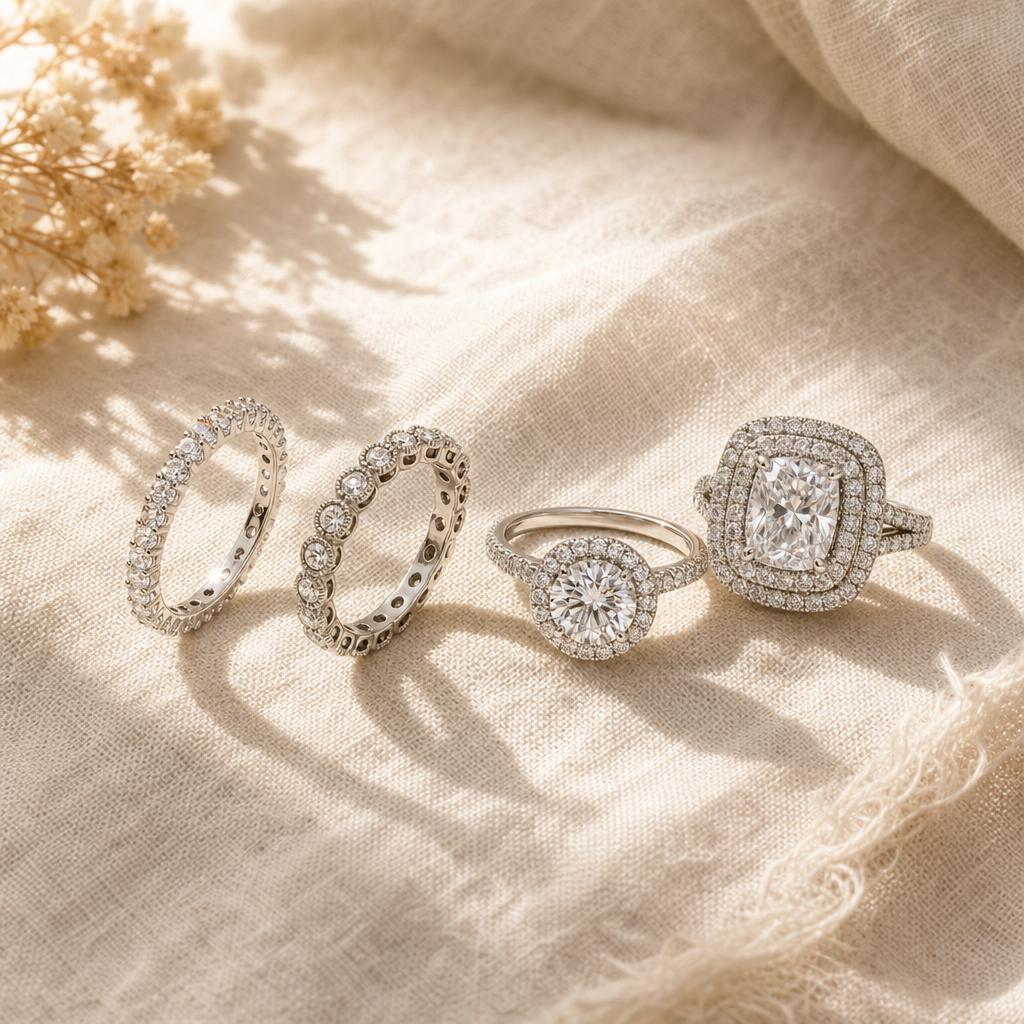
What Does $50, $100, $150 or $200+ Actually Get You in a Ring? An Honest Breakdown
Simulated diamond rings span a huge range — from under $30 to well over $200 — and the price gap is not arbitrary. If you've ever stood in front of two rings wondering whether the cheaper one is secretly the same thing in different packaging, this is the honest breakdown you need.
What you're really buying when you buy a simulated diamond ring is a combination of four things: the base metal underneath, the plating method and thickness, the stone quality, and how complex the setting is. Every one of those elements changes meaningfully as the price increases. Understanding which ones matter most for how you plan to wear the ring is the fastest route to spending your money well — and not regretting it.


Under $50: wearable, but only just
Rings at this price point are built on a brass or zinc alloy base with a thin layer of rhodium or silver plating applied over the top — usually 0.5 microns or less. At that thickness, the coating doesn't have much of a lifespan under regular wear. Exposure to water, lotion, and daily friction will strip the plating within weeks for some people, within a few months for most.
The stones in this tier are cubic zirconia, sometimes of quite variable quality. Some of it is fine out of the box — bright, clear, presentable. Some of it is cloudy from the start. At this price, there's not much quality control invested in stone selection. Settings are simple by necessity: a basic prong solitaire or a flat band are achievable; any real setting complexity is not.
There's also a nickel risk worth mentioning. Many cheap alloy bases contain nickel, which is a common skin sensitiser. If your skin runs sensitive, a ring that costs almost nothing in money can cost more in irritation. That's not universal — plenty of people wear these rings without issue — but it's worth knowing before you buy.
None of this makes under-$50 rings worthless. They're excellent for a beach holiday, a costume, or a ring you genuinely don't mind losing. For consistent daily wear, they're a false economy: you'll replace them within a season and spend more in total than you would have done buying once at a higher tier.
The $50–$100 range: better metal, better longevity
This is where quality genuinely starts to improve. You'll find copper or sterling silver bases more often than brass or zinc. Plating tends to be 1–2 microns thick, which translates to noticeably longer wearability — a year or more of regular use is realistic from a well-made ring in this range.
The CZ stones are measurably better too. You'll see more consistent faceting, which produces more uniform sparkle rather than the variable flash of cheaper stones. Some brands in this range use higher-grade CZ marketed under trade names, and a few introduce moissanite-adjacent materials. The design options remain relatively simple — solitaires, thin bands, basic cluster settings — but they're executed with more care.
For travel rings and light everyday use, this tier makes a lot of sense. A well-made $80–$95 ring is not a throwaway — it's a considered purchase with a reasonable lifespan, appropriate for the purpose. Where it starts to fall short is design ambition. If you want anything with real visual complexity, or a ring that feels like something when you put it on, this tier won't fully deliver on either count.
The $100–$150 tier: the sweet spot for stacking and everyday wear
Something meaningfully changes at this price point. Sterling silver (925 silver) becomes standard rather than occasional. The manufacturing quality increases in ways you can feel as well as see — the rings have more weight to them, the prongs are more precisely set, and the design vocabulary available expands considerably.
Pavé settings, eternity bands, milgrain detailing, and full-circumference stone settings all become achievable in this range. Those designs require consistent stone sizing, careful all-around setting work, and a base metal that won't flex under pressure — and that's exactly what this tier's budget allows. A good $149 eternity ring from a quality brand will have stones that sit flush and even all the way around the shank. That's not something you'll find reliably in the tier below.
The stones are also noticeably better. Higher-grade cubic zirconia in this tier approaches the light refraction of moissanite — not identical, but closer than you might expect. If you're buying a stacking ring, an eternity band, or an everyday piece that needs to hold up to real wear, this is the tier where those decisions start paying off.

The Beloved Ring
A full row of round-cut simulated diamonds set in a vintage-inspired prong setting with delicate milgrain detailing along both edges — running the complete circumference of the shank, so it looks just as considered from the side as it does face-on. A strong example of what the $100–$150 tier produces when the design brief is taken seriously.
Shop The Beloved Ring →The $150–$200 range: where design complexity enters
If the previous tier is where simulated diamond rings become genuinely wearable, this is where they start to look genuinely impressive. The additional budget funds more than better materials — it funds more ambitious design. Crossover bands, twisted shanks, bypass designs, and intricate eternity configurations all appear at this price point because the manufacturing margin can support them.
These designs aren't just cosmetically different from simpler rings. A crossover band sits differently on the hand. A split-shank setting changes how a center stone presents. These are design choices that have visual consequences, and they're ones that require real craftsmanship to execute well. At $150–$200, you're paying for that execution as much as you're paying for the materials.
Moissanite also becomes more consistent in this tier. A few quality brands offer moissanite rings in the $150–$180 range, and it's worth knowing why that matters: moissanite is significantly harder than CZ (9.25 on the Mohs scale vs 8–8.5), has a higher refractive index, and resists scratching and clouding over time far better than any CZ variant. If the ring is going on your hand every day for the next few years, moissanite earns its small premium at this level.

The Destiny Ring
Two slender pavé-set bands that cross at the center in a ribbon-like interlace — a design that manages to feel both delicate and substantial. It works beautifully on its own as an everyday ring and stacks even better alongside an engagement ring. A crossover design this precise is a direct product of what the $150–$200 budget allows a good manufacturer to do.
Shop The Destiny Ring →At $200+: engagement-quality presence in simulated diamonds
The upper tier of the simulated diamond market produces rings that, in design and visual presence, are genuinely comparable to fine jewelry. The stones are at the top of the CZ or moissanite quality spectrum. The settings are heavier and more precisely crafted. The designs available — full halos, double halos, elaborate side-stone configurations, sculptural shanks — require significant manufacturing investment to execute at the quality level these rings deliver.
There's also something harder to quantify that changes here: the ring feels like something. The weight is present. The construction is solid. When you put it on, it doesn't read as a compromise — it reads as a choice. That distinction matters more than it might seem, particularly if you're wearing the ring daily or in contexts where you'd prefer it to be genuinely indistinguishable from a fine jewelry piece.
It's also worth putting this tier in context against what $200 buys in mined diamonds. Almost nothing, if we're being honest. A $200 natural diamond ring will have a stone so small it borders on invisible, in a setting so plain it barely registers. The gap in visual presence between a $200 simulated diamond ring and a $200 mined diamond ring is enormous — and it falls emphatically in favour of the simulated stone. That's not spin. It's simple arithmetic.

The Aura Ring
A radiant-cut simulated diamond set in a sculpted halo with pavé-set shoulders — a ring that stops people mid-sentence. The radiant cut is flattering precisely because of how it throws light: intense, fire-forward, and visually larger than the carat weight alone suggests. This is the kind of ring that makes the $200 tier make complete sense.
Shop The Aura Ring →What the price tag doesn't tell you
Price tier narrows the field. It tells you what's possible at a given budget — what base metals, stones, and designs can reasonably be produced at that cost. What it doesn't tell you is where within that field your specific ring lands, because that depends entirely on the brand making it.
A $180 ring from a brand that cuts corners on plating thickness or uses substandard CZ will underperform against a $149 ring from a brand that doesn't. The tier sets the ceiling on what's achievable; the maker determines how close to that ceiling the ring actually gets.
Worth knowing: The most reliable quality signals — beyond price — are plating thickness in microns (ask for the number, not just "thick plating"), base metal composition, stone grade or source, and return policy generosity. A brand confident in its product is transparent about all four. Ambiguity on any of them is worth paying attention to.
Design execution matters too. A simpler ring that's expertly made will outlast and outperform a complex ring that's poorly assembled. If longevity is the priority — and for daily wear it should be — look closely at how the stones are set, whether the shank has consistent weight around the circumference, and how cleanly the setting edges are finished. Those details reveal more about quality than the headline price ever does.
The Price Tier Summary
- Under $50: brass or zinc alloy bases, thin plating, variable CZ — fine for costume or occasional use, not for daily wear
- $50–$100: better plating and base metals; ideal for travel rings and light seasonal use; limited design complexity
- $100–$150: sterling silver becomes standard; eternity bands, pavé settings and milgrain detailing all achievable; the sweet spot for stacking
- $150–$200: design complexity increases significantly; crossover, twisted shank and bypass designs enter the picture; moissanite becomes more consistent
- $200+: engagement-quality settings in simulated diamonds; full and double halo designs; rings with real visual presence and long-term wearability
- Price sets the ceiling — the brand determines how close to it your ring actually gets
Frequently asked questions
Is there a meaningful difference between a $149 ring and a $199 ring, or is it mostly marketing?
Within a quality brand, the difference is real. The $50 gap at this level typically funds a more complex setting design, slightly heavier construction, or a step up in stone quality. The most visible change is usually design: halo settings, sculptural shanks, and side-stone configurations are more achievable at $199 than at $149. If a simpler design suits you, a good $149 ring from the right brand is an excellent buy. If the design you want lives in the more elaborate category, the extra spend is justified.
Should I buy CZ or moissanite once I'm shopping in the $150+ tier?
It depends on how long and how intensively you plan to wear the ring. For a travel ring or something rotated in and out of regular use, quality CZ at $150+ is excellent and will look beautiful for years. For a ring worn daily as a long-term everyday piece or an engagement ring substitute, moissanite is worth the premium — it's harder, resists clouding, and holds its brilliance over time much more reliably than CZ. Both are genuinely beautiful. The choice comes down to use case and how often you're comfortable thinking about upkeep.
How do I know if a brand is actually using the full budget on the ring itself?
Ask about specifics. A quality brand will tell you the plating thickness in microns (look for 2–3 microns minimum on rhodium-over-sterling-silver), the base metal composition, and whether the stones are graded or sourced from a specific supplier. Vague descriptions — "high-quality stone," "thick plating" — are a sign that the specifics don't flatter the product. A generous return window is also a good signal: a brand confident in its quality won't hesitate to let you send back something that doesn't hold up.
The best ring at any price point is the one built well enough to last as long as you need it to, designed thoughtfully enough that you'll still want to wear it in six months, and bought clearly enough that you knew exactly what you were getting before you spent a penny. The tiers above map the territory — your priorities tell you where within it to look.


