

Wedding Bands for Princess Cut Rings: Flat Edges, Flush Fits and What to Avoid
The princess cut is one of the most architectural shapes in jewellery — four flat sides, four precise corners, clean geometry that catches the light from every angle. It also pairs with wedding bands differently to a round brilliant. If you've ever pressed a curved contour band against a princess cut ring and noticed the fit isn't quite right, this is the guide that explains why — and what to choose instead.
Unlike a round stone, which has a smooth circular base and accepts almost any band shape without complaint, a princess cut has 90-degree corners and dead-flat sides. That changes which bands sit flush, which ones gap, and which ones look like they were chosen deliberately. This guide covers the styles that work, the widths that matter, and the common mistakes worth avoiding before you buy.


Why princess cuts pair differently to rounds
The round brilliant is a forgiving shape. Its circular base sits comfortably against a gently curved contour band, a flat straight band, or a channel-set eternity — all of them press close without visible gaps, because the smooth perimeter of a round ring accommodates minor mismatches in band profile without complaint.
The princess cut is less forgiving. Because its base is square, the ring's four corners sit at the exact points where the band makes contact. If a band curves inward at all — as contour bands designed for round engagement rings typically do — those corners push against the curve and create a small but visible gap at the base of the setting. The two rings don't sit flush. They press together at the corners but lean slightly apart everywhere else.
This isn't a flaw in either ring. It's geometry. A curved band was designed to hug a curved ring. A flat band was designed to sit against a flat side. Because princess cuts have four very flat sides, a flat straight band is the natural pairing — and in this particular case, the simpler band is the correct one.
Worth knowing: The "flat sides" of a princess cut ring refer to the exterior of the shank — the outward-facing surface when the ring is on your finger. Most modern shanks have a comfort-fit interior (slightly rounded inside for comfort) but a flat or knife-edge exterior profile. It is the exterior that determines how a band sits alongside it.
The wedding band styles that work
Flat, straight-profile bands
The single most important thing to look for. A band with a flat, even profile — no outward curve, no dramatic taper — sits flush against a princess cut shank consistently. The flat surface of the band presses against the flat side of the setting, and the two rings sit parallel along their full contact length without rocking or separating.
When you're shopping, look for bands described as "flat profile," "straight band," or "comfort fit flat." Terms like "curved," "contoured," or "fitted" indicate bands shaped for round engagement rings. Some brands specify which stone shapes a band is designed to sit alongside — worth reading if the product description includes this detail.
Channel set princess cut eternity bands
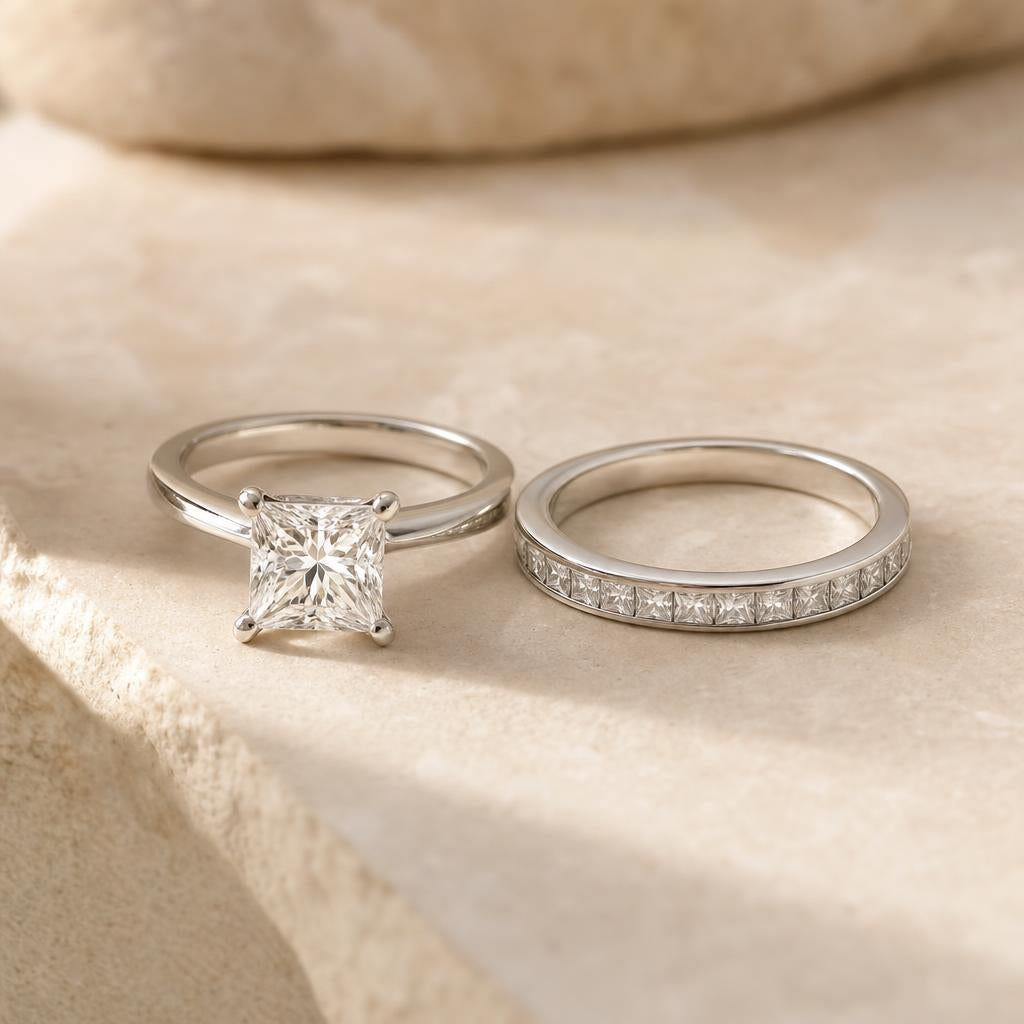
A channel-set band with princess cut stones is the most architecturally sympathetic pairing you can make. Both rings share the same stone shape and the same geometric language — square stones in a straight continuous row — and when they sit together, they look like a single intentional design rather than two separate purchases. The channel setting also means there are no protruding stone edges that could catch against the engagement ring's prongs.
The Evermore Ring was built for exactly this pairing. Princess cut simulated diamonds sit in a clean channel running the full circumference of a flat sterling silver band. Next to a princess cut engagement ring, it reads less like two rings and more like one ring, extended.
Pavé round eternity bands
A fine pavé band set with round brilliant stones also works well alongside a princess cut ring — the contrast between a geometric centre stone and a row of rounds is subtle enough to read as considered rather than mismatched. The key variable is width. A slim pavé eternity of 1.6–2mm doesn't compete with the princess cut centre stone; it frames it from below and lets it hold all the visual attention. A wider pavé band starts to compete, particularly if the pavé stones sit high off the band surface.
Bezel set flat bands
A bezel set band — where individual stones are enclosed in a continuous metal surround rather than lifted on prongs — is a quieter option that sits exceptionally well alongside a princess cut. The flat, uninterrupted surface presses evenly against the ring shank, and the enclosed setting means there are no prong tips catching against each other when both rings are worn in contact. Bezel bands also tend to be more durable in daily wear, since no stone edges are left exposed.

The Quinn Ring
A 1.25 carat princess cut in a clean, restrained setting — no halo, no heavy pavé shoulders, just the stone and a slim silver shank. The Quinn's uncomplicated silhouette makes it one of the most band-friendly princess cuts in the collection: nothing on the shank to compete with, catch against, or clash with whatever band you choose to pair it with.
Shop The Quinn Ring →The bands to avoid
Curved contour bands designed for round cuts
The most common pairing mistake. Contour bands are widely available and frequently marketed as the standard wedding band solution, without always making clear that they were shaped specifically for round engagement rings. A contour band curves inward at its centre to embrace the base of a round ring. Against a princess cut, that inward curve creates a gap at the base of the setting — the band and ring meet at the corners but separate in between. The two rings also have a tendency to rock against each other rather than sit parallel.
If you already own a contour band and love it, you have options: wear it on the other side of the engagement ring, creating a deliberate framing gap rather than an accidental one; wear it on a different finger; or accept the slight gap as part of the look. Some women keep a straight flat band for daily wear and reserve the contour band for occasions where the overall effect matters more than precise fit.
Bands wider than the engagement ring shank
Proportion matters more than most buyers expect. A wedding band that is noticeably wider than the shank of the engagement ring draws visual attention downward toward the finger rather than upward toward the centre stone — the stack looks heavy and unbalanced, particularly on smaller hands.
Most princess cut engagement ring shanks sit between 1.8mm and 2.5mm wide. A band at the same width or 0.2–0.4mm narrower sits naturally and gives the engagement ring visual priority. Going more than 0.5mm wider than the shank risks overwhelming the pairing, especially when the centre stone is under 2 carats.
High pavé bands with protruding stones
Some pavé bands are set with stones that sit significantly above the surface of the band rather than flush with it. When worn pressed directly against a princess cut ring, these raised stones can make contact with the engagement ring's prongs — creating friction, a knocking sensation when the hands move, and potential wear on the metal of both rings over time.
A flat-top pavé band or a channel-set design avoids this entirely. If you're drawn to a high pavé band, check whether it has a smooth, flush exterior surface at the stone level. If the stones are noticeably protruding, consider wearing that band as a standalone piece on a different finger rather than pressing it directly against the engagement ring.
✦ Quick fit test: Hold both rings together, flat sides in contact, and look at the join from the side. A flush fit shows a clean, unbroken contact line. If there is visible daylight anywhere between the two bands, the profile does not match your ring's geometry — and that gap will be visible on the finger.
Width and proportion: the practical numbers
If you know your engagement ring's shank width, these guidelines give you a starting point for band selection:
| Band width relative to shank | Visual effect | Best when |
|---|---|---|
| Same width as shank | Seamless, intentional pairing | You want the pair to read as a set |
| 0.2–0.4mm narrower | Barely perceptible; engagement ring leads | You want visual priority on the centre stone |
| 0.5mm+ wider | Band becomes prominent; layered effect | You want the band to register as a second piece |
| Under 1.4mm | Delicate, barely-there shimmer | You want sparkle alongside without a full "band" look |
If you don't know your exact shank width, a millimetre ruler across the outside of the band gives you a close estimate. Most modern princess cut engagement rings fall in the 1.8–2.5mm range — broad enough that you'll find compatible bands at most jewellery retailers.

The Infinity Ring
A continuous pavé eternity with round brilliant simulated diamonds in a slim, flat-profile band. The flat top surface sits flush alongside any princess cut ring without gaps or prong contact, and the slender profile keeps the visual focus wherever it belongs — on the centre stone above. One of the most versatile stacking bands in the collection.
Shop The Infinity Ring →Metal matching: same tone or mixed?
Matching metals remain the easiest default. Silver alongside silver, gold alongside gold — the consistent tone makes the pair read as a set without additional thought. For most buyers, this is the right starting point.
Mixed metals are valid and increasingly popular, but they require more intention. Yellow gold alongside a silver-toned princess ring, or rose gold next to white gold — both can work if the ring styles are compatible. One useful principle: let the engagement ring lead. If your princess ring is in sterling silver with rhodium plating, pairing it with a yellow gold band draws the eye down toward the stack. That can be a beautiful, deliberate effect — but it should be chosen, not accidentally arrived at.
What tends not to work: three or more different metal tones in a single two-ring stack. Two metals reads as a considered pairing. Three tones on two rings starts to look assembled rather than chosen. If you love working with multiple metals, spread them across more fingers rather than concentrating them all on one.
How setting style affects your band options
Not all princess cut rings present the same pairing challenges. The setting style matters:
Solitaire and low-profile settings are the most band-friendly. A clean solitaire — four corner prongs, minimal shank, nothing competing for attention — pairs well with almost any flat-profile band. The absence of halo stones or pavé shoulders means there are fewer surfaces for the band to catch against and fewer design elements to consider when matching.
Pavé shoulder settings pair best with bands that continue the pavé line. If the shank of your engagement ring is already set with small diamonds running down toward the finger, a pavé eternity or partial pavé band creates visual continuity. A plain metal band next to a heavily pavéd shank can look like an interruption in the design rather than a complement to it.
Halo settings add visual width to the ring, which means a very narrow band can look unexpectedly slim in comparison. A slightly wider band, or a double-row eternity, tends to balance a halo princess cut better than a very delicate single eternity.
Cathedral settings — where the shank arches upward to meet the centre stone — create a specific situation worth knowing about: the arch means the band makes contact lower on the shank. Depending on the height of the cathedral, there may be a small visible space between the top of the band and the point where the shank begins to rise. This is not a fault; it's inherent to the setting style. If a completely flush fit matters to you, a lower-profile or bezel-set setting will accommodate a band more snugly than a cathedral arch.
Quick Takeaways
- Princess cuts have flat sides — flat, straight-profile bands sit flush while curved contour bands create gaps
- Channel set princess cut eternity bands are the most geometrically sympathetic pairing
- Slim pavé eternity bands in round brilliant stones also work well alongside a princess ring
- Match band width to the engagement ring shank, or go slightly narrower — not wider
- High pavé bands with protruding stones can create friction against princess prongs — look for flat-top or channel set alternatives
- Solitaire and minimal settings are the most band-friendly; halo settings may benefit from a slightly wider band for visual balance
- Two metals in a stack reads as intentional; three or more tones on two rings usually doesn't
Frequently asked questions
Can I wear a curved contour band with a princess cut ring?
You can — but it won't sit flush. The inward curve designed for round rings creates a gap against a princess cut's flat sides. Some women wear the contour band on the opposite side of the engagement ring to create a deliberate framing effect rather than an accidental gap. If a clean, flush fit matters to you, a straight flat-profile band is the more reliable choice.
Does the prong style on my princess ring affect which bands fit?
It can. Large corner prongs that extend down the shank — common in some vintage or statement settings — create a slightly raised contact surface that may cause the band to tilt at a subtle angle. Most modern princess cut rings use clean, flush prongs or knife-edge shanks that don't interfere with band fit. If you're unsure, hold your potential band against the ring and check for an even contact line before purchasing.
Should the wedding band sit below or above the engagement ring?
Most people place the wedding band below the engagement ring — closer to the palm — as the marriage is traditionally "closest to the heart." Others reverse this if the engagement ring has a very tall setting and the band creates better visual balance worn above. There is no rule; try both arrangements and wear what looks right.
Do I need to solder my princess ring and wedding band together?
Only if shifting or rotation becomes a persistent annoyance. Because princess cuts tend to sit well against flat straight bands, the pairing generally stays in place better than round rings with contour bands. Wear both rings together for a few weeks before deciding — many people find they don't need soldering, and leaving them separate makes resizing, cleaning, and future adjustments straightforward.
✦ ✦ ✦
The princess cut rewards the right band the same way it rewards everything else — with precision. A flat-profile eternity that presses clean against the shank doesn't just fit the ring; it completes it. Get the geometry right, match the width, and the pair will look like they were designed for each other. Which, in a sense, they were.


