

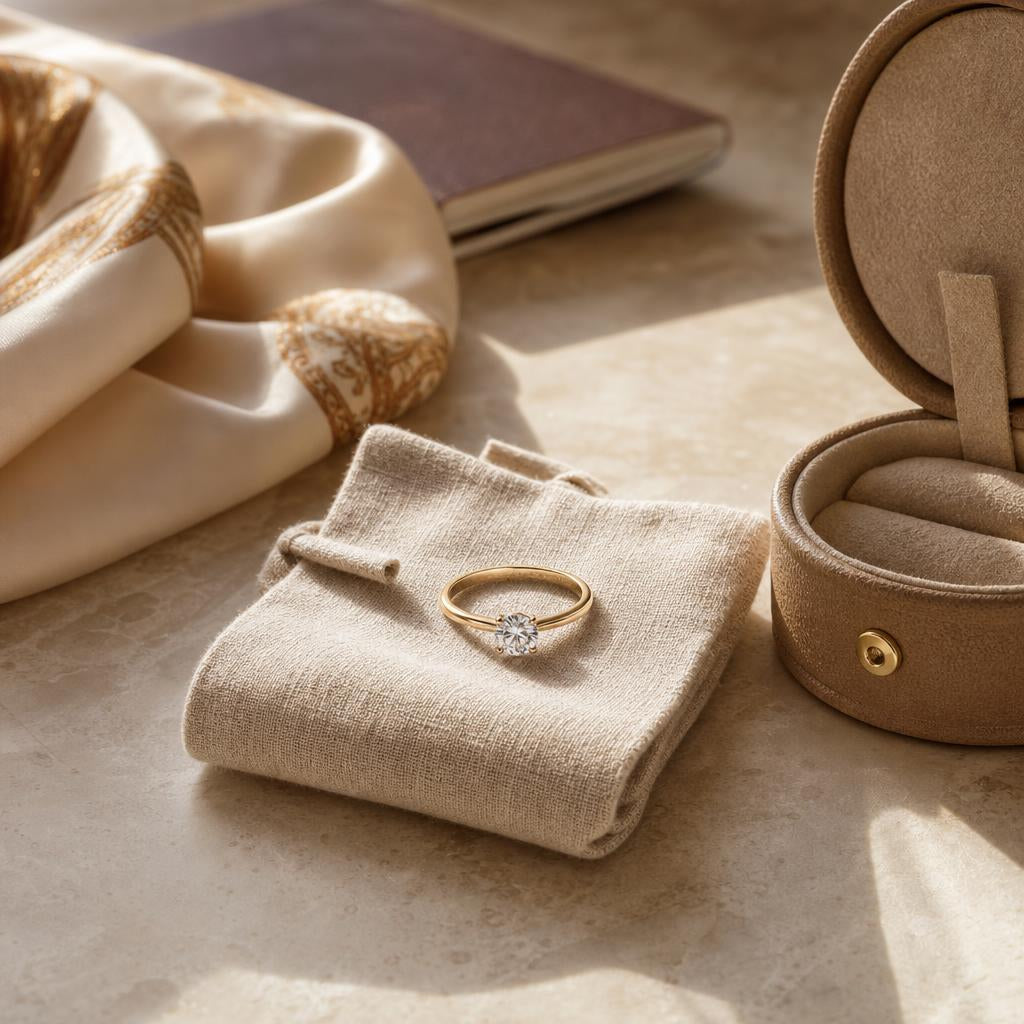
Traveling With Jewelry: What's Actually Worth Insuring Before a Big Trip
There's a specific kind of pause that happens the night before a trip, ring box open on the dresser: do you bring it, or leave it home? And if you bring it, does it need to be insured first?
Most of what gets written about traveling with jewelry assumes you're packing something that would take a five-figure claim to replace. If that's not your situation, the entire question changes — and so does the packing list. Here's what actually needs coverage before a trip, and the simpler fix a lot of women have already landed on.


Why "Do I Need to Insure My Jewelry for This Trip?" Is the Wrong First Question
Search around and you'll find plenty of guidance on jewelry insurance, most of it written for a very specific buyer: someone with a mined diamond ring worth thousands, who'd feel real financial pain replacing it. That advice is sound — for that ring. Standard homeowners or renters policies usually cap jewelry theft payouts at a low flat amount and often exclude simple loss entirely, which is exactly why standalone riders exist for pieces like an Ophelia-style ring appraised at $15,000 or higher.
But if the ring in your hand is a simulated diamond rather than a mined one, the math doesn't work the same way. A yearly premium exists to protect you from a loss you couldn't otherwise absorb. When the replacement is a phone call and a few days' shipping, the premium is solving a problem you don't have.
Worth knowing: Gemiros rings are 925 sterling silver set with moissanite or lab-created stones — indistinguishable from a diamond, and it passes diamond testers. What it isn't is a $15,000 loss if it goes missing in a hotel room. That distinction is the whole reason this decision gets easier.
What Actually Needs Insuring Before a Trip
Before you pack anything, it's worth sorting your jewelry into two honest categories: pieces you'd genuinely grieve losing the money on, and pieces you'd simply replace. The first category — a mined stone, a family heirloom, anything with real appraised value — deserves a standalone policy or rider before it leaves the house, full stop. Check the payout cap on your renters or homeowners policy first; most people are startled by how low it is.
The second category is where most of what's actually in a travel jewelry box lives. If you're bringing simulated diamonds, sterling silver, or gold-plated pieces, a dedicated policy is rarely worth the annual cost relative to what you'd spend replacing the piece outright. That's not a compromise — it's the entire point of building a travel-specific collection in the first place.
Traveling With Jewelry: The Packing Rules That Actually Matter
Once the insurance question is settled, the practical one is simpler than it sounds. Airport security and airline policy don't cap how much jewelry you can bring in a carry-on — TSA has no piece limit and won't ask you to declare it domestically — but that doesn't mean anything goes. A few habits do most of the work:
- Carry-on only, always. Never place jewelry, even low-value pieces, in checked luggage. Checked bags get lost, delayed, and occasionally opened by hands that aren't yours.
- Keep it on your person during screening. Leave jewelry in a zipped interior pocket rather than a bin whenever the piece is small enough — bins are the single most common place jewelry gets left behind at a checkpoint.
- Photograph what you pack. A quick photo of everything before you leave the house makes any insurance claim (for the pieces that need one) or hotel lost-and-found conversation dramatically faster.
- Use the hotel safe for anything you're not wearing that day. This applies even to an inexpensive ring — not because of the dollar value, but because it's one less thing to think about while you're out.
What Changes on an International Trip
Domestic travel has essentially no restrictions worth worrying about. International trips add one real consideration: customs. Most countries only require a formal declaration for jewelry above a fairly high value threshold — well outside the reach of a standard travel ring collection. If you happen to be carrying a genuinely high-value piece across a border, keep the receipt or appraisal paperwork with you; it's the fastest way to prove ownership if anyone asks. For everything else, the rules are the same ones that apply at home: carry-on only, keep it on you during screening, and don't overthink it.

The Cherish Ring
A bezel setting rims each stone in a smooth edge of metal instead of exposed prongs — nothing to snag on a jacket zipper, a seatbelt, or the strap of a carry-on. It's the version of "durable" that actually matters mid-trip.
Shop The Cherish Ring →How to Pack Jewelry for a Trip Without the Ten-Minute Untangling Session
Packing jewelry for travel goes wrong in one of two ways: everything ends up in one pouch and arrives as a single knot, or nothing is protected and a prong catches on a sweater. Both are avoidable with almost no extra gear.
Thread necklace chains through a cut drinking straw before closing the clasp — it keeps the chain straight and prevents the tangling that ruins the first morning of a trip. For rings and studs, a divided pill case or even a folded piece of felt inside a small zip pouch keeps each piece separated and scratch-free. If you already own a proper jewelry roll or case, use it; if you don't, this is a case where improvising with what's in a bathroom drawer works just as well as anything sold for the purpose.
✦ Pro tip: Pack one ring, not five. A single versatile piece — something that works with everything from a beach cover-up to a dinner reservation — solves more outfits than a full jewelry box ever will, and it's one less thing to keep track of.

The Eternity Ring
A full band of pavé stones that reads as finished on its own — no halo to check, no side stones to count after a long day. If you're only bringing one ring on this trip, a low-profile band like this one is built to be worn and forgotten.
Shop The Eternity Ring →The Smarter Fix: Why More Women Travel With a Second Ring Entirely
The women who've stopped worrying about any of this didn't find a better insurance policy — they stopped bringing the piece that needed one. A dedicated travel ring means there's no claim to file, no rider to renew, and no anxious mental inventory every time a hotel room door closes behind you. It's not a downgrade in how it looks; a well-made simulated diamond ring is indistinguishable from a mined one at a glance, including to most jewelers. It's a downgrade in how much there is to lose.
That's the actual through-line here: the question was never really about insurance. It was about whether a piece of jewelry deserves to cost you peace of mind on vacation. For most travel jewelry, the honest answer is no — and building a small, replaceable collection for exactly this purpose is the more modern, more intelligent way to still get to wear something beautiful on a trip.
Quick Takeaways
- Only genuinely high-value, appraised jewelry needs a standalone insurance policy before travel
- Affordably priced pieces are rarely worth insuring — replacing one outright usually costs less than a year of premiums
- Always pack jewelry in a carry-on, never checked luggage, regardless of its value
- There's no TSA limit on how much jewelry you can bring domestically, but keep it in reach during screening
- A dedicated travel ring removes the insurance question, and the anxiety, entirely
Frequently Asked Questions
Will TSA confiscate jewelry at security?
No. TSA doesn't prohibit jewelry in a carry-on, and there's no piece limit for domestic flights. Metal pieces can occasionally trigger a scanner, so keep anything bulky somewhere easy to remove and reach quickly during screening.
How much jewelry can I actually bring on a plane?
There's no official weight or piece limit for domestic travel, whether it's worn or packed in a carry-on. International trips can involve customs declarations for very high-value pieces, but a few everyday rings and a necklace won't raise any flags.
Do I need to insure a Gemiros ring before a trip?
Almost never. A standalone policy makes sense when a piece would be a genuine financial loss to replace. Replacing a Gemiros ring outright typically costs less than several years of premiums would — the math simply doesn't favor insuring it.
What's the safest way to pack a ring for a flight?
Keep it in your carry-on or personal item, never checked luggage. A divided pill case or small zip pouch keeps it from scratching against keys or coins, and a hotel safe is worth using once you land, even for an inexpensive piece.
Is it better to travel with one ring or several?
One versatile piece almost always wins. It's less to pack, less to lose track of, and — with the right low-profile design — it works across more outfits than a full stack would anyway.
However this trip shapes up, the packing list doesn't need to include a call to your insurance agent. Sort what's actually worth covering, leave the rest of the anxiety at home, and bring the ring that was built to go with you in the first place.


