

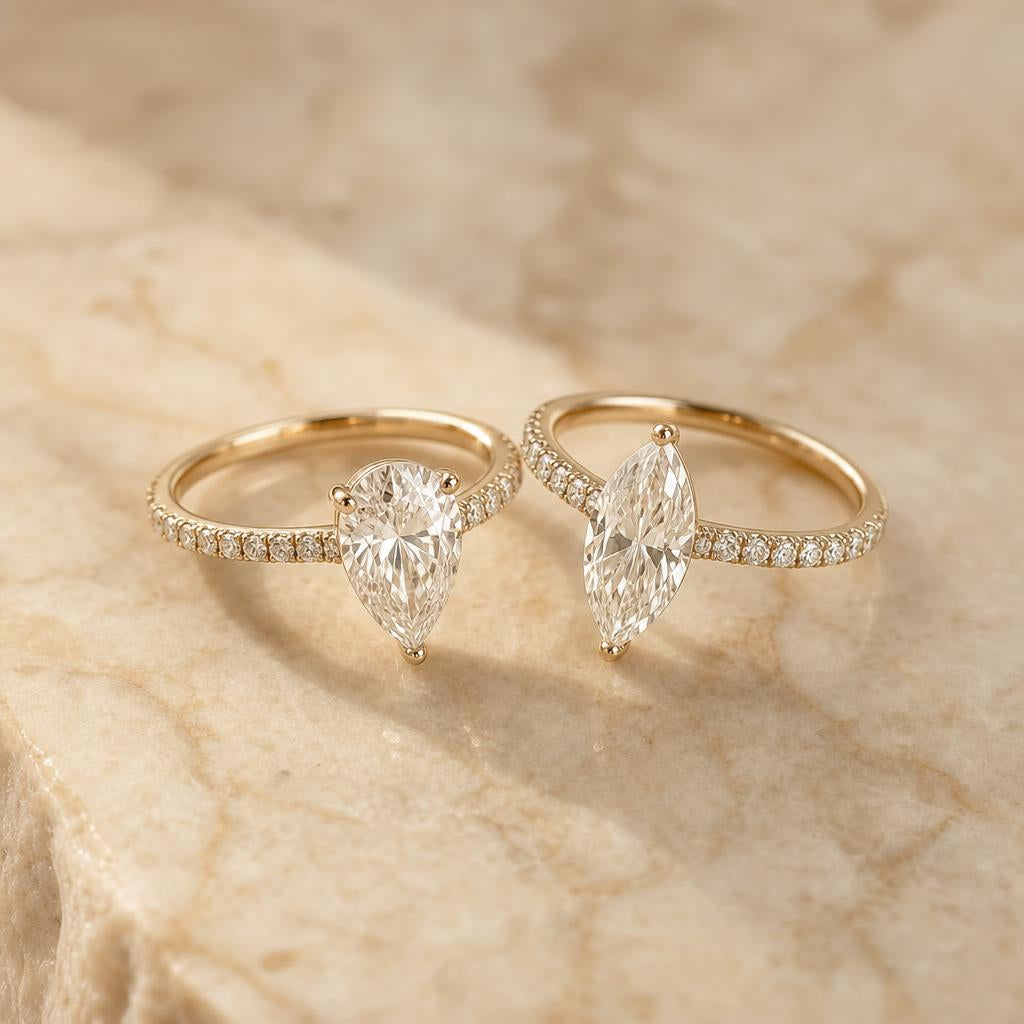
Toi et Moi Rings: What They Are, Why They're Trending, and How to Style Them
The toi et moi ring has a name that translates from French as "you and me" — and the sentiment is written right into the design. Two stones, side by side on one band, each distinct, each complete, together forming something more than either could be alone.
What was once a quiet romantic symbol has become one of the most searched ring styles of the moment. It's on the fingers of celebrities, in the feeds of jewellery editors, and increasingly, in the carts of women who've simply decided: two stones is more interesting than one.


What is a toi et moi ring?
A toi et moi ring features exactly two stones set on a single band, typically positioned at the shoulders of the ring so they face each other or tilt slightly outward. The two stones are usually different cuts — a round and an oval, a pear and a marquise, an emerald cut beside a trillion — chosen to complement rather than match.
The name is French: toi et moi, you and me. The style carries an intentional narrative — two distinct entities, united. It has historically been given as a symbol of romantic partnership. Napoleon Bonaparte gave Joséphine a toi et moi ring featuring a pear-shaped sapphire and diamond in 1796, and the style has surfaced repeatedly in the centuries since, always with the same underlying meaning: two things that belong together.
Modern wearers are just as likely to choose one for themselves — as a self-purchase, a milestone ring, or simply because two stones make for a more visually interesting finger than one.
Worth knowing: The toi et moi silhouette is one of the oldest engagement ring styles in European jewellery history, but it has had several distinct revival moments — most recently in the early 2020s, when celebrity sightings pushed it firmly back into mainstream conversation and search volumes for the term climbed sharply.
Why toi et moi rings are everywhere right now
The resurgence has a few obvious catalysts. High-profile rings worn by women who don't follow traditional jewellery conventions have made the toi et moi feel like both a romantic and an independent statement. It reads as considered rather than conventional — the kind of ring a woman chooses because she understands jewellery, not because it was the obvious option on the display stand.
There's also the visual case. Two different stone shapes on one band creates natural tension and interest. Where a solitaire is singular and resolved, a toi et moi is a conversation. It has movement — the eye travels from one stone to the other, notices the contrast in cut, appreciates the dialogue between shapes.
Social media has amplified this. The toi et moi is inherently photogenic: it has layers of detail at a glance, and the asymmetry of mismatched cuts photographs well from any angle. Once a ring appears consistently in aspirational feeds, it tends to migrate quickly from niche preference to active consideration — and toi et moi rings have made exactly that journey over the past two years.
The stone combinations that work
The design logic of a toi et moi ring is that contrast creates interest. The most classical pairings play with opposing energies:
- Oval and pear — both elongated, both brilliant, but one curved and one with a tapered point. The softest, most romantic of the classic combinations.
- Round and marquise — the round brings symmetry and brightness; the marquise brings drama and length. A particularly strong pairing on shorter or narrower fingers.
- Pear and trillion — dynamic and graphic. Less common, which makes it immediately more distinctive.
- Emerald cut and round — the contrast between a step-cut and a brilliant cut is striking, particularly when the two stones differ slightly in size.
- Contrasting colours — two stones of the same or different cuts in different colours (a white simulated diamond beside a champagne stone, or a clear stone beside a coloured one) is a more modern interpretation that plays on the toi et moi name quite literally.
There are no fixed rules. The unifying principle is that both stones carry visual weight — neither should overwhelm the other to the point where the partnership disappears entirely.

The Isabella Ring
A pear-cut simulated diamond in a luminous halo setting — the most classic shape in the toi et moi vocabulary. Worn solo, it makes a confident statement. Paired alongside a round or oval solitaire on the same finger, it creates an instant toi et moi effect. The pavé band adds brilliance in every direction without competing with the centre stone.
Shop The Isabella Ring →How to get the toi et moi look without a bespoke ring
Custom toi et moi settings exist — and they're beautiful — but they're not the only route. A bespoke two-stone ring is a commitment: to a specific combination, a fixed design, a single moment in time. For many women, that's exactly right. For others, particularly those who like the idea of a changing, evolving jewellery look, the stacked alternative is more interesting.
The approach is straightforward: two rings on the same finger, each with a different stone shape, achieve the toi et moi effect with considerably more flexibility. You can adjust the pairing, switch one ring to a different finger on a different day, or add a third piece to move toward a stack rather than a two-stone look. Nothing is locked in.
This is where having a small collection of individually strong rings pays off. A pear-cut solitaire beside a marquise halo reads immediately as intentional toi et moi styling. So does a round brilliant pavé band worn alongside a longer, more elongated shape. The key is that each ring works alone as well as together — so the combination looks deliberate rather than accidental.
✦ Styling note: For the most convincing stacked toi et moi look, choose rings with similar band widths so they sit close together without one riding up over the other. Slim bands — typically under 2mm — nest more naturally than wider statement styles and allow both stones to read clearly side by side.

The Ondine Ring
A clean pear-cut solitaire that does exactly what a great toi et moi partner ring needs to do: it has presence, a clearly defined shape, and a minimal band that sits close to whatever is beside it. Pair it with a round halo or marquise style for an immediate two-stone stack, or wear it solo on the right hand as a counterpoint to your main ring finger.
Shop The Ondine Ring →Which finger does a toi et moi ring go on?
Traditionally, toi et moi rings were worn as engagement rings on the left ring finger — and they remain entirely appropriate there. But the contemporary reading of the style is looser. A toi et moi worn on the right hand reads as a self-purchase or meaningful personal choice rather than a bridal symbol, which suits a lot of women who want the aesthetic without the relationship signifier.
The index finger is another strong option if you want volume and presence without the ring-finger associations. It has more visual space, sits forward on the hand in a way that draws attention, and carries a stronger, more declarative energy than the ring finger's quieter symbolism.
The toi et moi and travel jewellery
One of the most practical interpretations of this trend is using it as a framework for your travel ring collection. Rather than travelling with a single valuable ring, you bring two well-chosen simulated diamond pieces that work together on the same finger — so you have the visual richness of a two-stone look, with none of the anxiety about what you'd do if one disappeared.
Two rings that create a considered, layered look together — and both stand alone individually — is a genuinely intelligent travel approach. It's also why many women who started with one travel ring have ended up building a small collection: once you understand how rings interact, a single piece starts to feel like an incomplete sentence.
Quick Takeaways
- A toi et moi ring features two stones on a single band — typically different cuts, positioned side by side or tilted slightly apart.
- The name means "you and me" in French; the style is centuries old but is currently in a strong revival moment.
- The best stone combinations contrast a brilliant cut with something more elongated or geometric: oval and pear, round and marquise, emerald cut and round.
- You don't need a fixed two-stone ring to achieve the look — two individually strong rings stacked on the same finger read exactly the same way.
- Choose rings with slim, similarly-proportioned bands for the closest and most intentional-looking stack.
- The style works on any finger and carries different meanings depending on context — engagement, self-purchase, anniversary, or purely aesthetic.
Frequently asked questions
Is a toi et moi ring an engagement ring?
It can be — and historically, many were. But today the toi et moi is worn well outside the context of engagement. It's become a popular self-purchase, anniversary ring, and milestone gift. The "you and me" symbolism works for any meaningful relationship, including the one you have with yourself.
Do both stones in a toi et moi ring have to be the same size?
No — and they often aren't. What matters is visual balance, which doesn't require identical carat weights. A smaller pear beside a larger oval can look entirely intentional if the overall proportions feel considered. The goal is for neither stone to disappear completely beside the other.
What stone shapes work best for toi et moi rings?
Pear and marquise are the most classic choices — both elongated and directional, which makes the pairing feel dynamic. Oval is widely versatile and works alongside almost any other shape. Round brilliants are reliable because their symmetry creates contrast against more angular or tapered shapes. Emerald cuts work particularly well if you want a graphic, architectural result.
Can you achieve a toi et moi look by stacking two separate rings?
Yes — and for many women this is actually the better approach. Two rings with different stone shapes worn side by side on the same finger read as a toi et moi stack. The advantage is flexibility: you can rearrange, replace, or separate the rings as your taste or occasion changes, which a fixed two-stone setting cannot do.
The toi et moi isn't a trend in the way seasonal colours are trends — it's more of an idea whose time has come back around. Two stones, two shapes, one ring: a design with inherent meaning, and that's a rarer quality than it sounds. Whether you wear it as a symbol of partnership, a milestone for yourself, or simply because the aesthetic appeals to you, it's a look worth understanding before you buy.


