

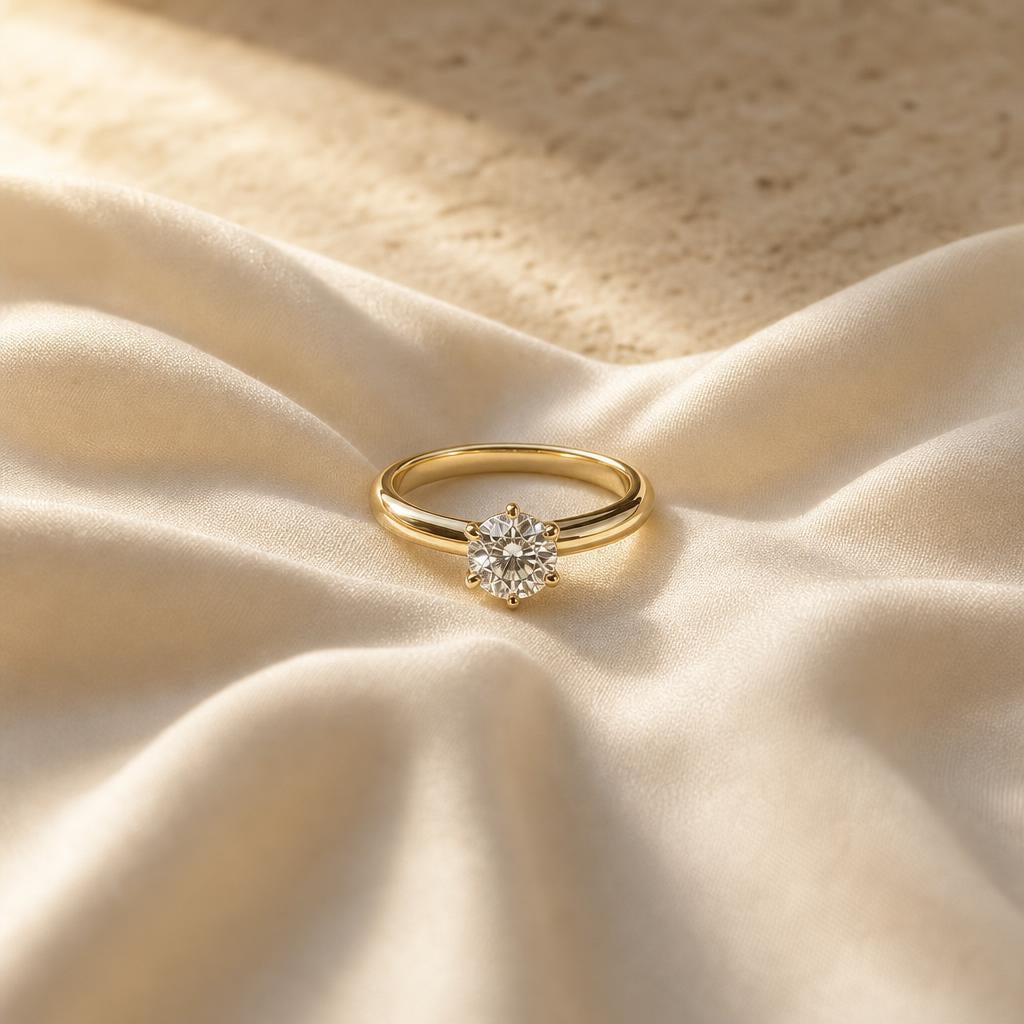
The Uniform Ring: Why the Best Everyday Rings for Women Never Change
Some women have a signature scent. Others have a signature order at their coffee shop, or a lipstick they've bought in the same shade for a decade. And then there's the ring — the one she reaches for every single morning, regardless of whether she's heading into a client meeting, a wedding, a beach vacation, or nowhere at all. Not a different ring for each occasion. The same one, every time.
Call it the ring uniform: one style, worn everywhere, chosen once and never second-guessed again. It isn't indecision — it's the opposite. Here's what's actually behind it, and how to find the ring worth committing to.


The ring uniform is a real style decision, not a lack of options
The idea of a "uniform" isn't new — it's the same logic behind Steve Jobs' black turtleneck or the woman who owns one perfect white shirt in five colors. When you already know what works, choosing it again isn't boring. It's efficient. It frees up decision-making for things that actually deserve it. Applied to jewelry, this looks like a woman who owns exactly one ring she reaches for daily, rather than rotating a drawer full of pieces she has to think about.
This is different from simply owning fewer rings. It's a deliberate stance: this ring represents me, in every context, so it needs to hold up in every context. That's a much higher bar than a piece you only wear occasionally — and it's exactly why the search for everyday rings for women tends to get more specific, not less, the longer someone has been shopping for one.
What actually qualifies a ring for everyday duty
Not every ring earns a spot in the rotation of one. A ring that's going to be worn through typing, dishwashing, gym sessions, and the occasional forgotten hand-washing needs to meet a few non-negotiables before it earns "uniform" status:
- It has to hold its shine without babying. A ring you have to remove for every task isn't an everyday ring — it's a special-occasion ring you're testing.
- The setting needs to sit low and secure. Prongs that snag on sweaters or scarves get left in a jewelry box within a month.
- The material has to be trustworthy against skin. Nickel-free, hypoallergenic metal is the difference between a ring you forget you're wearing and one that leaves a green ring on your finger by Thursday.
Gemiros rings are built in 925 sterling silver with rhodium, 18k gold, or rose gold plating — nickel-free, hypoallergenic, and indistinguishable from a diamond. Passes diamond testers. No one will know it isn't mined, including your jeweler — which matters, because a ring you're wearing every single day needs to survive more scrutiny than one worn twice a year.
Worth knowing: Jewelers sometimes reference a "2:1:1 rule" for everyday jewelry — roughly, two pieces you never take off, one you rotate weekly, one you save. Whatever the exact ratio, the underlying logic holds: the fewer pieces doing the daily work, the more each one has to earn its place.
Choosing the one ring you'll actually commit to
The women who successfully wear the same ring every day tend to land in one of three camps. Knowing which one you are makes the decision considerably faster.
The solitaire loyalist
She wants one clean stone and nothing competing with it. A single round or oval cut in a simple prong setting reads as intentional in a boardroom and doesn't look out of place at a beach wedding. It's the lowest-maintenance option in the "wear it everywhere" category, because there's nothing on the setting to catch, snag, or need re-checking.

The Stella Ring
A round-cut solitaire in a clean 4-prong setting — the closest thing to a ring "capsule wardrobe" in one piece. Minimal enough for every day, sharp enough to still turn heads.
Shop The Stella Ring →The quiet-sparkle type
She still wants shine, just distributed rather than concentrated in one stone. A pavé band or hidden-halo setting gives her that everyday glint without reading as a "special occasion only" ring. This is often where the search for affordable minimalist engagement rings ends up — buyers want restraint, not absence, of sparkle.
The stacking purist
Rather than one ring, she's built one look — a fixed combination of two or three thin bands worn together so consistently that removing even one of them feels incomplete. It functions the same way a single signature ring does: it's not about how many pieces are on the finger, it's about how rarely the combination changes.

The Everlasting Ring
A continuous line of pavé stones built to sit flush against your primary ring or stand entirely on its own — the rare band that works equally well solo or stacked.
Shop The Everlasting Ring →Why this is actually the smarter way to buy a ring
There's a version of ring shopping that treats every occasion as a reason to buy something new — a going-out ring, a work-appropriate ring, a vacation ring you're slightly less precious about. It sounds practical. In reality, it's the more expensive habit, and it's built on a fear worth naming directly: that any one ring won't be "enough" for every room it walks into.
It will be. A well-made ring in 925 sterling silver with a genuinely brilliant simulated diamond doesn't downgrade for casual settings or feel underdressed at formal ones — it simply looks like a ring someone chose on purpose. That's a very different message than a rotation of rings chosen for anxious occasion-matching. One signature ring, worn with total confidence, reads as more expensive than five rings worn with hesitation.
This is also where the case for sterling silver everyday rings gets stronger the more you actually live in them. Sterling silver with rhodium plating is dense, durable, and — done properly — resistant to the kind of dulling that makes a ring look tired after a few months of daily wear. The reputation silver has for tarnishing mostly applies to lower-grade alloys and inconsistent plating, not to a well-plated 925 base worn as intended.
The halo option, for those who want a little more presence
Not everyone wants their everyday ring to whisper. If your signature style leans toward more visible sparkle without tipping into "special occasion only" territory, a halo setting gives you that presence while still reading as appropriate for a Tuesday.

The Camilla Ring
A round-cut center stone in a halo setting with a twisted pavé band — enough presence to feel deliberate, still built for daily wear.
Shop The Camilla Ring →✦ Pro tip: If you're specifically hunting for everyday rings that won't tarnish, look for rhodium-plated sterling silver over plain silver or gold vermeil — rhodium is harder, more scratch-resistant, and holds its shine considerably longer under daily wear.
What to actually do before you commit to one ring
Committing to a single ring style is a bigger decision than buying a ring you'll wear occasionally, so it's worth a short gut-check before you land on "the one":
- Wear a similar style for a full week first — even a costume piece — to see if the silhouette actually survives your real life, not just a mirror check.
- Check it against your hands doing things, not posed on a table. Typing, gripping a steering wheel, washing dishes.
- Be honest about maintenance tolerance. A ring you have to think about isn't a uniform — it's a chore with sparkle.
- Choose the setting height last, not first. Get the shape and stone right before worrying about how "safe" the prongs are — most low-profile settings can achieve both.
Quick Takeaways
- Wearing one ring style everywhere is a deliberate choice, not indecision — it works the same way a personal uniform does.
- Durability matters more than novelty: nickel-free, hypoallergenic 925 sterling silver with rhodium plating holds up to daily wear.
- Most women land in one of three camps — solitaire, quiet-sparkle pavé, or a fixed stacking combination.
- A confidently worn single ring reads as more considered than a rotation chosen out of occasion-anxiety.
Frequently asked questions
What type of ring is best for everyday wear?
A low-profile setting in a durable metal is the safest starting point — solitaires and pavé bands in rhodium-plated 925 sterling silver tend to hold up best, since there's minimal surface area to snag or scratch through daily use.
Which type of ring will never tarnish?
No metal is entirely immune to wear over time, but rhodium-plated sterling silver comes closest for everyday jewelry — rhodium is a dense, scratch-resistant metal that protects the silver underneath far longer than untreated silver or thin gold vermeil.
What is the 2:1:1 rule for wearing jewelry?
It's an informal styling guideline: roughly two pieces worn daily without exception, one piece rotated weekly, and one piece saved for specific occasions. The exact numbers matter less than the underlying idea — decide in advance which pieces are doing the daily work.
What is a basic engagement ring?
Typically a solitaire or simple halo setting with a single center stone and minimal detailing on the band — "basic" here means uncomplicated, not lesser. It's often the style that ages best precisely because there's nothing trend-specific to outgrow.
What are the rules for stacking rings?
Keep band widths proportional so nothing overwhelms the others, choose one focal ring the rest support rather than compete with, and settle on the combination early — the stacking version of a ring uniform only works if it stays consistent.
Whichever camp you land in, the point isn't the specific setting — it's the decision itself. Choosing one ring and wearing it everywhere isn't settling for less variety. It's deciding you already know what looks like you, and refusing to keep re-litigating it every time you get dressed.


