

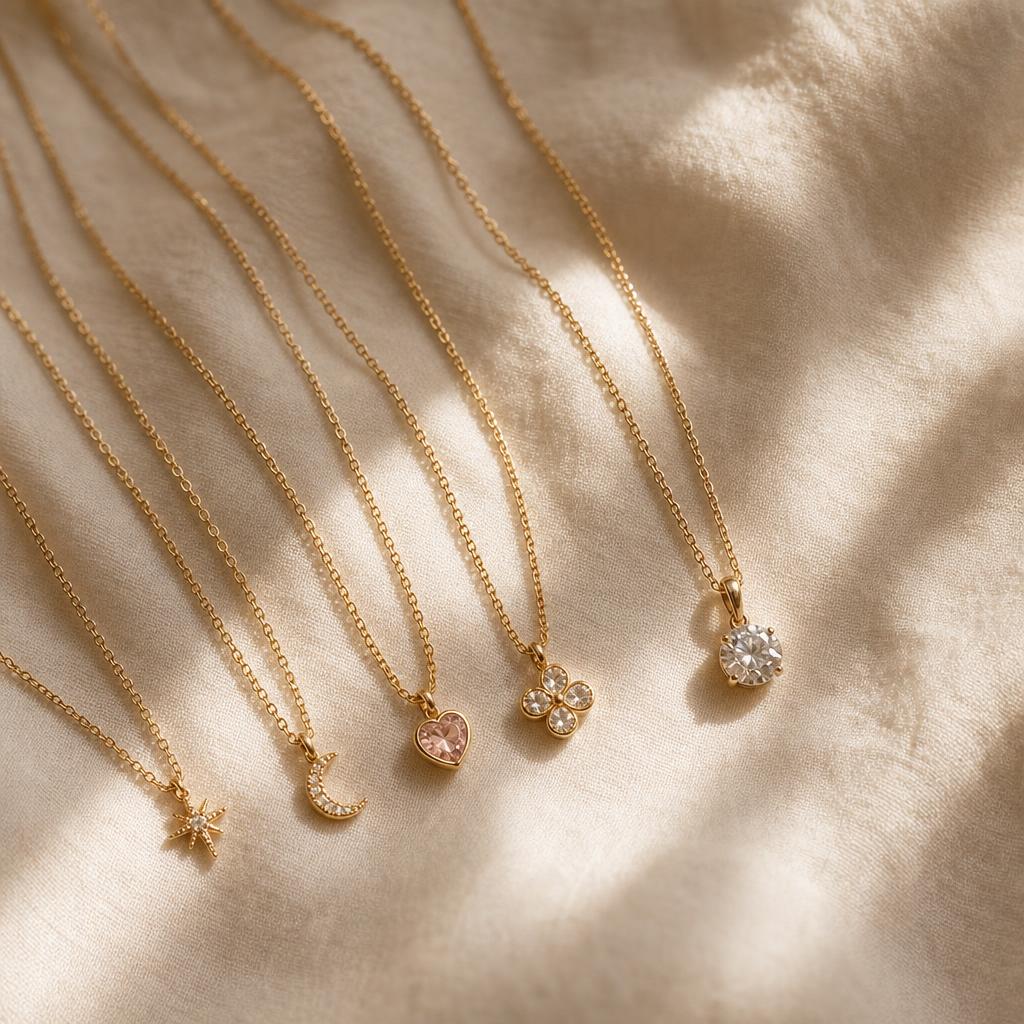
The Necklace You Wear at 25 vs. the One You Wear at 35
The necklace you reached for at 25 and the one you reach for now were never doing the same job. One was decoration — a little proof you were paying attention to trends, a way to fill space at your collarbone. The other is quieter and does more work with less: it's the piece you put on without thinking, the one that's stopped being an accessory and started being part of how you look like yourself.
Nobody tells you this shift is coming, and it isn't really about turning a certain age at all. It's about how many pieces you've tried, what you've learned looks good on you specifically, and how much you still need a necklace to perform for anyone else. Here's what actually changes — and a few pieces built for wherever you are in that shift.


What Actually Changes Isn't Your Age
It's tempting to file this under "growing up," but that framing gives the wrong credit. What actually shifts between 25 and 35 is exposure — you've now tried the layered chains, the trend pendant, the piece that looked incredible on someone else's neckline and slightly wrong on yours. You've bought a few things you don't reach for anymore. That's not a failure of taste; it's how taste gets built. By the time you're a decade in, you're not guessing anymore. You know your neckline, your skin tone, how a chain sits against your collarbone, and — most importantly — you know you don't need a necklace to say anything on your behalf. It can just be beautiful.
The other real shift is quieter: permission. At 25, a necklace often has to justify itself — it needs an occasion, a compliment, a reason. At 35, "I liked it" has become a complete sentence. That's the actual milestone here, and it has nothing to do with a birthday.
The Necklace You Wear at 25
In your twenties, jewelry is exploratory by design, and that's exactly what it should be. You're testing shapes — a clover, a star, a heart — because each one is a small, low-stakes way to figure out what you actually like versus what you've just seen everywhere. Volume matters more than precision: several inexpensive pieces you can rotate and layer teach you more about your own taste than one expensive piece you're too nervous to wear daily. The Clover Moissanite Necklace lives exactly here — a dainty, symbol-driven pendant with real sparkle, the kind of piece that gets worn constantly precisely because it doesn't ask to be protected.
This is also the era of the necklace that tells a story to other people — the one a friend compliments, the one that photographs well, the one you buy because it matches a specific outfit rather than your whole wardrobe. None of that is wrong. It's just a different relationship to the object: necklace as expression, not yet necklace as identity. In a lot of ways, it's the same divide as editorial versus everyday necklaces — one is built for a moment, the other for a decade of ordinary Tuesdays.
The Necklace You Wear at 35
Somewhere in the last decade, the math flips. Instead of asking "does this go with what I'm wearing," you start asking "does this go with me" — and the second question gets a much shorter list of answers. A single, well-considered pendant necklace does more for how put-together you look than three trend pieces stacked on top of each other, and once you've noticed that, it's hard to go back to noise for noise's sake.

The Leighton Necklace
A 0.8-carat round-cut simulated diamond set inside a cushion-shaped halo — the kind of quiet, considered sparkle that reads as intentional rather than loud, built to be worn every single day without a second thought.
Shop The Leighton Necklace →This is also when a necklace like The Ophelia starts to make more sense — not because a bigger stone is inherently more "grown up," but because by now you know exactly how much presence you want at your collarbone, and you're no longer second-guessing whether you're allowed to wear something that commands a room. A 5.5-carat oval-cut simulated diamond isn't a phase you're growing into. It's a decision you're finally not talking yourself out of.
Why the Shift Actually Happens
Three things are usually doing the work at once. First, you've stopped buying for an audience — the necklace no longer needs to be recognized or complimented to feel worth it. Second, you've learned your own proportions well enough to know that one considered piece will always outperform several undecided ones. Third, and maybe most honestly: you've stopped waiting for someone else to hand you a "reason" to buy something beautiful. Anniversary, birthday, promotion — those are lovely when they happen, but they're no longer the only door in.
Worth knowing: None of this is a rule about age. Plenty of 24-year-olds buy exactly like this, and plenty of 45-year-olds still love a stack of playful pendants. What's actually being described here is confidence, not chronology — and confidence arrives on its own schedule.
The Piece That Bridges Both
Not every necklace has to pick a side. A clean, radiant-cut floating pendant like The Aura Necklace works at 25 because it photographs beautifully and never feels fussy, and it keeps working at 35 because it doesn't try too hard — it just sits close to the skin and catches light. The best transitional pieces share that quality: understated enough not to date quickly, sparkling enough to still feel like a moment every time you put it on.

The Aura Necklace
A radiant-cut simulated diamond in a clean, floating setting designed to sit flush against the skin — sleek enough for a first grown-up piece, versatile enough to still be in daily rotation a decade later.
Shop The Aura Necklace →If you're trying to figure out where you personally land on this spectrum, it's worth reading about why one statement piece can be enough before you assume you need a whole collection to feel finished.
Building the Version of This for You
The honest answer to "which necklace should I be wearing" was never about your birth year. It's about being specific: knowing whether you gravitate toward a halo or a clean solitaire, whether you want your jewelry to be noticed or simply to feel like yours. That's the difference between a halo and a solitaire pendant in the first place — two completely different philosophies about how a necklace should hold attention. Once you know which one you are, the rest of the decision gets a lot easier, whether you're 25, 35, or nowhere near either.
And if quiet is more your language than bold, what the minimalist necklace look actually requires is a useful next stop — restraint has its own rules, and they're not the same as doing less effort.
Quick Takeaways
- What changes between 25 and 35 is exposure and confidence — not a rule about age.
- Younger jewelry-buying tends to be exploratory: more pieces, lower stakes, worn for how they photograph or match an outfit.
- Later jewelry-buying tends to consolidate: fewer, more considered pieces worn daily because they suit you specifically.
- A clean floating solitaire is one of the few styles that genuinely works at both stages.
- The real milestone isn't a birthday — it's not needing a reason to buy something beautiful.
Frequently Asked Questions
Is there an actual "right" age to switch to more minimal jewelry?
No — this shift tracks confidence and exposure to your own taste, not a specific age. Some women simplify their jewelry box at 24; others love a playful, layered look well into their forties. Wear what feels like you, on whatever timeline that happens.
What's the real difference between a statement necklace and an everyday one?
A statement piece is designed to be the focal point of an outfit — larger stone, more presence, worn deliberately. An everyday piece is built for constant wear: comfortable against the skin, versatile enough to not compete with what you're wearing, and sturdy enough that you never have to think about taking it off.
Should I get rid of necklaces from my twenties if I don't wear them anymore?
Not necessarily. A piece you've outgrown stylistically can still be worth keeping for sentimental reasons, gifting to someone who'd love it, or simply revisiting later — taste isn't always a straight line, and pieces sometimes come back into rotation years later.
How many necklaces do I actually need at once?
There's no fixed number, but most women find that a small rotation — one everyday piece, one halo or solitaire for dressier moments, and one playful piece for when the mood strikes — covers nearly everything without the box turning into clutter.
Whichever necklace you're reaching for right now, it's telling the truth about where you are — not where you're supposed to be. That's worth more than matching anyone else's timeline.


