

The Best Emerald Cut Engagement Rings: Sleek, Modern Styles Worth Knowing About
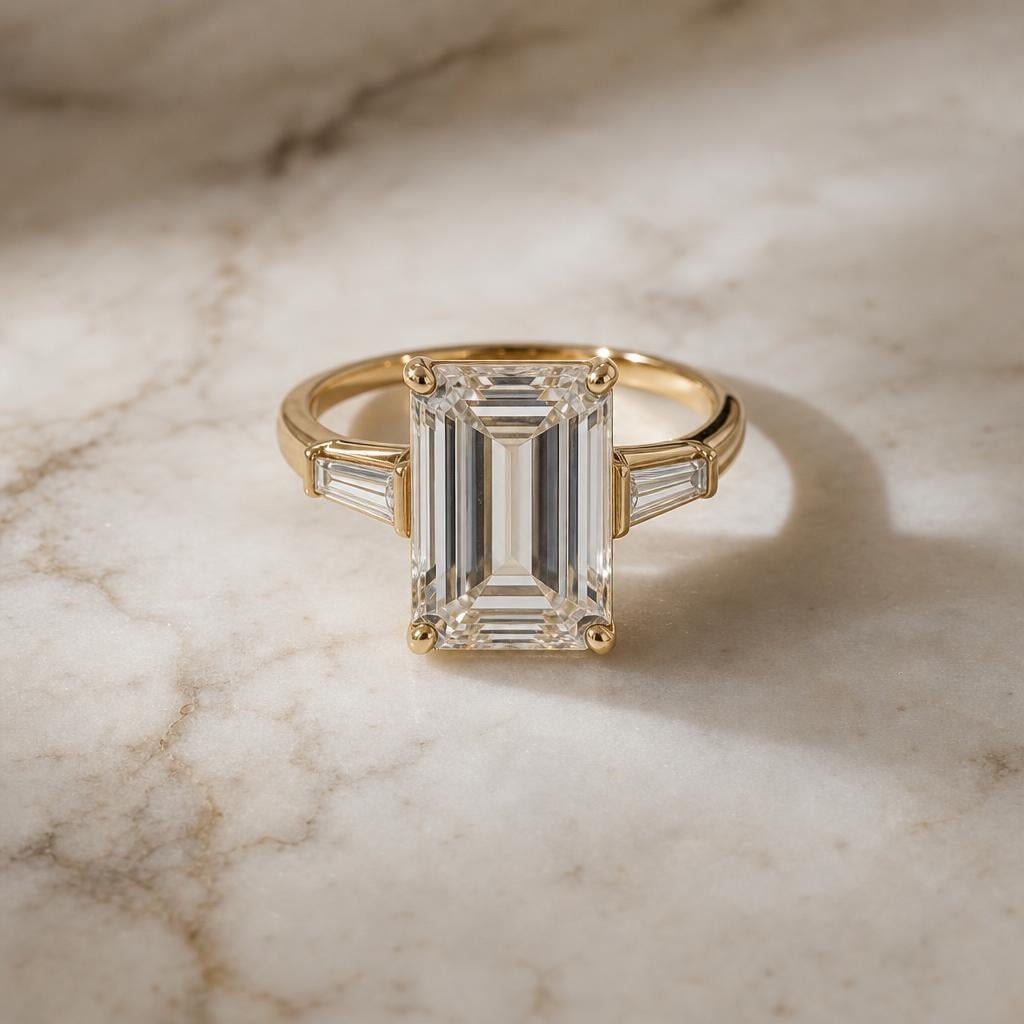
There is a particular kind of confidence in choosing an emerald cut. Where round brilliants scatter light in every direction and cushions invite softness, the emerald cut does something altogether different — it holds the light, reveals it slowly, and lets the stone speak without shouting.
It is, in short, the ring shape for women who know exactly who they are. And right now, it is having a moment — though calling it a trend undersells it. Emerald cuts have been the choice of Hollywood icons, royalty, and anyone with a taste for architectural beauty for nearly a century. What has changed is that a broader audience has discovered what those in the know always understood: this is the most sophisticated stone shape in the game.
These four styles from the Gemiros collection offer a range of ways to wear an emerald cut — from spare and architectural to quietly radiant.


What makes the emerald cut different from every other shape
Most engagement ring shapes are brilliant cuts — round, oval, cushion, pear. Brilliant cuts are designed to maximise light return, scattering sparkle in every direction. They are the stones that catch the light from across a crowded room, that flash as you move your hands while talking, that photograph well even in difficult lighting.
The emerald cut is a step cut, not a brilliant. Its long rectangular facets run parallel to one another — like a series of terraced steps descending into the stone — rather than radiating from the centre. The effect is completely different. Instead of sparkling, an emerald cut glows. It creates what jewellers call the hall-of-mirrors effect: deep, clean corridors of light that shift as you move, like reflections receding endlessly into one another.
Where a brilliant cut says look at me, an emerald cut says come closer. It rewards attention rather than demanding it.
Worth knowing: Because an emerald cut's step facets are transparent windows into the stone rather than light-scattering prisms, they reveal the interior of the stone more clearly than brilliant cuts. In mined diamonds, this means clarity matters significantly more. With simulated diamonds — produced under controlled conditions — the stone interior is already flawless, which is one reason emerald cuts work particularly beautifully in simulated form.
The settings that work best with an emerald cut
Emerald cuts have strong opinions about their settings. Their clean geometry reads best in settings that respect their architectural character rather than competing with it.
The pure solitaire
Nothing shows an emerald cut better than a simple solitaire on a smooth band. The unadorned setting lets the stone's step facets do exactly what they were designed to do — create depth, catch light, and command the eye without assistance. This is the choice for women who find fussiness exhausting and prefer their ring to make a quiet statement rather than a loud one.

The London Ring
A 3-carat emerald-cut center on a clean, smooth band — the definitive expression of this shape. The hall-of-mirrors facets catch the light with extraordinary clarity, while the unadorned band keeps focus precisely where it belongs: on the stone. Available in rhodium-plated silver or 18k gold plating.
Shop The London Ring →The pavé band with hidden halo
If the pure solitaire feels too austere, a pavé band version adds warmth without disturbing the emerald cut's essential character. A row of small pavé-set stones along the band draws the eye from the finger up to the center stone, elongating the whole effect. A hidden halo — tiny stones set beneath the center stone rather than around it — adds a glimmer from unexpected angles without competing with the top-down view.

The Kensington Ring — Gold
A 3-carat emerald-cut center with a pavé half-eternity band and a discreet hidden halo beneath the stone. The warm 18k gold plating gives this version an heirloom quality that suits anyone drawn to the old-world elegance of the emerald cut. The sparkle comes quietly, from all directions.
Shop The Kensington Ring — Gold →The halo setting
A traditional halo — a frame of smaller stones surrounding the center stone — works differently on an emerald cut than on a round or oval. On those shapes, the halo amplifies and softens. On an emerald cut, it creates a double rectangle: an inner frame of clean step facets, an outer frame of brilliant sparkle. The contrast between the two creates a graphic, architectural effect that is deeply vintage in spirit but entirely wearable today.

The Harlow Ring
A 1.75-carat emerald-cut center framed in a sparkling halo of simulated diamonds on a sleek, smooth band. Named with old Hollywood in mind, The Harlow layers vintage glamour over a clean modern silhouette — the choice for women who love the character of the emerald cut but want their ring to flash from every angle, not just when the light is just right.
Shop The Harlow Ring →Which fingers and hands does the emerald cut flatter?
The emerald cut is one of the most flattering shapes for almost every hand type — but for different reasons depending on your proportions.
If you have long, slender fingers, an emerald cut looks effortlessly correct: the horizontal lines of the step facets complement the vertical line of the finger without competing with it. It is the ring equivalent of a well-cut blazer — architectural, precise, and somehow inevitable.
If you have shorter or wider fingers, the emerald cut is still an excellent choice, but proportion matters. A 3-carat stone — which has more surface area than a round brilliant of the same carat weight, because of the rectangular shape — can actually make shorter fingers appear more elongated by drawing the eye along the finger's length. The key is avoiding a setting that adds too much width at the sides: a solitaire or a pavé band tends to be more flattering than wide side stones.
For petite hands, the 1.75-carat Harlow tends to read beautifully — substantial enough to be a statement, but proportioned so the hand does not disappear beneath the ring.
✦ Travel tip: Emerald cuts sit lower on the finger than many other shapes because the stone's flat profile requires less height to secure it. If you live an active life and find high-set stones impractical, this is a genuine advantage — and one of the reasons emerald cuts work particularly well as travel rings or daily alternatives to a more precious original you would rather leave at home.
Silver or gold: which metal suits an emerald cut?
Both metals work beautifully with this shape — the choice is really about the mood you want the stone to carry.
Silver and rhodium-plated settings give the emerald cut a cool, clean finish. The stone reads as almost architectural, like a piece of modernist jewellery. It suits women who gravitate towards a minimal aesthetic, prefer cool tones in their wardrobe, or want their ring to feel contemporary rather than traditional.
Gold plating gives the same stone a warmer, richer character. The emerald cut has deep historical ties to the Art Deco period — a time of geometric precision and luxurious materials. Pair an emerald-cut stone with warm gold and something interesting happens: the ring takes on a genuinely antique quality. It reads like something passed down through a family rather than bought recently, which is its own kind of appeal entirely.
Both the London Ring and the Kensington Ring are available in rhodium-plated silver and 18k gold plating, so you can choose on feel rather than compromise.
Quick Takeaways
- Emerald cuts are step cuts, not brilliant cuts — they glow with a hall-of-mirrors effect rather than scatter-sparkle
- Simulated diamonds suit the emerald cut especially well because their flawless interiors are fully visible through the wide step facets
- The pure solitaire is the most architectural option; pavé bands and hidden halos add warmth without losing the shape's essential character
- Emerald cuts sit low on the finger — an advantage for active wearers and travel ring use
- Silver gives a cool, contemporary look; gold gives a warmer, heirloom quality to the same stone
- The rectangular shape can elongate shorter fingers — a larger stone sometimes works better than a smaller one for this hand type
Frequently asked questions
What is the difference between an emerald cut and a radiant cut?
An emerald cut is a step cut with long parallel facets that create a mirror-like glow. A radiant cut is a brilliant cut in a rectangular shape — it sparkles far more aggressively. Hold them side by side and the emerald cut will look deeper and quieter; the radiant will flash. If you want dramatic sparkle in a rectangular shape, choose radiant. If you want depth and presence, choose emerald.
Do emerald cuts look smaller than round stones of the same carat weight?
Interestingly, the opposite is often true. Because an emerald cut is rectangular, its face-up surface area spreads across a larger footprint than a round stone of the same carat weight. A 3-carat emerald cut has more visible surface area than a 3-carat round brilliant — it simply looks different in outline rather than larger in the obvious sense. Many people find that an emerald cut reads as more substantial on the hand, even at lower carat weights, because of the elongated silhouette.
Is an emerald cut a practical choice for everyday wear?
Yes — more so than many people expect. The large, flat step facets are easier to clean than the complex geometry of a brilliant cut, and the low-profile setting catches on things less. It is one of the more practical choices for daily wear, which makes it a natural fit as a travel ring or as a simulated diamond alternative to a more valuable original you would rather keep safely at home.
What is a hidden halo on an emerald cut ring?
A hidden halo is a ring of small pavé-set stones positioned beneath the center stone — around its underside — rather than in the visible frame around the top. From above, the ring looks like a clean solitaire with a pavé band. From the side or at an angle, you catch the glimmer of the hidden stones as they catch light from beneath the emerald cut. It is a quiet detail that reveals itself gradually — very much in the spirit of the shape itself.
The emerald cut remains one of the most enduring shapes in jewellery — chosen by those who find a ring that improves with a second look more compelling than one that demands attention at first glance. Whether you are drawn to the architectural simplicity of the London Ring, the understated warmth of the Kensington in gold, or the vintage glamour of the Harlow's halo, the emerald cut has a way of feeling — immediately — as though it was always supposed to be on your hand.


