

Stacking Rings for Petite Hands: The Widths, Shapes and Stone Sizes That Work
Petite hands are not a problem to solve. But they do have their own logic — and once you understand it, building a stack that looks deliberately curated rather than accidentally overwhelming becomes surprisingly easy.
The tricky thing about stacking rings on smaller hands is not finding rings you love — it is knowing which proportions will actually hold their own without making your fingers look shorter, broader, or buried. Band widths, stone sizes, and setting heights all play a role. Get the balance right, and a well-chosen two- or three-ring stack can make your hand look longer and more slender. Get it wrong, and the nicest rings in the world can just look like too much.


Why proportions matter more on smaller hands
On a petite hand — shorter fingers, a narrower palm, or both — rings sit differently than they do on longer fingers. A band that looks delicate and refined in product photography can read as chunky when worn. A stone that looks proportionate on a size 7 finger can feel like a boulder on a size 5.
This is not about avoiding anything bold. It is about understanding that scale is relative. The same principles that make an outfit look pulled-together apply to rings: proportion, negative space, and knowing which elements should carry visual weight and which should support quietly. A wide, elaborate ring on a petite finger does not look wrong because of your hand — it looks wrong because the proportions between ring and finger are fighting each other. Change the proportions and the same hand can carry almost anything.
Worth knowing: The most common women's ring sizes are US 5–7. Petite hands often sit at US 4–5.5, and the guidance in this post is written directly for that range. If your fingers tend to run slim or short, the rules here apply to you.
Band width: the single most important choice
If you take one thing from this guide, make it this: on petite hands, band width determines everything. It is the factor that decides whether a ring looks delicate or dominant, whether your fingers appear longer or shorter, whether the overall look is refined or crowded.
As a general rule, bands under 2mm look almost invisible on any hand. Bands between 2mm and 3mm are the sweet spot for stacking on petite fingers — they have enough visual presence to register, without creating the covered-knuckle effect that wider bands produce. Bands above 4mm start to fill the space between knuckle joints, and on shorter fingers, that can make the hand look broader rather than more interesting.
Both The Eternity Ring and The Beloved Ring sit in that 2–3mm range. They are broad enough to carry real sparkle, slim enough to sit cleanly without dominating the finger. That is the balance you are looking for in any stacking band destined for a smaller hand.
The exception to the rule
There is one scenario where a wider band works beautifully on a petite hand: worn alone, as a single deliberate statement. A bold eternity band worn solo on one finger can look spectacular on smaller hands — confident, architectural, totally intentional. It is only when you start stacking multiple medium-to-wide bands that the proportions begin to fight each other. Worn alone, almost anything goes. In a stack, slimmer is almost always smarter.
Stone size: small does not have to mean modest
Here is a common misconception: petite hands need small stones. That is only partially true. What petite hands actually need is the right relationship between stone size and band width — and the right shape.
A larger stone set on a very fine band can look spectacular on a smaller hand, because the slender band draws the eye upward toward the stone rather than across the width of the finger. A row of tiny stones on a wider band can read as heavier and busier, even though the stones themselves are diminutive.
For stacking specifically, you are working with bands rather than solitaires — and what matters most here is that the stones sit close to the band surface rather than protruding. Pavé settings, bezel settings, and channel settings all hug the finger. High-profile settings, by contrast, add visual height that can make the overall profile look chunkier than intended, and they also catch on clothing when rings are stacked tightly together.

The Destiny Ring
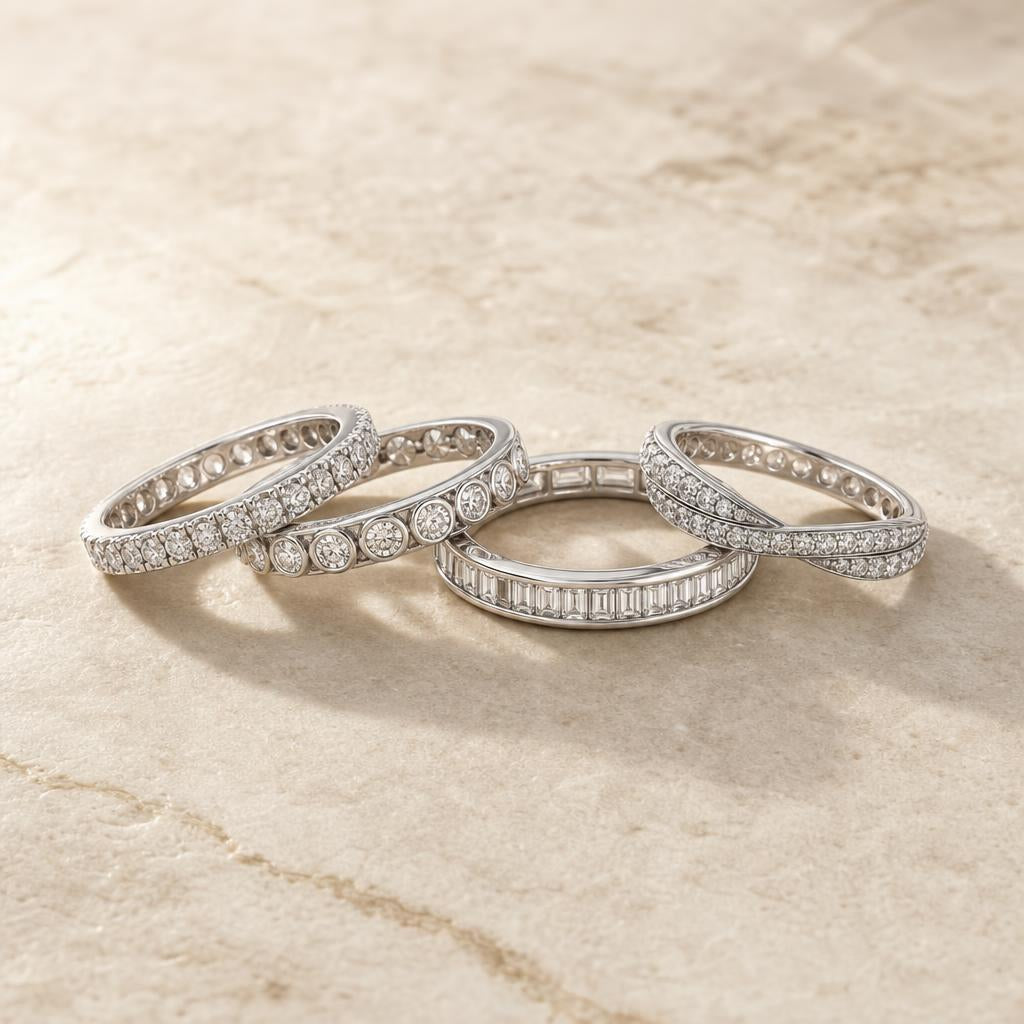
Two delicate pavé bands cross at the centre of the finger in a gentle V-shape, creating an elegant crossed silhouette that takes up minimal visual space on the hand. The stones sit almost flush against the band surface — no protrusion, no snagging — making this a quietly brilliant companion for any petite-hand stack.
Shop The Destiny Ring →The stone shapes that make fingers look longer
Shape plays a more significant role than most people realise — particularly for any ring with a focal stone, and to a lesser extent for band profiles too.
Elongating shapes — oval, pear, marquise, emerald cut — draw the eye up and down the finger rather than side to side. They create an illusion of length that genuinely works, and the effect becomes more pronounced on a shorter finger where there is less space to work with. An elongated oval solitaire paired with two slim eternity bands can make a petite hand look considerably more elegant than the same stack built around a wide round or cushion-cut centre stone.
Rounder shapes — round, cushion, princess — are beautiful but read as wider rather than longer. They can be stunning on petite hands when the setting is slim and the stone is not oversized, but they do not naturally create the same lengthening effect. If you are drawn to round cuts, which are classic and always appropriate, keep everything else in the stack as narrow and low-profile as possible to compensate.
For pure stacking bands with no focal stone, shape matters slightly less. What you are primarily managing is the width and profile of the band itself. But it is worth thinking about the ring or rings anchoring your stack — usually an engagement or centrepiece ring — and whether their stone shape is creating a vertical line or a horizontal one.
How many rings to stack — and where to put them
More is not always more. On a petite hand, three rings is usually the point at which a stack stops looking curated and starts looking crowded. There are exceptions — very slim bands can sit together in groups of four without overwhelming — but as a starting point, two or three is enough to create real visual interest without covering the finger entirely.
Placement matters too, and not in the way people expect. You do not have to stack everything on the same finger. Spreading rings across two or three fingers tends to look considerably more intentional on smaller hands — it allows each ring to breathe while still creating the layered effect you are after. The most natural combinations are index plus ring, or middle plus ring, or all three with different weights on each to avoid uniformity.
✦ Pro tip: Try wearing your most substantial ring alone on the ring finger and adding one slim stacking band on the middle or index finger instead of directly beside it. You get the richness of multiple rings across the hand without any single finger looking crowded or covered.
Which settings sit lowest — and why it matters for stacking
For a stack that does not catch on clothes, snag on hair, or create an uneven silhouette where rings sit at different heights, setting profile is worth thinking about before you buy. Here is how the main stacking-friendly settings compare:
- Pavé: Small stones set directly into the band surface, sitting almost flush. One of the best settings for stacking — continuous sparkle, very low profile, looks refined without adding any height above the band. Both The Eternity Ring and The Beloved Ring use pavé settings.
- Bezel: Each stone is surrounded entirely by a smooth metal collar, sitting level with or only fractionally above the band. Sleek, modern, and completely snag-free. The Cherish Ring uses individual bezel settings along a full eternity band.
- Channel: Stones sit in a groove between two parallel rails of metal, completely flush. One of the lowest-profile settings available, and an excellent choice if you do a lot of physical work or travel frequently.
- Baguette: Step-cut rectangular stones set in a row along the band. Slightly higher than pavé but still relatively flat — and the geometric shape reads as architectural and elegant on a slim band, which is exactly what The Devotion Ring delivers.
Settings to use with more care when stacking: high cathedral prong settings, raised solitaire heads, and anything with a prominent basket that protrudes significantly above the shank. These can interfere with adjacent rings and create an uneven look that is especially unflattering on petite fingers where there is less space to absorb the height difference.

The Cherish Ring
A full circle of round stones, each one individually nestled inside its own smooth bezel setting. The result is continuous sparkle with none of the snag risk of prong settings — and a profile so low it tucks cleanly against any ring beside it. One of the most practical, wearable stacking options in the collection, and particularly good for those who are hard on their jewellery.
Shop The Cherish Ring →Choosing your metal tone
White metal — silver and white gold tones — tends to recede slightly against the skin, which makes individual rings feel more delicate. It is a flattering choice for stacking on petite hands because it does not pull as much visual weight as a warm-toned metal does. That said, yellow gold and rose gold are beautiful choices — they just work differently.
A single gold ring worn alone carries a confident warmth that reads as intentional. Mixing metals — a silver band alongside a gold one — can look very considered when done deliberately, particularly if you keep the overall stack small. What tends to look less pulled-together on petite hands is stacking several warm-toned and cool-toned rings together in a dense arrangement on the same finger. The contrast between the metals draws the eye outward rather than upward, which is the opposite of what you want.
Worth knowing: The stacking rings in the Gemiros collection are available in silver, gold, and rose gold tones. If you want to mix metals, choose one as your dominant tone and use the others as accents — one gold ring in a silver stack reads as deliberate; equal parts of each reads as undecided.
Three stacks that actually work on petite hands
If you want a shortcut to something that looks genuinely good, here are three combinations that work particularly well on smaller fingers:
The minimal pairing: The Eternity Ring alongside a slim solitaire engagement ring. The pavé band tucks neatly against the engagement ring shank and adds a continuous line of sparkle without competing with the centre stone. Clean, modern, and flattering on almost every hand shape.
The architectural trio: The Devotion Ring in the centre, flanked by The Eternity Ring on one side and The Beloved Ring on the other. The baguette-cut Devotion creates a structured focal point, and the two round pavé bands on either side soften the look without adding bulk. The whole stack sits surprisingly flat for three rings worn together.
The adjacent approach: The Destiny Ring worn on the finger next to your engagement ring rather than stacked directly against it. The crossed-band silhouette fills visual space across the hand while both rings keep their own room to breathe. This works especially well for anyone who finds that stacking directly on the ring finger starts to feel crowded or uncomfortable.
Quick Takeaways
- Keep stacking bands between 2mm and 3mm wide — the sweet spot for petite hands
- Low-profile settings (pavé, bezel, channel, baguette) sit flush and stack cleanly without snagging
- Elongating stone shapes — oval, pear, marquise — create the illusion of length on shorter fingers
- Two or three rings is usually the right depth for a stack on petite hands — more can overwhelm
- Spreading rings across adjacent fingers looks more intentional than crowding a single finger
- Choose one metal tone as dominant and treat the others as accents — three tones at equal weight reads as noise
Frequently asked questions
What ring size counts as petite?
There is no official cutoff, but for styling purposes, petite hands generally refers to fingers in the US size 4–5.5 range (UK G–K). At these sizes, ring proportions behave quite differently than they do on the size 6–7 fingers that most product photography is shot on. The guidance in this post applies most directly to that range, though the principles around band width and setting height are useful for any hand that runs smaller than average.
Can I wear a bold statement ring on petite hands?
Yes — worn alone, a statement ring can look spectacular on smaller hands. A larger stone or a bolder band that would be overwhelming in a stack can be exactly right as a solo piece. The key is context: wear the statement ring alone and let it do its job without competition. Once you start adding stacking bands around it, the visual load adds up quickly on a smaller finger.
Do eternity bands suit petite hands?
Eternity bands are among the best options for petite hands, specifically because they typically combine a slim band with a low-profile setting. A full pavé or bezel eternity sits flush against the finger with no protruding head, which means it stacks cleanly, does not catch on clothing, and creates a continuous line of sparkle rather than a concentrated visual focal point. If the band is under 3mm wide, an eternity band can look beautifully refined on even the slimmest fingers.
How do I tell if a ring is too wide for my hand?
A practical rule: if the band covers more than half the visible skin between your knuckle and your next joint, it is likely too wide for a comfortable, proportionate look on your hand. Another useful check is whether the ring moves naturally when you flex your finger — a ring that fits well allows a small amount of natural movement. If it is covering so much of the finger that it can only sit in one position, the proportions are working against you.
The best stacking rings for petite hands are not necessarily the smallest rings you can find — they are the rings with the right proportions for your fingers: slim bands, low-profile settings, and intentional placement. Start with one or two pieces that genuinely speak to you and build from there. A stack of two rings that sit perfectly together will always look more considered than five that crowd each other for space.


