

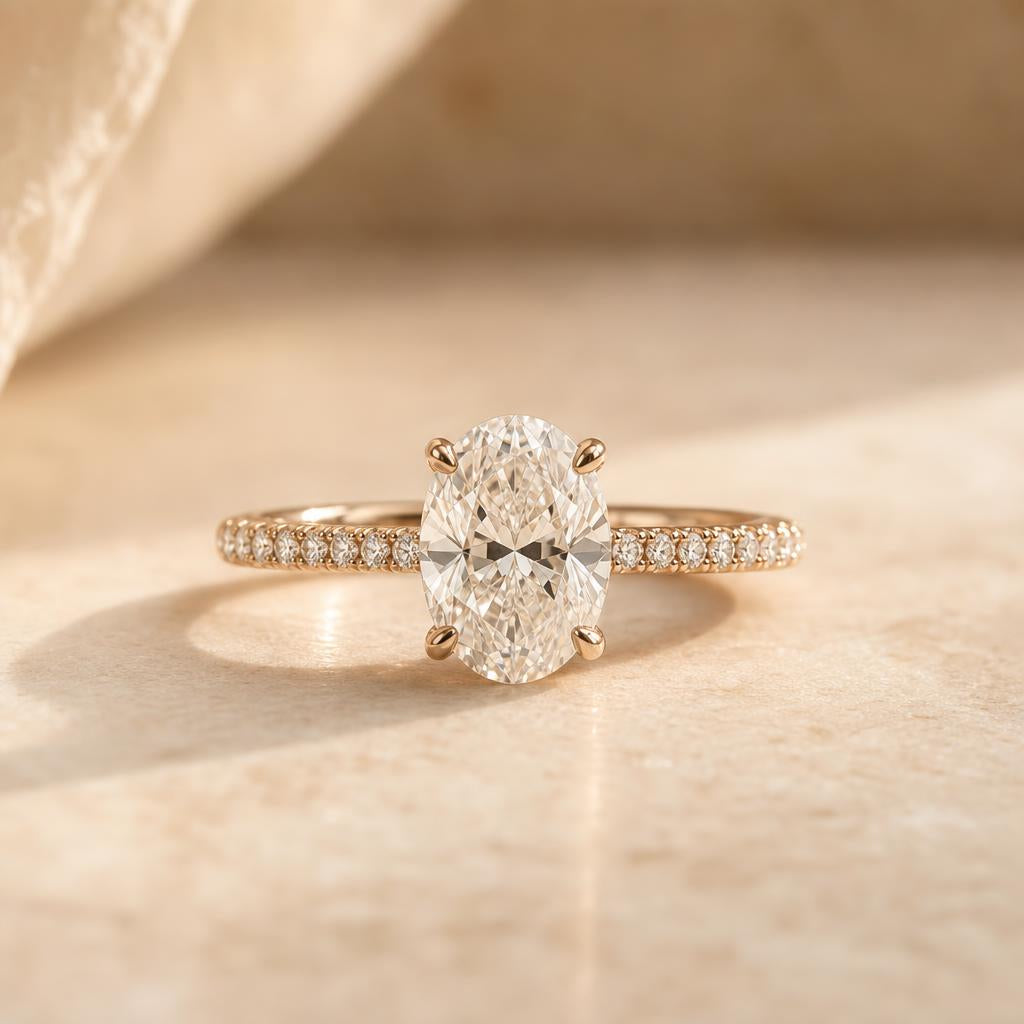
Soft-Shape Rings: Oval and Cushion Cut Engagement Rings for Elegance Without Edges
Some rings announce themselves. Others simply fit — the line of the stone following the line of your finger so naturally that people notice the ring is beautiful before they notice why. That's the quiet trick of a soft shape.
Oval and cushion cut stones share the same logic: no hard corners, no sharp points to catch or compete with. They flatter the hand instead of interrupting it, which is exactly why both shapes keep outlasting whatever's trending. Here's what makes each one work, and how to choose between them.


Why Soft Shapes Keep Winning
Round stones are safe. Sharp shapes — emerald, radiant, princess — make a statement through their edges. Oval and cushion do neither. They're brilliant without being severe, which is the whole appeal for a woman who wants a ring that reads as considered rather than loud. There's no bow-tie of hard geometry to manage, no crisp corners to snag on a sweater. Just a stone that catches light in every direction and a silhouette that looks intentional on almost any hand.
That softness is also why these two shapes anchor so much of what people search for under elegant engagement rings — the phrase itself is really shorthand for "beautiful, but not trying too hard."
Oval Cut: The Elongating Classic
The oval is a round brilliant stretched into an elongated silhouette, and that stretch does real work — it makes the finger look longer and the stone look larger than a round cut of the same size, because the eye reads length as size. It's the shape most often chosen by women who want maximum visual impact without maximum carat weight.
The one thing worth knowing before you buy: some oval cuts show a faint "bow-tie" — a shadow across the center where light doesn't bounce back evenly. It's not a flaw to be nervous about. It's a cutting detail, and a well-proportioned oval — the kind with the right length-to-width ratio and enough facets — minimizes it almost entirely. Every oval in the Gemiros collection is cut with that ratio in mind, so the shadow you might have read about isn't something you need to plan around.
Searches for oval moissanite engagement rings have climbed for a reason: moissanite's fire — the rainbow flash you see as the stone moves — reads especially well in an elongated cut, where more surface area means more light bouncing back at every angle. Gemiros carries moissanite alongside our Signature Simulated Diamond stones across the collection, so if that particular sparkle is what you're after, it's worth asking which oval styles carry it before you check out.

Octavia Ring
An oval center stone surrounded by a full pavé halo — the halo adds visual size and a continuous ring of sparkle around the center, which is what to look for if you want the "bigger carat" look without the bigger carat.
Shop Octavia Ring →Cushion Cut: Vintage Softness, Modern Polish
The cushion cut is the oldest shape on this list by a couple of centuries, but it doesn't read as old. Think of it as a square or rectangle with rounded corners and larger facets than a round brilliant — the result is a softer, more diffuse kind of sparkle, closer to candlelight than to the sharp scintillation of a round stone. It's the shape people reach for when they want vintage character without an actual antique setting.
Within cushion cuts, there's a meaningful choice to make between a classic square cushion and an elongated cushion — the latter stretched closer to a rectangle. Elongated cushion cut engagement rings have picked up real momentum lately because they split the difference between cushion's softness and oval's finger-lengthening effect, without fully committing to either. If your hand runs shorter or your fingers are on the fuller side, the elongated version is usually the more flattering call.

Majesté Ring
A cushion center stone with a hidden halo tucked beneath it — you see the effect of extra sparkle and size from every angle except the one that would make the band look busy.
Shop Majesté Ring →Cushion is also having a moment among moissanite buyers specifically. Cushion cut moissanite engagement rings tend to show off the stone's brilliance a little differently than a diamond simulant cut for a round or oval shape — the larger facets on a cushion let more of that characteristic fire come through.
Oval vs. Cushion: A Quick Comparison
| Detail | Oval Cut | Cushion Cut |
|---|---|---|
| Silhouette | Elongated, rounded ends | Rounded square or rectangle |
| Sparkle style | Bright, brilliant-cut flash | Softer, larger facets |
| Finger effect | Visibly lengthening | Lengthening if elongated; compact if square |
| Best paired with | Hidden halo, pavé, solitaire | Hidden halo, milgrain, split shank |
| Watch for | Bow-tie effect on poorly cut stones | Chunkier look on very square proportions |
Settings That Keep Soft Shapes Looking Elegant, Not Busy
The setting does almost as much work as the cut. A hidden halo — a ring of small accent stones tucked beneath the center stone, invisible from the top but visible in profile — adds size and sparkle without changing the ring's silhouette from above. It's the setting most likely to make an oval or cushion stone look larger than its actual measurements, which is exactly why it shows up on so many of Gemiros' best-selling styles.
A full pavé band does something different: it extends the sparkle down the shank instead of concentrating it around the center stone, which reads as more continuously elegant and less like a single showpiece. Solitaire settings, by contrast, let the shape of the stone do all the talking — no halo, no pavé, just the cut itself. For a soft shape like oval or cushion, that's often plenty.
Worth knowing: Indistinguishable from a diamond, passes diamond testers, and set in 925 sterling silver with rhodium or 18k gold plating — every Gemiros ring is built to hold up to daily wear, not just a photograph.
What you won't find in any of this is a reason to hedge. A soft-shape ring from Gemiros isn't a compromise on the way to a "real" diamond ring — it's the ring, full stop, chosen because the shape and the sparkle already do exactly what you wanted them to do.
Which Shape Is Actually Yours?
If you're drawn to a stone that looks larger than its carat weight and elongates the hand as dramatically as possible, oval is the more decisive choice. If you want something that reads as a little more romantic, a little softer at the edges, and slightly less common on the average hand right now, cushion is worth a closer look — especially in the elongated proportion if you want some of oval's lengthening effect without leaving cushion's character behind.
Neither is the "more correct" choice. Both shapes have carried engagement and self-purchase rings for well over a century between them, and both look exactly as intentional in a hidden halo as they do in a plain solitaire. The only real mistake is picking a shape because it's trending rather than because it actually flatters your hand — and with a return policy and a price point that doesn't punish you for changing your mind, that's a low-stakes thing to test.
Quick Takeaways
- Oval elongates the finger and reads larger than its actual carat weight — watch for proportion to avoid a bow-tie shadow.
- Cushion offers a softer, vintage-leaning sparkle; the elongated version borrows some of oval's lengthening effect.
- Hidden halo settings add the most visual size to either shape without changing the ring's outline from above.
- Both shapes are available across Gemiros' Signature Simulated Diamond and moissanite stones — ask which styles carry which stone before you buy.
Frequently Asked Questions
Are oval and cushion cut stones more expensive than round?
With a natural or lab-grown diamond, fancy shapes like oval and cushion are often priced slightly differently than round because of how the rough stone is cut down. With a simulated diamond or moissanite, that math doesn't apply the same way — a larger, more dramatic oval or cushion doesn't carry the same cost jump, which is part of why so many buyers choose the shape purely on how it looks on their hand.
What are the downsides of an oval-cut ring?
The main one is the bow-tie effect — a dark shadow across the stone's center that shows up when the proportions or faceting aren't quite right. It's a cutting issue, not a shape issue, and a well-cut oval in the right length-to-width ratio avoids it almost entirely.
Is a cushion cut a good choice for an engagement ring?
Yes — it's one of the longest-running shapes in engagement ring history for a reason. It offers a softer, more diffuse sparkle than a round or oval brilliant, and it pairs especially well with hidden halo and pavé settings that add extra fire without changing the ring's outline.
What's the difference between a cushion cut and an elongated cushion cut?
A classic cushion cut is closer to a rounded square; an elongated cushion stretches that same silhouette into more of a rectangle. The elongated version borrows some of oval's finger-lengthening effect while keeping cushion's characteristic soft corners and larger facets.
Is oval or cushion more flattering?
It depends on what you want the ring to do. Oval is the more decisive choice for elongating the finger and maximizing visual size. Cushion reads softer and slightly more vintage. Both flatter most hand shapes — the better test is which one you keep coming back to in photos.
Whichever shape you land on, the decision doesn't have to be permanent or expensive to test. Try the oval. Try the cushion. See which one you reach for on a Tuesday morning without thinking about it — that's usually the real answer.


