

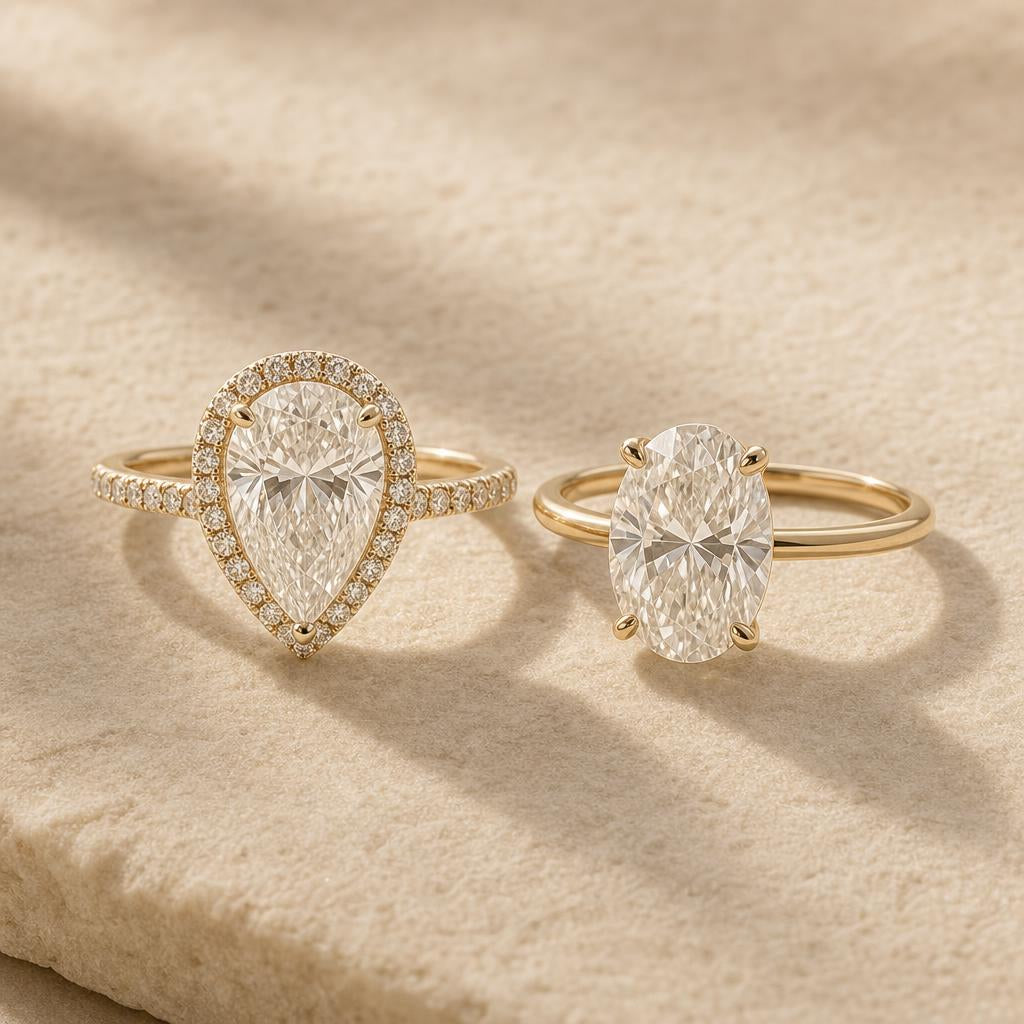
Soft and Romantic vs Sleek and Modern: How to Figure Out Which Aesthetic Is Actually Yours
Most women know, roughly, what kind of ring they want. And then they see one that's the opposite — and love it. The gap between what we say is "our style" and what we actually reach for is where most ring regrets live.
There are two dominant aesthetics that define most of today's ring landscape: the soft and romantic, and the sleek and modern. Both are genuinely beautiful. Both look extraordinary in the right setting. The question isn't which one is better — it's which one is actually, honestly, yours. And figuring that out before you buy saves you from owning a ring that photographs well but never quite feels like you.


What "soft and romantic" actually means in a ring
The romantic aesthetic isn't about being frilly or over-the-top. It's about warmth, detail, and visual softness — rings that feel like they belong in a story. The hallmarks are stone shapes with curved silhouettes (pear, oval, round, cushion), settings that add layers of sparkle around the centre stone (halos, double halos, pavé-lined shoulders), and metal tones that lean warm: rose gold, yellow gold, or champagne-toned silver.
Romantic rings tend to have more surface area catching the light. Where a modern ring directs your eye to the stone, a romantic ring lets your eye wander — across the halo, down the band, back to the centre. That visual complexity is part of the appeal.
The women who gravitate toward this aesthetic are often — though not always — drawn to soft colours in general. Blush, cream, warm earthy tones. Their homes have texture: a throw blanket, a candle on every surface, botanicals somewhere. Their wardrobe might include linen and silk rather than sharp tailoring. Not always, but often enough that it's a useful signal.

The Victoria Ring
A marquise-cut centre stone surrounded by a full pavé halo, set on a band with decorative shoulder detail. The marquise elongates the finger, and the halo amplifies the stone's natural drama. This is a ring that wears like a piece of history — and photographs like something from a different era entirely.
Shop The Victoria →What "sleek and modern" actually means in a ring
The modern aesthetic is defined by restraint. Less setting, more stone. Where the romantic ring frames the stone in a halo, the modern ring elevates it — a single centre stone on a slim band with minimal or no embellishment. The effect is confident, architectural, and intentional in a way that feels very now.
Modern rings tend to favour geometric shapes: ovals, princess cuts, emerald cuts, and asscher cuts — shapes with clean lines and angular or elongated profiles. The metal choices lean cool: white gold, sterling silver with rhodium plating, or a cool-toned yellow gold used sparingly. Even when yellow gold appears in a modern ring, it's usually the only element of warmth — the setting itself is stripped back to the point of near-invisibility.
There's a particular kind of confidence to a modern ring. It doesn't ask for permission. It sits on the hand and doesn't say very much — but what it says, it says clearly. The women who tend to choose this aesthetic often dress with a similar logic: fewer pieces, higher impact. They're the ones who wear one good coat and nothing that competes with it.

The Morgan Ring
A 3-carat princess-cut simulated diamond set on a slim pavé band. The princess cut is inherently geometric — four sharp corners, a perfectly square face — and this setting lets that geometry do all the work. The result is a ring that feels contemporary without being cold.
Shop The Morgan →How to actually figure out which aesthetic is yours
The problem with choosing a ring aesthetic online is that almost everything looks beautiful on a white background. A pear-cut halo ring in rose gold is objectively gorgeous. So is a clean oval solitaire in silver. The visual quality of each image tells you very little about which one will still feel right on your hand in five years.
Here are the questions that actually reveal your aesthetic — not the ring, but you:
Look at your wardrobe, not your wishlist
Open your wardrobe right now and look at what's actually there — not what you've saved on Pinterest, not what you wore to that one event three years ago. What are the shapes? Are there soft, draped fabrics or is most of it structured? Are your colours warm (creams, caramel, olive, rust) or cool and neutral (black, white, grey, navy)? Do you have jewellery with detail and layering, or do you tend toward a single clean piece?
Your wardrobe is your real aesthetic. It's the one you live in daily. A ring that disagrees with your wardrobe will feel out of place, even if you can't name why.
✦ Pro tip: Pull out three items you wear at least once a week. Look at the details — curved seams or sharp tailoring? Embellishment or clean fabric? The answer is usually consistent.
Look at your home
Interior preferences track almost perfectly with jewellery preferences. A home with candles, layered textiles, warm lighting and collected objects suggests a romantic aesthetic. A home with clean surfaces, architectural pieces and deliberate negative space suggests a modern one. Neither is better — they're just different visual languages, and a ring is part of the same language you speak every day.
How do you describe yourself?
Not to others — to yourself. When you imagine how you want to feel on a normal Tuesday, what are the words? Soft? Cosy? Feminine? Grounded? Or pulled together? Intentional? Streamlined? Words like "cosy" and "layered" tend to point toward romantic rings. Words like "clean" and "minimal" tend to point toward modern ones.
Worth knowing: Aesthetic preferences are stable over time. The ring you choose should reflect how you dress and live today — and how you've dressed and lived for the last five years. Trends come and go; your natural style doesn't change much.
When you're genuinely somewhere in the middle
Many women are. The soft-romantic vs sleek-modern spectrum isn't binary — there's a whole middle zone where the two aesthetics overlap and create something slightly harder to name but very easy to love. It's the oval solitaire with one thin pavé band. The cushion cut in a clean bezel setting. The round brilliant on a band with the faintest milgrain edge.
If you find yourself equally drawn to both, don't force a decision — look for rings that live in that middle ground. They exist in abundance, and they're often the most wearable rings for exactly this reason: they don't commit fully to either end of the spectrum, so they work with almost everything.

The Leighton Ring
A round brilliant centre set in a halo that blends the softness of a cushion outline with the precision of a round stone — where softness meets sparkle without committing to either extreme. The band is pavé but slim, keeping the overall silhouette clean. This ring photographs differently depending on the light: sometimes romantic, sometimes architectural.
Shop The Leighton →
The Aura Ring
A radiant-cut centre stone flanked by a side halo — a design that reads as bold and structured but carries the light in all directions. The radiant cut has an angular face but rounded corners, landing it squarely between modern geometry and romantic sparkle. It's the ring for the woman who refuses to pick a lane.
Shop The Aura →A note on trends vs identity
Engagement ring trends shift every few years. Emerald cuts had a moment. Toi et moi rings are having one now. Chunky bands came in, then went quiet. The risk of choosing a ring based on what's trending is the same as the risk of buying a dress based on what's on the runway: by the time it's everywhere, you're already quietly bored of it.
Aesthetic identity, on the other hand, doesn't trend. The woman who has always gravitated toward clean, minimal things will feel at home in a solitaire in 2025 the same way she did in 2015 and will in 2035. The woman who loves warmth and detail will love her halo ring just as much a decade from now. Trends are useful for discovering new styles — but they're a poor substitute for knowing yourself.
If a ring has been on your favourites list for more than six months — through multiple trend cycles, through seasons, through moods — that's the ring. Not the one you saved last week because everyone is suddenly talking about it.
Quick Takeaways
- Romantic rings lean soft: halos, curved shapes, warm metals, pavé detail. Modern rings lean clean: solitaires, geometric cuts, cool metals, minimal embellishment.
- Your wardrobe and home reveal your real aesthetic more reliably than your ring wishlist does.
- If you're drawn to both, look for middle-ground rings — they're the most wearable and age best.
- Stable personal style outlasts any trend. Choose a ring that matches who you are consistently, not who you are this season.
- A ring that photographs well but doesn't feel like you is a ring you'll stop reaching for.
Frequently asked questions
Can I mix romantic and modern elements in one ring?
Yes — many of the most wearable rings do exactly this. A round solitaire on a twisted pavé band, or an oval stone in a bezel with one diamond-set row on the shoulders, sits comfortably between aesthetics. The key is that the elements feel proportionate and intentional, rather than competing for attention.
Does metal colour affect which aesthetic a ring reads as?
Significantly. Rose gold almost always reads as romantic, regardless of the stone shape — the warmth of the metal tone tilts the whole ring toward softness. White gold and silver push rings toward modern. Yellow gold sits somewhere in the middle; in a minimal solitaire setting it reads as modern, in a halo or vintage-style setting it reads as romantic.
I like the look of halo rings but I also love minimalism. What should I do?
Look at hidden halos — where the halo sits beneath the centre stone rather than around its perimeter. From the side, the ring looks like a clean solitaire. From the top, there's extra sparkle. You get both things without the ring committing fully to either aesthetic.
Will my aesthetic preference change over time?
The evidence on personal style suggests aesthetic identity is quite stable after your mid-twenties. The way you feel about colour, texture, and ornamentation in clothes and interiors tends to be consistent — which is why your home and wardrobe are more reliable predictors than your mood board. That said, major life changes can shift things. If you're in a transitional moment, it's worth waiting a few months before committing to a ring.
There's no wrong answer between soft and romantic and sleek and modern. Both aesthetics produce rings that are genuinely beautiful, genuinely luxurious, and genuinely wearable. The only question is which one reflects the version of you that shows up every day — the one who gets dressed without thinking too hard, reaches for the same few pieces, and always looks like herself. Find that aesthetic, and the ring decision becomes much simpler.


