

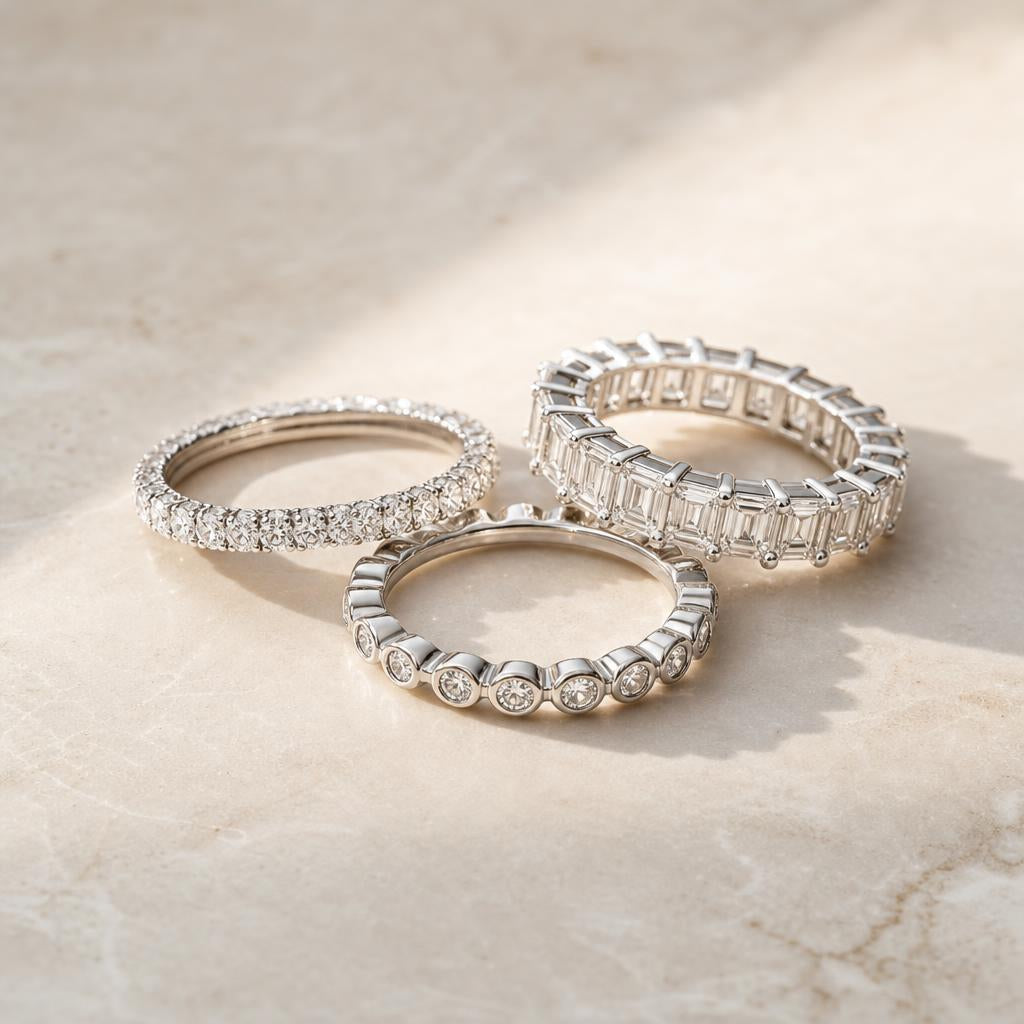
Promise rings that don't look like engagement rings: styles that feel intentional, not interim
A promise ring should feel like a decision — not a placeholder. But somewhere between the too-small-to-be-real solitaires and the heart-shaped styles aimed at teenagers, the category lost the plot. Here is what a promise ring actually looks like when the intention behind it is taken seriously.
The styling challenge with promise rings isn't finding something meaningful — it's finding something that reads as deliberate rather than interim. The right ring doesn't whisper "engagement ring in progress." It stands on its own: worn with confidence, chosen with care, and beautiful enough that you'd reach for it whether or not the context were romantic at all.


Why most promise rings get the brief wrong
The traditional promise ring has a shape problem. The designs that dominate the category tend to fall into two camps: the miniature solitaire that reads like an engagement ring that hasn't quite made it yet, or the overtly symbolic style — hearts, infinity loops, knot motifs — that announces its sentiment so loudly it becomes hard to wear outside the moment it was given.
Neither works particularly well as an everyday ring. The first creates an awkward visual hierarchy the moment you stand next to someone who does have an engagement ring; the second tends to peak on the day you receive it and become something you take off more often than you put back on.
The styles worth looking at instead have one thing in common: they were designed to exist fully in their own right. They don't need context to justify themselves. An eternity band is an eternity band. A bezel-set stone is a bezel-set stone. They carry no visual obligation to become something else later.
Worth knowing: A promise ring has no official definition — which means you can give one, wear one, or accept one without it following any particular rulebook. The meaning is what you assign to it, which makes the style question even more important. The ring should reflect the intention, not perform it.
The eternity band as a promise ring
Eternity bands are, structurally, a loop of stones with no beginning and no end. As a piece of jewelry, they have always carried symbolism independent of any engagement-ring context — which is exactly what makes them so well suited to the promise ring brief.
They read as considered. They wear beautifully on any finger. They look as natural on the right hand as the left. And because their design language belongs to a distinct jewelry category — bands, not statement rings — they sidestep the "is that an engagement ring?" question entirely.

The Destiny Ring
Two intertwining pavé paths that meet at the center — The Destiny is one of those rings that holds meaning without needing to explain itself. Worn alone, it reads as a beautifully made dress ring. Worn in a stack, it adds dimension without competing. The symbolism is built into the form, not applied on top of it.
Shop The Destiny Ring →Round versus baguette eternity: the visual difference
Both round and baguette eternity bands work as promise rings, but they project very differently. Round pavé eternity bands are soft and romantic — the small stones blur together into a continuous shimmer that catches light from every angle. They're the warmer, more traditionally feminine option.
Baguette eternity bands are sharper. The rectangular cuts sit flush against each other in a way that creates a clean, architectural line — it reads as modern and intentional, and the style has a formality that makes it feel more like fine jewelry and less like dress-up. If the person you're buying for gravitates towards geometric shapes, clean silhouettes, or Art Deco aesthetics, baguette is almost always the right call.
✦ Styling note: Baguette eternity bands wear well alongside watches and geometric pieces. Round pavé bands sit more naturally with vintage-inspired or softer jewelry. Neither pairing is wrong — it's worth thinking about what else she regularly wears on that hand before you decide.
Bezel settings: the case for the understated stone
A bezel setting is one where the stone is surrounded entirely by a rim of metal rather than held in place by prongs. It's an older setting technique that has had a significant resurgence in contemporary jewelry — partly because it protects the stone, partly because it wears so smoothly against the skin, and partly because it produces a silhouette that couldn't be mistaken for anything else.
A bezel-set ring doesn't look like an engagement ring. It doesn't look interim. It looks considered — which is exactly right.

The Amore Ring
An oval eternity band that makes a statement in its own right — The Amore links a continuous row of oval stones in a design that's bold without being loud. The oval cut reads as more contemporary than round, and the eternity format means it wears with the ease of a stacking ring at a presence level that doesn't ask for company.
Shop The Amore Ring →Which finger, and does it matter?
Technically, a promise ring can go on any finger. In practice, the choice matters more than people let on — not because of any rule, but because of what adjacent fingers are already wearing, and what they might wear in future.
The most common placement is the ring finger of the right hand. This signals intentionality without claiming the left ring finger, which remains culturally associated with engagement and marriage. It's a clean solution: the ring gets a prominent placement, it's easy to gesture with, and the meaning is clear without requiring explanation.
The left ring finger is sometimes chosen — particularly when the promise is of the "we'll be engaged soon" variety — but it comes with a visual vocabulary that can create confusion. If the ring you choose already reads as different from a traditional engagement ring, this matters less. An eternity band or baguette ring on the left hand reads as a wedding band before it reads as anything else, which can actually work in its favour.
The right middle finger is a less common but interesting option for someone who doesn't want the ring to carry relationship signalling at all — it reads as a fashion ring in the best sense, a piece chosen for how it looks rather than what it represents. This can be the right call when the promise is personal rather than romantic: a ring you've given yourself, or one that marks a milestone between friends.
Thinking about the long game: stacking potential
One question worth asking before choosing a promise ring is whether it should be able to sit alongside an engagement ring or wedding band later. For some people, this is irrelevant — the promise ring will always live on a different hand, or it's something that will be worn and then retired when circumstances change. But for others, a ring that plays well in a future stack is genuinely useful.
Eternity bands and slim pavé bands are the most versatile stacking companions. They sit flush against most settings, they don't compete with a center stone, and they add brilliance to a stack without demanding attention. The styles that work best this way are the ones with a continuous setting and a low profile — the kind of ring that disappears into a stack and makes everything around it look better.
Worth knowing: If stacking is part of the plan, consider metal tone before you buy. A silver-toned promise ring will mix most easily with white gold or platinum engagement rings. Rose gold or yellow gold can create a beautiful mixed-metal look, but only when the combination is deliberate rather than accidental. Mixing metals for the sake of it rarely works — mixing them for the sake of a considered aesthetic nearly always does.
Quick Takeaways
- Promise rings that read as intentional avoid solitaire silhouettes that mimic engagement rings — eternity bands, bezel settings, and baguette cuts are the more confident choices
- Eternity bands carry their own symbolic language and don't require romantic context to justify themselves as a ring choice
- Bezel settings are modern, wear smoothly, and look nothing like placeholder jewelry
- The right ring finger is the most common placement; the left ring finger works when the ring's design already reads differently from a traditional engagement ring
- If stacking is part of the plan, prioritise low-profile continuous bands that sit flush against other rings
- Metal tone chosen now will determine how easily the ring integrates with future pieces — it's worth thinking ahead
Common questions
What finger does a promise ring go on?
Most commonly, the ring finger of the right hand. This gives the ring a prominent placement without claiming the left ring finger, which is culturally reserved for engagement and wedding rings. That said, there is no rule — the choice depends on your own preferences, what else you're wearing on each hand, and what meaning you want the ring to carry.
What is the difference between a promise ring and an engagement ring?
An engagement ring is a formal declaration of intent to marry, typically accompanied by a proposal. A promise ring has no fixed definition — it can mark a commitment, a personal milestone, a relationship milestone, or any intention the giver and recipient decide to assign to it. This flexibility is precisely what makes the style choice so important: the ring has to carry the meaning, because the category itself doesn't.
Do promise rings need to have a stone?
No. Plain bands, twisted wire rings, and textured bands without any stones are all used as promise rings. That said, rings with stones tend to photograph and wear more distinctly — they read as a specific, considered choice rather than a generic band. If you want the ring to feel deliberate rather than incidental, a stone or a continuous row of stones communicates that more clearly.
Can a promise ring become a stacking ring later?
Yes, and for many people this is the intended outcome. An eternity band or slim pavé ring chosen as a promise ring sits beautifully alongside an engagement ring and wedding band later — particularly if the metal tones are consistent. Choosing with the long game in mind doesn't diminish the ring's meaning in the present; it just makes for a better-considered decision.
How do you make a promise ring feel like a considered gift rather than an afterthought?
The design is the first signal. A ring that looks like it was chosen — rather than grabbed from a display that says "promise rings" — communicates care before it's even unwrapped. Beyond the ring itself: presentation matters. A simple box, a quiet moment, a few words that explain what it means. The ring is the tangible thing; what surrounds it is what makes it memorable.
The promise ring category doesn't have to be defined by the rings that have historically dominated it. The styles worth giving — and worth wearing — are the ones that exist fully in their own right: beautiful enough to want without context, chosen with enough care that the story behind them doesn't need to be explained at a glance. That's not a high bar. It's just the right one.


