

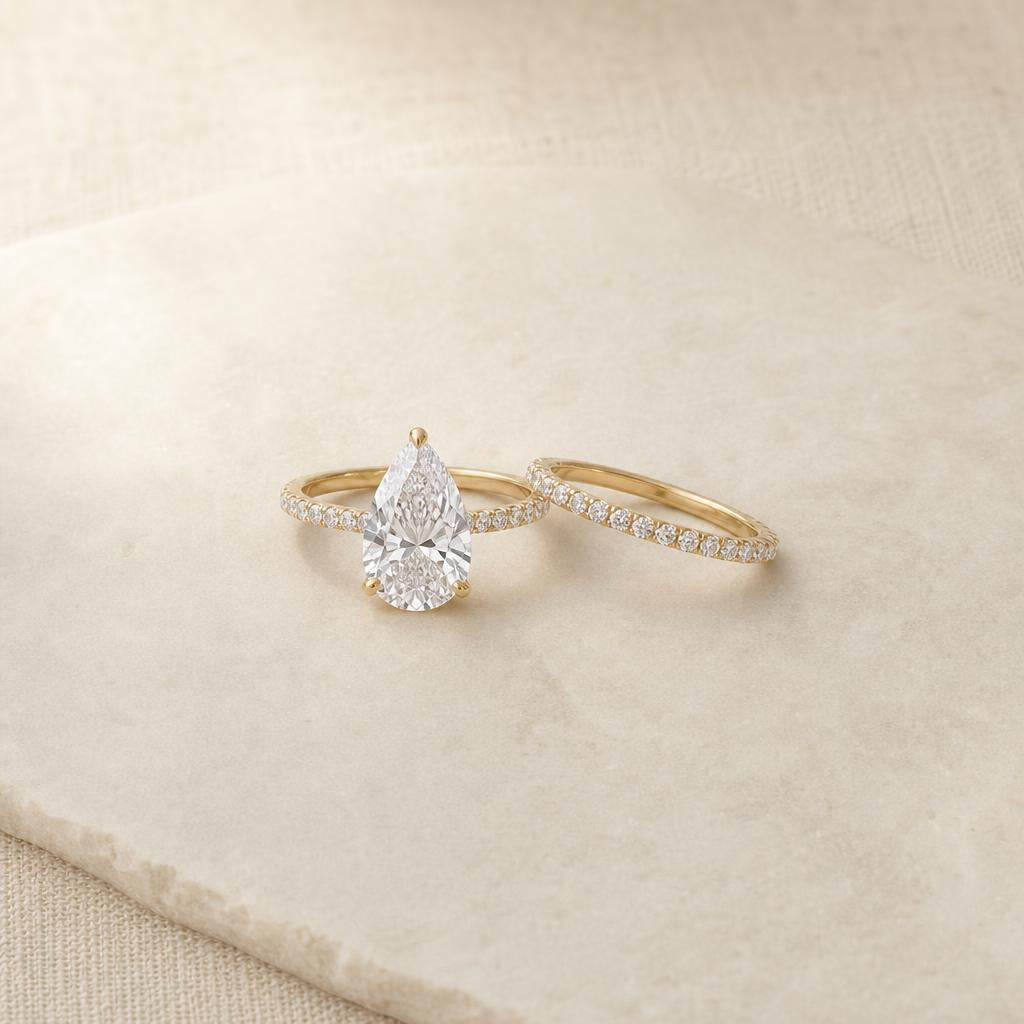
Pairing a Wedding Band with a Pear Cut Ring: The Shapes, Widths and Fits That Work
The pear cut is the most rewarding ring to style well — and the most punishing when you get it wrong. Its pointed tip, dramatically curved silhouette and typically elevated profile make it unlike any other shape to pair with a wedding band. The advice that works for round or oval rings largely doesn't carry over. But once you understand the handful of principles specific to the pear, the decision becomes much more straightforward.
The question most people find themselves asking isn't simply "which band?" — it's "will it sit properly?" and "will the gap at the point look odd?" Both are fair concerns, and both have specific answers. Below is a breakdown of the shapes, widths and fits that genuinely work with a pear cut ring, and the ones that tend to disappoint in person even when they look fine on a screen.


Why the pear cut is unlike any other shape to pair
Most engagement ring shapes are symmetrical across both axes — a round brilliant, a cushion, a radiant. Place a straight band against any side and the relationship is identical all the way around. The pear cut breaks this immediately. It has a point at one end and a curve at the other, and that asymmetry changes how a band sits against it in several specific ways.
There are three challenges the pear cut introduces that other shapes don't:
- The pointed tip creates a gap. Any straight band will curve away from the point of the stone. On a round ring, the band sits flush all the way along. On a pear, there will always be a visible separation at the tip unless you choose a band specifically shaped to address it — or decide to embrace the gap as part of the look.
- The setting height matters more. Pear cut stones are often set high, particularly in halo or cathedral settings. This pushes the engagement ring upward and away from any band placed beside it, which increases the chance of movement or rocking if the bands aren't proportioned carefully.
- Orientation affects everything. A north-south pear (point toward the nail) and an east-west pear (point to the side) sit against a band in completely different ways. The orientation you wear your ring in determines which styles will work well and which will draw attention to the wrong places.
Worth knowing: The gap at the tip of a pear cut ring is not a fitting problem. It is a geometric inevitability — even bespoke contoured bands from fine jewellers have a small space at the point. The goal isn't to eliminate it; it's to decide whether you want to work with it or around it.
The three band types that work well with a pear cut
Once you understand the geometry, the options narrow to a manageable set. Three band types reliably work with pear cuts across a range of settings and orientations.
Slim straight bands
This is the simplest solution and often the best one. A narrow straight band — typically 1.5mm to 2mm wide — sits beside the pear without fighting it. Because it's slim, the small gap at the point is barely noticeable. The clean line reads as intentional rather than ill-fitting. Add a slim pavé band if you want more sparkle without drawing attention to the tip. A plain polished band works equally well and puts all focus on the stone itself.
The risk with a straight band is going too wide. Over about 2.5mm, the gap at the tip becomes more visible, particularly for north-south orientations where the point faces directly up the finger. Keep it slim and the gap sits quietly in the background.
V-shaped and chevron bands
A V-shaped or chevron band is designed specifically for pointed stones — pear, marquise and some princess cuts. The V notch at the top allows the band to nestle close to the point of the stone without creating a distracting space. The two arms of the V extend downward and outward, following the curve of the setting rather than cutting straight past it.
The result looks deliberate and elegant — the band was clearly chosen to work with the stone, not just placed next to it. This style works particularly well with north-south orientations, where the point is front and centre and any gap would be immediately visible. For east-west pears, a V-band can feel over-engineered; a slim straight band often suffices.
Full eternity bands
A full pavé eternity band — stones set all the way around the ring — is one of the most practical and visually effective choices for a pear cut. The continuous sparkle running around both rings creates a seamless halo of light that makes it nearly impossible to focus on any gap at the tip. Your eye is drawn across the entire stack rather than to any single point.
Full eternity bands also have the advantage of sitting consistently regardless of how the ring rotates on the finger during the day, which is a practical consideration that straight bands or asymmetric contoured styles don't offer.

The Amore Ring
A continuous band of oval-cut simulated diamonds in a slim silver setting. The curved oval facets echo the shape of a pear stone beautifully, creating a cohesive visual conversation between the two rings rather than simple contrast. An understated but effective pairing choice.
Shop The Amore Ring →Width: the variable that matters most
Width is the single most important decision you'll make when choosing a band for a pear cut ring. The guidance is simple, but it's worth being precise, because the difference between 1.5mm and 3mm looks much more significant in person than it does in a product image.
| Band Width | Gap at Tip | Best For | Avoid If |
|---|---|---|---|
| Under 1.5mm | Minimal — almost invisible | Delicate looks, petite hands, multiple bands stacked | You want the band to register as a distinct piece |
| 1.5–2mm | Small — reads as intentional | Most wearers — the most versatile width for pear cuts | Nothing — this is the sweet spot for almost all pear settings |
| 2–2.5mm | Moderate — noticeable but not distracting | East-west orientations; larger stone settings with wide shanks | North-south pears with prominent halos or cathedral profiles |
| Over 3mm | Significant — will draw attention | Only with a custom-contoured band specifically fitted to the setting | Straight bands; north-south orientations; most halo settings |
For most women wearing a pear cut ring in the 1ct to 3ct equivalent range, a 1.5–2mm band is proportionally ideal. It's narrow enough to sit quietly, wide enough to hold visual presence, and forgiving enough that any gap at the tip doesn't demand attention.
✦ Practical tip: Before ordering, hold a thin ribbon or the thinnest ring you own beside your pear cut to gauge how different widths look in context. The 1.5mm range is roughly as wide as a standard piece of gift ribbon. Three millimetres looks substantially more substantial in person than most product images suggest.
The gap at the tip: when to care and when not to
This comes up in almost every conversation about pear cut band pairings. Someone sees a gap between their engagement ring and new band at the point of the stone, and immediately worries it looks unfinished or ill-chosen. Most of the time, it doesn't — and most jewellers will tell you exactly the same thing.
The gap at the tip of a pear cut is not the same as a poorly fitting garment or a misaligned frame. It's an expression of the stone's shape. A round stone has no point; there is no inherent gap. A pear stone does have a point, and any band that isn't custom-contoured to that exact setting will sit away from it to some degree. That is the geometry, not a mistake.
The occasions where the gap becomes a genuine concern are more specific:
- When the band is wider than 2.5mm — the gap becomes proportionally more visible against the width of the band
- When the pear is oriented north-south with the point facing directly up — the gap sits right at the top of the finger in your own direct line of sight
- When the setting has a very high cathedral profile — the band sits further from the stone, making the space between them larger and more obvious from the side
In most other contexts, the gap reads as a natural consequence of the stone shape and causes no practical or visual problems. If you know you'll be sensitive to it, a V-shaped band addresses it almost entirely — which is the main reason V-cut bands were developed for pointed stones in the first place.

The Forever Ring
A continuous pavé eternity band in sterling silver with round simulated diamonds set all the way around. The unbroken circuit of sparkle reads as a single seamless piece with a pear halo ring, drawing the eye across both rings rather than toward any gap at the point.
Shop The Forever Ring →North-south versus east-west: why orientation changes the answer
The way you orient your pear cut stone has a large effect on which bands work best. It's worth being clear about this before you shop.
North-south orientation (point toward the nail, curve toward the palm) is the traditional way to wear a pear cut. The stone appears longest and most dramatic this way, and the silhouette draws the eye vertically up the finger. The trade-off is that the gap at the tip sits right at the top of the stack, where it's most visible to you and others. North-south orientations benefit most from V-shaped bands, which address the gap directly and make the pairing look completely intentional.
East-west orientation (point facing to one side, worn horizontally) has grown significantly in popularity and is meaningfully more forgiving for band pairing. The point faces sideways rather than upward, which means the gap sits at the edge of the finger rather than its face. From most viewing angles — straight on, or from above — the gap is barely noticeable. This orientation is far more accommodating of straight and eternity bands, which opens up the field considerably.
If you haven't yet decided on orientation and you know you want the flexibility to use a straight or eternity band easily, east-west is the more forgiving choice. If you prefer the traditional north-south profile and know you'll want the cleanest possible look, plan for a V-shaped band from the start.
Metal tones and the pear cut stack
The pear cut looks particularly refined in white and silver settings, where the stone's brilliance plays against a cool, neutral metal without competition. That said, it works in rose gold and yellow gold equally well — the principle is consistency rather than specific tone.
- Silver and rhodium-plated settings are the most versatile — they pair with all band styles, keep the focus on the stone, and are forgiving if you want to add more bands over time.
- Rose gold creates warmth against a clear or near-colourless stone and pairs most cohesively with a matching rose gold band. The Isabella Ring in Rose Gold alongside a rose gold eternity band is a particularly complete look.
- Mixed metals tend to work better with the pear cut than with rounder stones. The pointed shape gives the stack a sense of visual direction that mixed tones can emphasise rather than muddle — if you want to pair a silver pear ring with a gold band, or vice versa, the result is often more intentional than the equivalent with a round stone.
Quick Takeaways
- A slim straight band (1.5–2mm) is the most versatile choice for most pear cuts and orientations
- V-shaped and chevron bands address the gap at the tip directly — best for north-south orientations
- Full eternity bands create continuous sparkle that draws the eye across the stack and away from any gap
- Width is the most important variable — wider than 2.5mm will emphasise the gap in most straight-band pairings
- East-west orientations are more forgiving and open up more band options than north-south
- Match metals for the most cohesive look; mixed metals work better with the pear's directional shape than with round stones
Frequently asked questions
Do I need a specifically shaped band for a pear cut ring?
No. A slim straight band works well for most pear cuts, particularly if the stone is oriented east-west or if a small gap at the tip doesn't bother you. V-shaped bands are worth considering for north-south orientations where the gap sits at the top of the finger, but they're not essential for every pairing. Start simple — a narrow straight pavé band is an excellent first choice that works with most settings.
Should the wedding band sit flush against the pear cut ring?
The band will sit flush along most of its length against the shank of the pear ring. A small gap at the tip of the stone is normal and expected — it results from the pointed shape rather than a sizing or fitting problem. Only a custom-contoured band made to match the exact profile of the setting will sit close to flush all the way around, and even then a small space at the very point usually remains.
What width wedding band works best with a pear cut engagement ring?
The 1.5–2mm range works for the widest variety of pear cuts and orientations. Under 1.5mm gives a delicate, barely-there look that stacks beautifully if you're planning to add multiple bands. Over 2.5mm starts to make the gap at the tip more visible, particularly for north-south orientations. When in doubt, err narrower — it's almost always the safer call with a pointed stone.
Can I stack two wedding bands on either side of a pear cut ring?
Yes. Two slim bands placed one on each side frames the pear stone elegantly and creates a symmetrical look that feels very finished. If you're adding multiple bands to a single side, keep the combined width in check so the gap at the tip doesn't become the dominant visual feature of the stack. Eternity bands with continuous stone coverage work particularly well in a stacked context because the sparkle draws the eye across the whole arrangement rather than toward any single point.
The pear cut rewards specific knowledge more than any other stone shape. The gap at the tip, the question of orientation, the band width — each has a clear answer once you know what you're looking at. Get those three variables right and the rest of the decision is straightforward. The ring you end up with will look as though it was always meant to sit exactly that way.


