

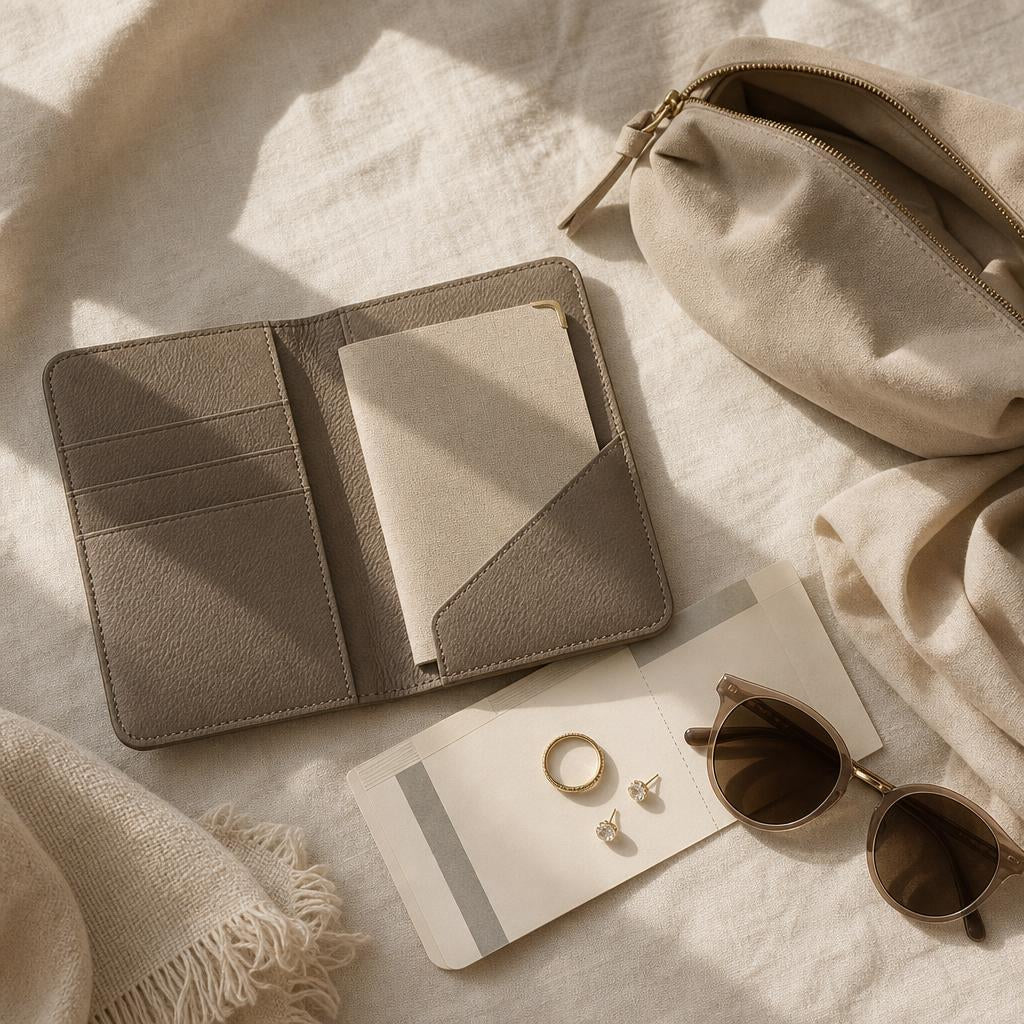
Flying Internationally With Jewelry: How to Pack It in Your Carry-On (And What Actually Gets Flagged)
Somewhere between booking the flight and packing the bag, a specific kind of anxiety shows up: what do you do about your jewelry? Not the studs you wear every day without thinking — the pieces that actually matter to you. The ring you don't want to leave in a hotel safe. The one you're not sure you're even allowed to bring.
Here's the good news: flying internationally with jewelry is far less complicated than the internet makes it sound, and most of what trips people up is easy to sort out before you ever reach security. Before we get into the specifics — packing, screening, and what customs actually cares about — a few travel-ready styles worth knowing, all built to move through an airport as easily as they move through your day.


Why Flying With Jewelry Makes People Anxious (Even When It Shouldn't)
Most of the worry around it isn't really about airport rules. It's about the two questions underneath them: will something get lost, and will something get flagged. Neither question has a complicated answer, but the internet tends to answer both of them badly — mixing up TSA screening with customs declarations, and conflating advice for someone carrying $20,000 in gold with advice for someone wearing the ring they put on every morning.
Those are genuinely different situations, and once you separate them, the whole thing stops feeling like a research project. There are three distinct moments to plan for: getting through security at departure, keeping track of everything mid-trip, and clearing customs on the way back in. Each one has its own, fairly simple, set of rules.
How to Pack Jewelry in Your Carry-On
The single most important rule, repeated by the TSA and every jeweler who's ever answered a customer's panicked email: jewelry belongs in your carry-on or personal item, never in checked luggage. Checked bags get lost, rerouted, and occasionally opened by people who aren't you. A carry-on stays where you can see it.
Beyond that, packing it well comes down to a few habits that take minutes to set up and save you from a tangled, scratched mess on the other end:
- Give each piece its own space. A pill organizer, a set of small zip-top bags, or a dedicated travel pouch all work — the goal is preventing metal-on-metal contact and chains that knot themselves into a puzzle.
- Thread necklaces before you clasp them. Running a chain through a plastic straw before closing the clasp keeps it straight and untangled for the entire trip.
- Keep it near the top of your bag. If a screener needs to take a closer look, you want to find everything in seconds, not by unpacking your whole carry-on in front of the line behind you.
- Consider wearing it instead. A low-profile ring or a pair of studs worn on your hand or ears never has to be "packed" at all — which is one real advantage of pieces built for daily wear rather than a jewelry box.

The Lumière Ring
A 4-carat round brilliant solitaire in a refined 4-prong setting with a slim band — the kind of low-profile silhouette that slides on for a travel day and doesn't need a case to feel secure.
Shop The Lumière →What Actually Happens at Airport Security
TSA does not prohibit jewelry in a carry-on, and in most cases you don't need to remove it before walking through the scanner. Thin rings, small studs, and delicate chains typically pass through without triggering a second look. What tends to get flagged is bulk, not brilliance: chunky cuffs, statement collars, and heavy layered pieces are more likely to set off a metal detector or prompt additional screening — not because they look expensive, but because they read as a large, dense mass of metal.
If you're wearing something you'd rather not remove in a public line, you're entitled to ask for a private screening. It's a normal request, and officers handle it routinely. Beyond that, the practical move is simple: wear your low-profile pieces through the checkpoint, and keep anything bulkier packed in the pouch you set up before you left the house.
Worth knowing: Security screening and customs are two separate systems with two separate sets of rules. Clearing the TSA checkpoint at departure has nothing to do with what you'll need to explain — or won't — at customs when you land.
Do You Have to Declare Jewelry at Customs?
This is the part that actually causes the most confusion, and the honest answer is: usually, no — but it depends entirely on where the jewelry came from. Personal jewelry you already owned and wore before you left the country is not something you need to declare when you come back. It was yours going out, and it's yours coming back in. Nobody expects you to fill out paperwork for the earrings you wore to the airport.
Where declarations come in is jewelry acquired abroad. If you buy something during your trip, receive it as a gift, or bring back a piece intended for someone else, that's a different category — it counts against your personal exemption, and above a certain value, it needs to be declared. If you're carrying something you're a little nervous about proving you already owned, U.S. Customs and Border Protection lets you register high-value pieces before you leave the country, and a dated photo or receipt works just as well in a pinch.
None of this is really about jewelry being expensive-looking. It's about whether it entered the country with you today or was already part of your life before you packed. A ring styled to read like it's worth $15,000 or higher doesn't automatically become a customs problem — because customs isn't assessing how a piece looks. It's asking a much narrower question: did you buy this on the trip you're returning from?

The Échelon Ring
A sharp, structured Asscher cut solitaire with deeply layered step cuts — a quietly confident everyday piece that reads as intentional, not occasion-only, which makes it easy to just keep wearing wherever you land.
Shop The Échelon →How Much Jewelry Can You Actually Bring?
There's no piece count or weight limit on the jewelry you can carry in your personal bag or wear on your body — the constraint isn't quantity, it's value and origin, and only once you cross into customs territory. So the question isn't really how much jewelry you can bring on the airplane; it's whether what you're bringing was already yours before the trip started. If it was, you can wear as many rings as you like without a second thought.
That said, practicality has its own limit. A gallon bag stuffed with jewelry is more likely to draw a curious glance from a screener than a single ring worn on your hand ever will be. The simplest version of "how much is too much" is: pack what you'll actually wear on this specific trip, and leave the rest of the jewelry box at home.
The Case for a Ring You Don't Have to Think About
This is really where a simulated diamond ring changes the entire calculation. It isn't a dupe you're quietly hoping no one examines too closely — it's 925 sterling silver and moissanite, indistinguishable from a diamond, and it passes diamond testers. It was yours before this trip. It stays affordable enough that losing track of it for a day isn't a financial emergency. And because it was never purchased on foreign soil, there's nothing to declare and nothing to prove.
That's the actual value of building a travel-specific piece into your jewelry rotation: not that it looks less like the real thing, but that it removes every variable that makes travel days stressful in the first place. You wear it through security without a second thought, you don't check a case into the belly of the plane, and you land with one less thing on your mind.
Quick Takeaways
- Always keep jewelry in your carry-on or personal item — never in checked luggage.
- Thin rings and delicate pieces usually clear security without removal; bulky metal is more likely to get a second look.
- You generally don't have to declare jewelry at customs if you already owned it before you left.
- Jewelry bought or acquired abroad is a different category and may need to be declared above your exemption.
- Photos, receipts, or a CBP registration before departure make proving prior ownership painless if it ever comes up.
Frequently Asked Questions
Do you need to declare jewelry when traveling internationally?
Only if it wasn't already yours before the trip. Jewelry you owned and wore leaving the country doesn't need to be declared coming back. Jewelry purchased, gifted, or acquired abroad does, once it exceeds your personal exemption.
Will jewelry set off airport metal detectors?
Small rings, thin chains, and stud earrings rarely trigger a metal detector. Larger, denser pieces — heavy cuffs, chunky watches, layered statement necklaces — are more likely to prompt a second look, simply because of the amount of metal involved.
Is there a limit to how much jewelry you can bring in your carry-on?
No official piece count or weight limit exists for jewelry carried in a personal bag. The practical consideration is customs value if any of it was acquired abroad, not the sheer number of pieces you're wearing or packing.
Do you need to take off jewelry at airport security?
Usually not. TSA doesn't require jewelry removal for most pieces, and modern scanners are generally able to screen travelers wearing rings, studs, and thin necklaces without an alarm. If you'd rather not risk it, you can always request a private screening.
Will TSA confiscate your jewelry?
No. Jewelry is fully permitted in carry-on bags, and TSA has no policy that involves confiscating personal jewelry. The only real risk to your jewelry on travel days is losing track of it — which is exactly what a dedicated carry-on pouch is for.
None of this needs to be complicated, and it's worth remembering that most of the anxiety here comes from vague, secondhand advice rather than the actual rules. Pack smart, wear the pieces that don't require a second thought, and know the difference between what security cares about and what customs cares about. The rest takes care of itself.


