

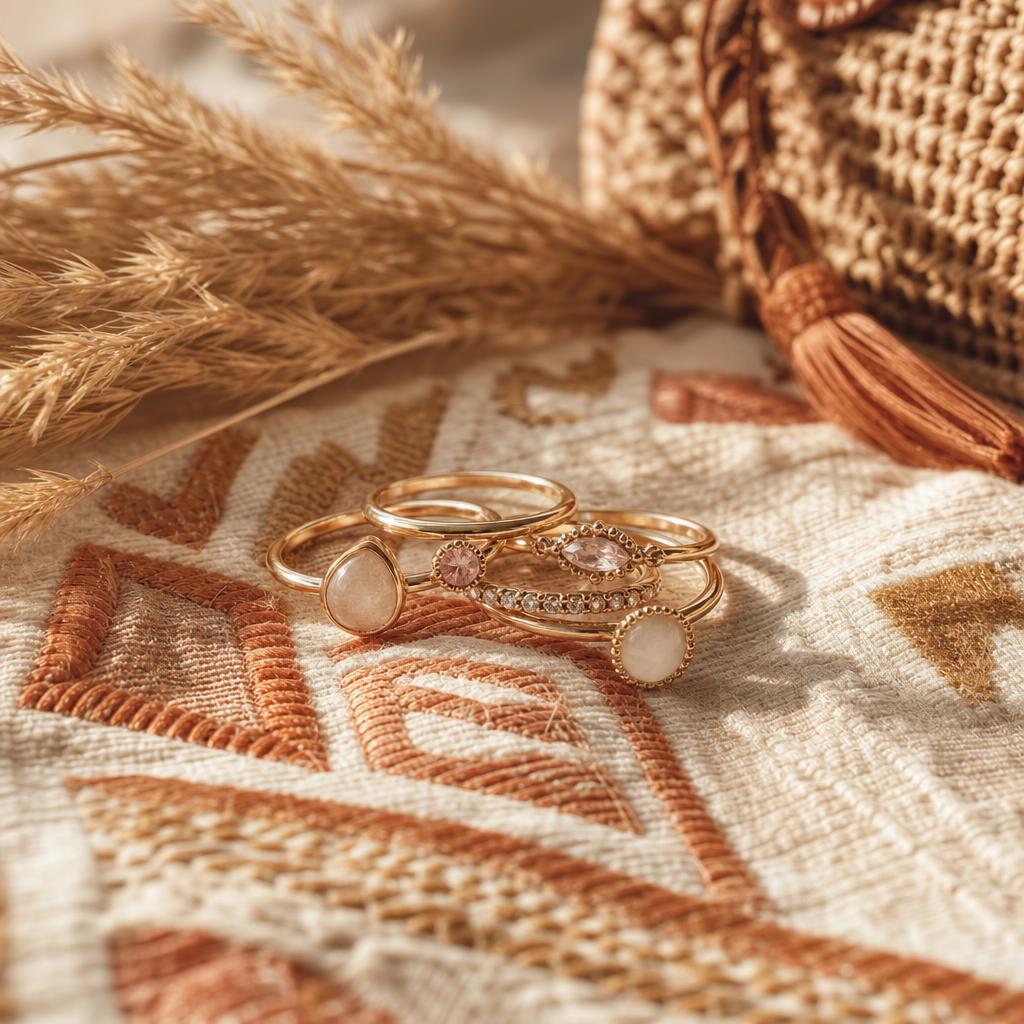
Festival Jewelry: What Actually Survives Crowds, Dancing and Long Lines
A festival is three days of crowds, heat, dancing, and a bathroom line you will remember for the wrong reasons. It is also, somehow, one of the most jewelry-anxious environments a woman can put a ring through — which is exactly why so many women leave their good pieces at home and regret it the second they see the photos.
You do not have to choose between "bare hands all weekend" and "spend the entire set worrying about a stone." The right ring is built to survive exactly this: sweat, sunscreen, a stranger's shoulder in the pit, a sink with no working lock on the stall door. Here is what actually holds up.


The real risks aren't what you think
Most women picture the worst-case scenario as "a stone falls out mid-set." In practice, the more common losses are dumber than that: a ring comes off with a glove at a cold-weather show, slips off during a hand-washing marathon in a festival bathroom, or gets tugged loose when someone grabs your hand to pull you through a crowd. Heat and sweat make fingers slightly smaller by the end of a long, hot day, which is exactly when a ring is most likely to slide off unnoticed.
The fix isn't leaving your hands bare. It's choosing settings that hold their stones securely under movement, sit low enough that they don't catch on clothing or hair, and don't require you to think about them for twelve hours straight.
What actually survives a full day of dancing
Bezel settings over prongs
A bezel setting wraps a rim of metal fully around the stone's edge instead of holding it with thin metal claws. That means nothing to snag on a tote bag strap, nothing to catch on someone's jacket as you squeeze past them toward the front, and a much lower chance of the setting bending out of shape from an accidental knock. If you're only bringing one ring for the weekend, a bezel is the setting that asks the least of you in return.

The Cherish Ring
A rubbed-edge bezel setting on a slim stacking band — nothing raised, nothing to snag, built to disappear into your hand while you dance.
Shop The Cherish Ring →Low-profile over high-profile
A tall setting is more likely to catch on hair, fabric, and other people's hands than a flush, low-set band. Pavé and half-eternity stacking bands sit close to the finger by design, which means fewer opportunities for a stone to take a direct hit. This is also, conveniently, the exact styling logic behind our one-ring, one-trip approach to travel jewelry — the fewer moving pieces on your hand, the fewer things there are to lose.
Moissanite for daylight and strobe lights both
Festivals move between two extremes: blazing afternoon sun and stages lit almost entirely by strobes and colored gels after dark. Moissanite is cut for exactly this kind of light variance — it throws off more fire and rainbow flash than a standard round brilliant does, which means it reads just as vividly under a sunset set as it does under stage lighting. It's also harder than most gemstones on the market, which matters more than people realize when a stone is spending three days getting knocked against a phone case, a water bottle, and someone else's bracelet.

The Forever Moissanite Ring
A half-eternity band set with moissanite stones cut for maximum fire — the kind of sparkle that photographs just as well at 3pm as it does at midnight.
Shop The Forever Moissanite Ring →✦ Pro tip: If you're wearing more than one ring, put your most secure piece — bezel-set, low-profile — closest to your palm. It's the position least likely to get grabbed, tugged, or brushed against a passing shoulder.
Skip the statement ring, if you can
A single dramatic ring — tall halo, big center stone, wide band — is a beautiful choice for a wedding or a night out. It is not the strongest choice for eleven hours on your feet in a crowd. The taller the setting, the more surface area there is to catch on a friend's cardigan, a stranger's backpack strap, or your own hair when the wind picks up between sets. It's not that a statement ring can't survive a festival; it's that it asks more of you, all day, than a slimmer piece does.
A better approach is often two slim stacking bands instead of one large ring. The Forever Ring and the Beloved Ring were both built for exactly this kind of layering — pavé, half-eternity, low-profile — so you still get real sparkle without a single piece doing all the work (or taking all the risk) on its own. Worn together, they read as considered rather than accidental, and neither sits high enough to catch on anything.
If you already own a stack you love from home, festivals are actually a reasonable place to wear it — provided every piece in it follows the same low-profile logic. What doesn't travel well is a stack built around one tall, delicate setting that was never meant to survive a crowd in the first place.
The bathroom line problem, solved
Ask any woman who's been to a festival and she'll tell you: the actual danger zone isn't the crowd near the stage, it's the sink. Portable bathrooms mean cold water, no counter space, and a strong incentive to wash your hands fast — all of which adds up to rings coming off and getting left behind more often than you'd expect. Sterling silver and rhodium plating don't discolor or react to hand sanitizer and festival-grade soap the way some cheaper base metals do, so at least the ring itself isn't the problem. The habit is.
Build a rule and stick to it: rings go on your hand or in a zipped pocket, never loose on a sink edge, ever, even for ten seconds. This is the same logic we cover in more detail in our guide to packing rings without a case — the goal is removing every moment where a ring is separated from your hand or your body.
Heat, sweat and swelling
Hours of dancing in direct sun swells fingers the same way a hot yoga class does — which is exactly why the advice in our piece on heat and humidity and how they affect rings applies just as well here. A ring that fits perfectly at 11am can feel tight by 4pm and then loose again once the sun goes down and your hands cool off. If a ring has ever gotten uncomfortably tight partway through a hot day, that's your body telling you something worth listening to before you're standing in a crowd trying to work it off over swollen knuckles.
Worth knowing: 925 sterling silver with rhodium or 18k gold plating is nickel-free and won't discolor your skin, even with a full day of sweat, sunscreen, and bug spray layered on top. The stone stays put — it's the fit and the setting that need to be right for the day, not the metal.
Should you bring your good ring at all?
This is the real question underneath all of this, and the honest answer is: it depends on how much peace of mind matters to you more than the ring itself. Some women bring a designated festival ring — something they love wearing but wouldn't be devastated to lose — and leave anything more sentimental safely at home. Others simply choose a setting secure enough that the question doesn't come up. Either approach is reasonable. What's not reasonable is spending three days not fully present because you're checking your hand every twenty minutes.
If you do want a backup plan, our guide on looking put-together without looking like a target covers how to wear jewelry in a crowd without drawing the kind of attention that makes anyone nervous — festival or otherwise.
Quick Takeaways
- Bezel settings and low-profile bands survive dancing and crowds better than prong settings and tall halos.
- Moissanite handles the shift from harsh daylight to stage lighting better than most stones — and it's genuinely durable.
- The bathroom sink, not the mosh pit, is where most festival rings actually go missing.
- Heat and sun cause real swelling — check your fit before, not during, a long hot day.
- Sterling silver with rhodium or gold plating won't react to sweat, sunscreen, or sanitizer.
Frequently Asked Questions
Is it safe to wear real jewelry to a festival?
It's safe if you choose the right setting and build a few habits around it — a secure bezel or low-profile band, and a strict rule about never leaving a ring loose near a sink or in a pocket without a zip. The risk isn't the festival itself; it's wearing a setting that wasn't built for movement.
What's the best type of ring to wear to a music festival?
A bezel-set or low-profile stacking band is the safest bet. It sits close to the finger, has no raised prongs to snag on clothing or hair, and holds its stone securely through hours of movement.
Will a moissanite ring hold up to a full day of heat and dancing?
Yes. Moissanite is one of the more durable gemstones available and handles temperature swings, sweat, and the harsh-to-dim lighting shifts of a festival day without losing its sparkle.
Should I bring a backup ring instead of my main one?
It's a reasonable approach if peace of mind matters more to you than which specific ring you're wearing. A designated festival ring — one you love but wouldn't be devastated to lose — lets you dance, wash your hands, and move through a crowd without thinking twice.
A festival doesn't have to mean bare hands or a weekend of low-grade anxiety about your ring. Choose a setting built to move with you, build a few habits around the moments that actually cause loss, and you'll spend the weekend watching the show instead of watching your hand.


