

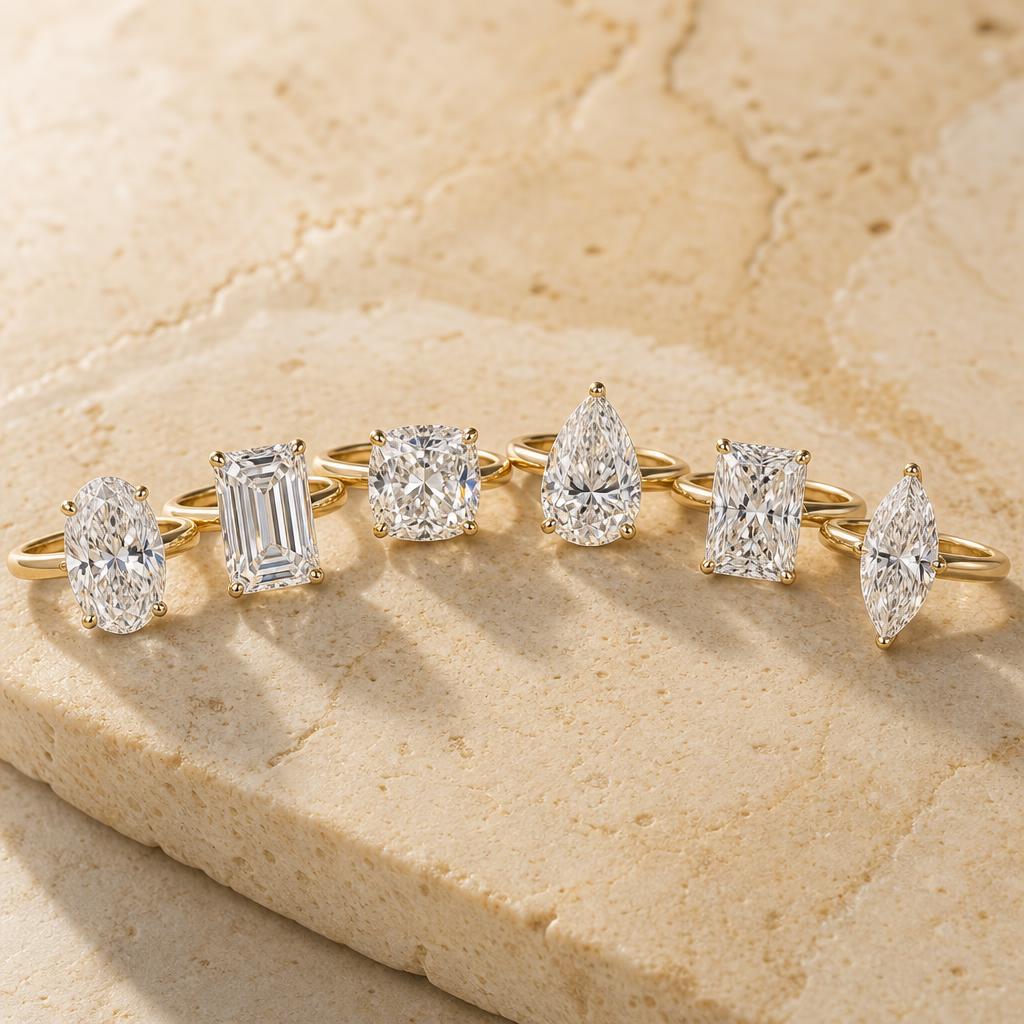
Engagement ring shapes and styles taking over right now: a trend report
Some ring shapes quietly build momentum for years before they tip into the cultural conversation. Others arrive suddenly, and overnight every engagement announcement on your feed features the same silhouette. Right now, we're in a rare moment where both things are happening at once — and the variety on offer is genuinely exciting.
Whether you're deep into research mode or just starting to pay attention to shapes for the first time, here's what's actually gaining ground — and the styles making each cut worth a second look.
The oval is still reigning — and here's what's making it interesting
Oval cut engagement rings have dominated search trends for several years now, and the reason is straightforward: the shape is flattering on almost every hand. The elongated silhouette creates the illusion of longer, slimmer fingers, and the brilliant facet pattern means it captures light from every angle. What's changed recently isn't the shape itself — it's the settings surrounding it.
The most compelling oval rings right now aren't plain solitaires. They're paired with tapered baguette side stones that frame the centre without competing with it, or they sit in hidden halo settings that give the stone an elevated, floating quality. The combination of a generous oval centre with architectural baguette flankers creates a look that reads as both vintage-influenced and completely modern — which is a difficult balance to strike, and exactly why it's working.

The Empress Ring
A powerfully poised 3.5-carat elongated oval centre stone flanked by tapered baguette side stones. The setting keeps the proportions balanced and the look thoroughly modern — this is the oval ring for someone who wants the shape without the predictability.
Shop The Empress Ring →The emerald cut revival: when clean lines become the statement
If oval has been the dominant shape of the last several years, the emerald cut is the one quietly building behind it. A step-cut stone rather than a brilliant one, the emerald cut works on an entirely different logic: instead of scattering light outward in flashes, it reflects it in broad, calm planes. The effect is architectural rather than sparkly — and for a certain type of buyer, that distinction is exactly the point.
The appeal here is tied closely to the aesthetic moment we're in. The preference for understated elegance and quiet confidence has rewired what people consider aspirational, and the emerald cut fits neatly into that sensibility. It looks expensive without trying to announce itself. A clean solitaire setting lets the stone do everything — no distractions, just the stone and its long, clear reflections moving as you move.
Worth knowing: Emerald cuts show inclusions more readily than brilliant cuts because they lack the light-scattering facets that disguise them. Simulated diamond options sidestep this entirely — you get the same architectural silhouette with flawless, perfectly consistent clarity throughout.

The Kensington Ring
A sharp, structured solitaire that lets the stone lead. The emerald cut centre sits in a refined setting that keeps the silhouette clean and uncluttered — exactly what this cut demands and deserves.
Shop The Kensington Ring →Cushion cuts and the hidden halo: two trends that found each other
The cushion cut has always had a particular warmth to it. The rounded corners and large facets create a soft, pillowy quality that feels more romantic than either the precision of a princess cut or the drama of a radiant. It was the dominant shape in Georgian and Victorian jewellery, and its popularity today is partly a response to that history — there's something about a cushion cut that feels like it carries time with it.
What's elevated the cushion cut recently is how it's being set. The hidden halo — a ring of small stones set beneath the centre stone rather than around it — is one of the subtler innovations in contemporary ring design. Viewed straight on, you see nothing but the cushion centre and its band. Look at it from the side or catch it at an angle in the light, and suddenly there's an extra ring of sparkle that was hiding in plain sight. It gives a familiar cut an unexpected dimension, and it rewards the kind of attention that a good ring deserves.

The Duchess Ring
A cushion-cut centre stone with a layered double halo — one visible, one tucked underneath for a surprise from every angle. The pavé band continues the brightness all the way around the finger.
Shop The Duchess Ring →The pear cut: a shape that flatters hands and rewards attention
The pear — sometimes called the teardrop cut — combines the rounded brilliance of an oval with a pointed tip that creates a completely different relationship with the hand. Worn point-up toward the fingertip, it elongates dramatically; it's one of the few shapes where the orientation choice visibly changes what the ring communicates. It's a shape that rewards some thought about how you wear it, which is part of what makes it interesting to live with.
Pear cuts have been picking up serious momentum recently, particularly in hidden halo settings where the surrounding stones trace the shape's silhouette without interrupting it. The hidden halo here does something distinct from what it does for a cushion cut: rather than adding surprise depth, it reinforces the pear's outline, making that pointed teardrop shape even more defined and intentional-looking. The result is a ring that looks as though it was carefully considered — because it was.
✦ Tip: If you're concerned about the pointed tip of a pear cut catching on fabric or snagging, look for a setting with a V-tip prong — a single prong that cups the point and protects it without drawing attention to the fact that it's there.

The Paris Ring
A pear-cut centre stone in a hidden halo setting with a pavé band that brings continuity to the whole design. The shape is distinctive; the setting is restrained enough to let the silhouette speak.
Shop The Paris Ring →Radiant cuts: when maximum sparkle is the whole point
A radiant cut is a round brilliant and an emerald cut in conversation with each other. It has the rectangular silhouette of a step cut — the clear outline, the geometric presence — but its facets are cut for brilliance rather than reflection. The result is a stone that combines architectural shape with the kind of fire and light return that round cuts are famous for.
If you want a ring that moves, that catches light from across the room, that flashes when you gesture in conversation, the radiant cut delivers that consistently. It's the choice for buyers who want something that looks dramatic without the softer shape of an oval or the rounded edges of a cushion. Pair it with a side halo and a pavé band and you're adding light to every part of the ring — the effect is cumulative and deliberately maximalist, and there's nothing wrong with that.

The Aura Ring
A dazzling radiant-cut centre stone in a setting with a surrounding side halo that amplifies every facet. This is the ring for anyone who has decided that maximum sparkle is not a compromise — it's the goal.
Shop The Aura Ring →Marquise cuts: the elongated shape that quietly never left
The marquise is one of the older cuts in the rotation — its origins are usually traced to 18th-century France, and it spent several decades as the definitive vintage shape before falling somewhat out of fashion in the 1990s. But it has always had something the other cuts don't: the longest perceived length-to-width ratio of any diamond shape. A marquise looks considerably larger face-up than a round stone of equivalent weight, which has always been its most practical argument.
What's brought the marquise back into contemporary conversation is partly that finger-lengthening effect — the same logic that drives oval cut popularity — and partly a renewed comfort with shapes that carry history. A marquise in a halo setting softens the pointed tips at each end and adds visual context around the shape, making it feel current rather than nostalgic. It's the kind of choice that signals you looked past the obvious options, and knew what you were choosing and why.

The Victoria Ring
A marquise-cut centre stone in a pavé halo setting that traces the shape's distinctive outline. The elongated silhouette creates exceptional visual presence — one of the marquise cut's most compelling arguments.
Shop The Victoria Ring →Quick Takeaways
- Oval remains the dominant shape — baguette side stones and hidden halos are the settings giving it a current edge
- Emerald cuts are gaining steadily, driven by a preference for clean, architectural elegance over maximum sparkle
- Cushion cuts read as romantic and vintage-adjacent; the hidden halo setting adds contemporary depth without altering the shape itself
- Pear cuts are rising — they elongate the finger dramatically and reward attention to setting details like V-tip prong protection
- Radiant cuts suit anyone who wants maximum brilliance inside a geometric outline — no apologies required
- Marquise cuts offer the best face-up size-to-weight ratio of any shape, and a halo setting keeps them feeling current
Frequently asked questions
Which engagement ring shape is the most popular right now?
Oval has held the top position for several years and remains dominant. The shapes gaining the most ground below it are emerald cut and pear cut, both of which have been pulling consistent search interest and appearing more frequently in engagement announcements across social media.
What is the difference between a radiant cut and an emerald cut?
Both are rectangular step-cut shapes, but they're faceted differently. An emerald cut has large, open facets that create broad, calm reflections — architectural and understated. A radiant cut has brilliant facets inside a similar outline, producing fire and sparkle closer to what you'd expect from a round brilliant. Same shape family, entirely different character.
Does a hidden halo work with every stone shape?
Hidden halos work best with shapes that have a defined footprint — cushion, oval, pear, round. The stones sit directly beneath the centre stone, so you see the effect from the side and at profile angles rather than face-on. For more elongated shapes like marquise, a traditional halo around the stone tends to be more practical and proportionate.
Which ring shape makes fingers look longest?
Marquise and oval create the most elongation, because both shapes run lengthwise along the finger. Pear cuts worn with the point toward the fingertip also create a strong elongating effect. The elongation comes from how much of the stone's length aligns with the finger's axis — carat size matters less than silhouette orientation.
The shape you choose will likely be with you for a long time, so it's worth understanding what each one does to the hand, the light, and the overall impression before you decide. The good news is that most of the cuts gaining momentum right now are doing so for reasons that will outlast the trend cycle: they're genuinely beautiful, they're versatile, and they suit a wide range of personal aesthetics. Following any of them is rarely a choice you'll find yourself reconsidering.


