

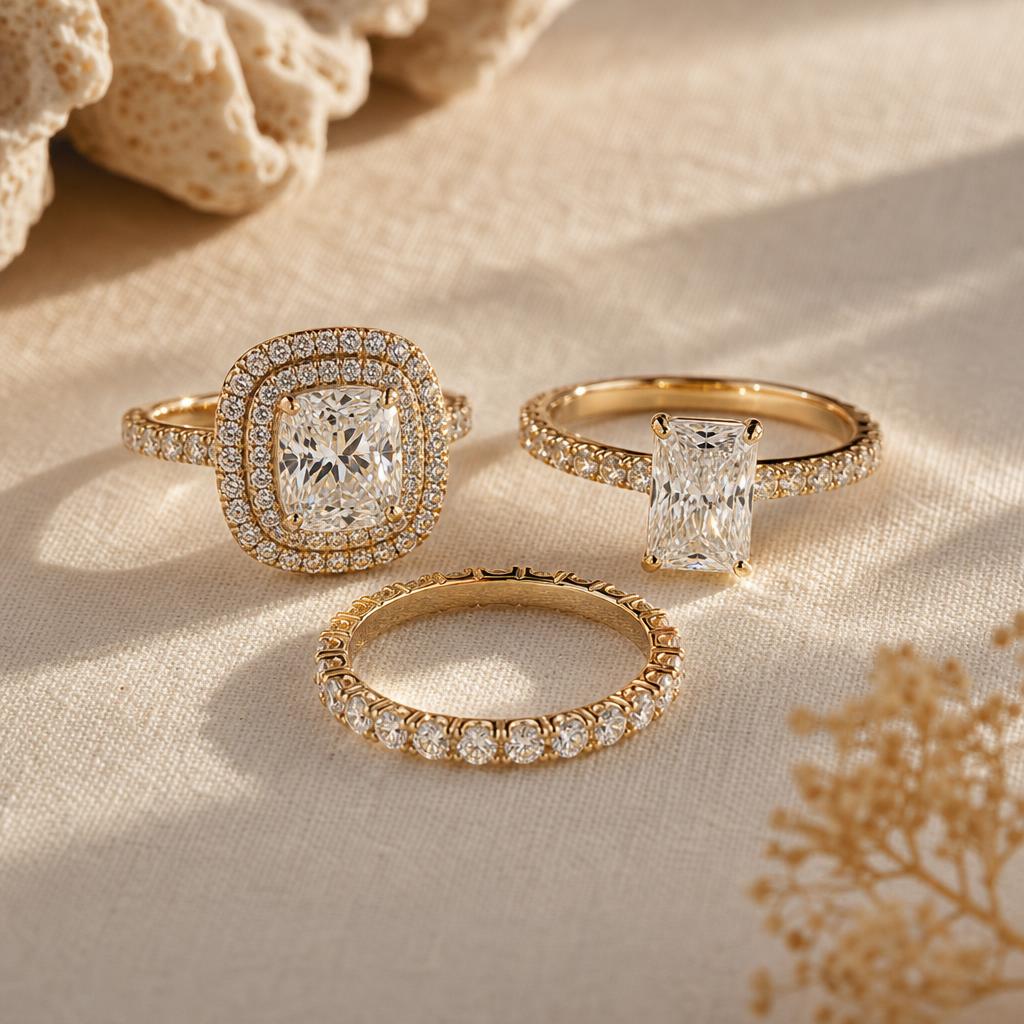
Destination Wedding Guest Jewelry: How to Dress Your Hands at a Resort Formal Event
You've RSVP'd yes, booked the flights, sorted the dress — and now you're staring at your jewelry box wondering what on earth goes with "resort formal." The answer, it turns out, is not necessarily your engagement ring.
Destination weddings have a dress code of their own. The setting is sunlit and special, the mood sits somewhere between a luxury dinner and a clifftop ceremony, and the brief — resort formal — sounds elegant in theory but is genuinely tricky to decode. Your jewelry needs to look polished and intentional, travel safely in a carry-on, and still read as elevated enough for the occasion. This is exactly the situation the travel ring was designed for.


What "resort formal" actually means — and why it's harder than it sounds
Resort formal sits between cocktail attire and black tie — in a no-man's land that most dress codes never explore. The expectation is that you look genuinely dressed up, but in a way that's suited to an outdoor venue, a sandy terrace, or a rooftop above the sea. Floaty floor-length dresses are in. Heavy suits feel out of place. Stilettos sink into the lawn.
The same logic applies to jewelry. Heavy, ornate pieces can feel mismatched in natural light and an open-air setting. Delicate, sparkly pieces that catch the sun read beautifully. The wedding-guest ring that looks impressive in a ballroom can feel overdressed at a clifftop ceremony, and something that looks elegant indoors can disappear entirely in bright sunlight. The brief, in short, is a ring that belongs in that setting — and that's not always your engagement ring.
Worth knowing: Many destination wedding venues — particularly beach settings, boat decks, or coastal terraces — involve sand, salt air, and sun cream. These conditions are demanding on precious metals and fine stones. A simulated diamond travel ring lets you lean fully into the occasion without the anxiety.
Why a travel ring is the smartest choice for your guest look
The travel ring was originally conceived as a stand-in for an engagement ring — something to wear on holiday so you're not taking a high-value piece through airport security or onto a boat. But the logic extends naturally to any occasion where your fine jewelry would be at risk, and a destination wedding ticks almost every box: checked luggage, unfamiliar venues, late nights at an open bar, and the kind of festive chaos that means you'll have no idea where you left your clutch by 10pm.
Wearing a travel ring to a destination wedding isn't a compromise — it's a considered choice. You get a ring that's specifically designed to look like the real thing, built to perform in environments where you wouldn't normally take your finest pieces, and priced so that you can focus entirely on the celebration rather than checking your hand every ten minutes. That's not settling. That's smart.
There's also a pure style argument here. The rings designed for travel tend to be the rings that photograph best in natural light: the halo settings, the radiant cuts, the bold oval styles with side stones. These are not understated everyday pieces. They are the rings you bring out for an occasion — and a destination wedding, with its golden-hour photography and sunlit champagne toasts, is exactly that.
Stone shapes and settings that thrive in the light
Outdoor light is unforgiving in the best way. It reveals every facet, fires every stone, and makes the right ring look extraordinary. What works in a dimly lit restaurant looks completely different in open sunshine, which is why stone shape matters more at a destination wedding than almost anywhere else.
Radiant and cushion cuts
These are the standout performers in natural light. The radiant cut has a modified brilliant facet pattern that bounces light in multiple directions at once — in sunshine, it fires almost continuously rather than in the single directional flash you get from a round brilliant. The cushion cut does something similar: its slightly softer corners and deeper facets give it a warm, champagne-glass glow that's particularly beautiful in late afternoon light. Both shapes look impressive from a distance, which matters at the large-scale outdoor ceremonies that destination weddings typically involve.
Oval and elongated shapes
Oval-cut rings have had a long, sustained moment in jewelry, and with good reason. The elongated shape is flattering across almost every hand shape and finger length, and the proportions make even a modestly-sized stone look substantial. At a resort formal event, an oval with baguette side stones — a clean, architectural combination — reads as genuinely elegant rather than simply decorative. It's a stone shape that does a lot of the styling work for you.
Halo settings
If you're choosing a ring specifically for a destination wedding, a halo setting is a strong choice. The ring of smaller stones around the centre creates a brightness that radiates outward — in photographs, in sunlight, and in the moment-to-moment glimpses other guests get when you're raising a glass or passing around a canapé. It's a setting designed to be seen from across a room, and it performs exactly as intended.
Step-cut stones: a more architectural choice
Asscher and emerald cuts take a different approach. Where brilliant cuts scatter light in all directions, step cuts create deep, geometric flashes that are more dramatic and more deliberate. In daylight, a step-cut stone delivers a hall-of-mirrors effect — long, structured flashes of light rather than continuous brilliance. At a destination wedding, this reads as sophisticated and distinctive: the kind of ring people notice not because it's the biggest in the room, but because it's interesting.

The Astrid Ring
A 3-carat asscher-cut simulated diamond with Art Deco-inspired side details and a pavé band. The asscher cut's step-facet pattern creates a distinctive hall-of-mirrors depth that looks genuinely special in natural light — an architectural ring for an occasion that deserves one.
Shop The Astrid Ring →Metal tones: what works at the beach, what doesn't
The destination matters here. The metal tone you choose for your guest ring should feel at home in its setting, and different resort locations have quite different palettes and lighting qualities.
White gold and silver tones feel clean and contemporary and photograph beautifully in bright, direct sunlight. If your destination is the Mediterranean, Santorini, or a whitewashed coastal venue, white metal reads as crisp and polished. It's a natural pairing with lighter dress colours — white, ivory, blush, powder blue — which tend to dominate resort formal occasions.
Yellow gold tones are warm and feel more at home in tropical settings — the Maldives, Bali, or a Caribbean beach wedding where the light itself has a golden quality. Yellow gold catches the warm end of the spectrum beautifully and pairs well with the earthy, sunset-toned dresses that tend to work in those environments.
Rose gold is the middle tone — warm enough for tropical settings, delicate enough for more classic European venues. It photographs particularly well in golden hour light, which is often when the key wedding photographs are taken.
✦ Tip: Match your ring metal to your other pieces — earrings, necklace, bracelet — rather than trying to coordinate with your outfit. A consistent metal tone across all your jewelry looks deliberate; mixing metals without intention reads as rushed.
Building your ring look as a destination wedding guest
There's a styling principle worth holding onto here: as a guest, your ring should complement the occasion, not compete with it. This isn't the moment to make a statement — that's the couple's job. Your goal is to look considered, polished, and like you understood the brief.
That doesn't mean understated. A resort formal event calls for real jewelry presence — something that reads from a few feet away and looks genuinely dressed up. But there's a clear difference between a ring that looks beautiful and one that dominates your hand to the point where it's all anyone notices.
If you're wearing one ring, choose something with enough visual weight to stand alone: a halo setting, a side-stone style, or a ring with a prominent centre stone all work well on their own. If you're stacking, keep it focused — a statement ring with a single slim eternity band is polished and complete without being busy. Adding a third band is almost always one too many for this kind of occasion.

The Eternity Ring
A full-circle pavé band that works beautifully as a standalone piece or as a polished complement to a bolder ring. Slim, refined, and continuously brilliant — it's the piece that makes a stack look considered rather than simply layered.
Shop The Eternity Ring →Practical notes on jewelry at destination weddings
A few logistics that are often overlooked until you're at the airport:
- Pack rings in your carry-on. Even simulated diamond pieces are worth protecting from the rough handling of checked luggage. A small zip pouch or ring box in your hand luggage is the right approach.
- Consider the ceremony setting. If the ceremony is on a beach or clifftop, you'll likely be removing shoes and possibly walking on sand or grass. A ring you're monitoring constantly isn't the right ring for that environment.
- Think about the whole trip. If you're spending several days at the destination, you want a ring that works for the rehearsal dinner, the ceremony, the day-after brunch, and the casual beach days in between. Versatility matters more than drama here.
- Salt air affects metals differently. Sterling silver can tarnish faster in coastal conditions. Gold vermeil and gold-plated pieces hold up better over a multi-day stay. Factor this in if you're staying for more than a night or two.
Quick Takeaways
- Resort formal calls for real jewelry presence — polished and intentional, not understated
- Travel rings are the practical and stylish choice for destination wedding guests
- Radiant, cushion, oval and halo settings perform best in outdoor natural light
- Match your metal tone to the destination's palette — white/silver for Mediterranean, gold for tropical
- As a guest, complement the occasion — a single statement piece or a two-ring stack is almost always enough
- Pack rings in carry-on; choose gold-plated or vermeil if staying in coastal conditions for several days
Frequently asked questions
Should I wear my engagement ring to a destination wedding?
There's no rule against it, but many guests choose not to. High-value pieces are at risk during travel and at outdoor venues, and the attention they attract can feel misplaced at someone else's wedding. A simulated diamond travel ring that looks the part is often the smarter choice — it lets you be fully present in the celebration rather than managing jewelry anxiety all day.
What if the dress code says "resort casual" rather than "resort formal"?
Drop one level. A resort casual dress code calls for something that reads as real jewelry without the full drama of a statement piece. A slim eternity band, a simple pavé ring, or a smaller halo feels appropriately dressed for a more relaxed occasion without overdoing it.
How many rings is too many for a destination wedding guest?
Two is almost always the right answer. One ring on your dominant hand, one on the other — or a thoughtful two-ring stack on one finger. Beyond that, the look starts to read as busy in photographs and can draw attention away from your outfit rather than completing it. As a guest, you want to look polished; you don't want to be the one everyone notices.
Is it rude to wear a ring that looks like an engagement ring if I'm not engaged?
Not at all. Larger solitaire-style rings are a mainstream fashion choice and have been for years. The key is to wear it on a finger other than the ring finger of your left hand, or to style it in a way that reads clearly as a fashion piece rather than a symbolic one. A halo on your right hand, a statement ring on your middle finger — both are completely appropriate for a guest at a wedding.
Destination weddings are among the most photographed occasions you'll attend as a guest. Your jewelry will be captured from angles you haven't anticipated, in light conditions you can't control, against somewhere genuinely beautiful. The case for thinking carefully about your ring isn't vanity — it's the same logic you'd apply to choosing the dress. Get it right, and everything else takes care of itself.


