

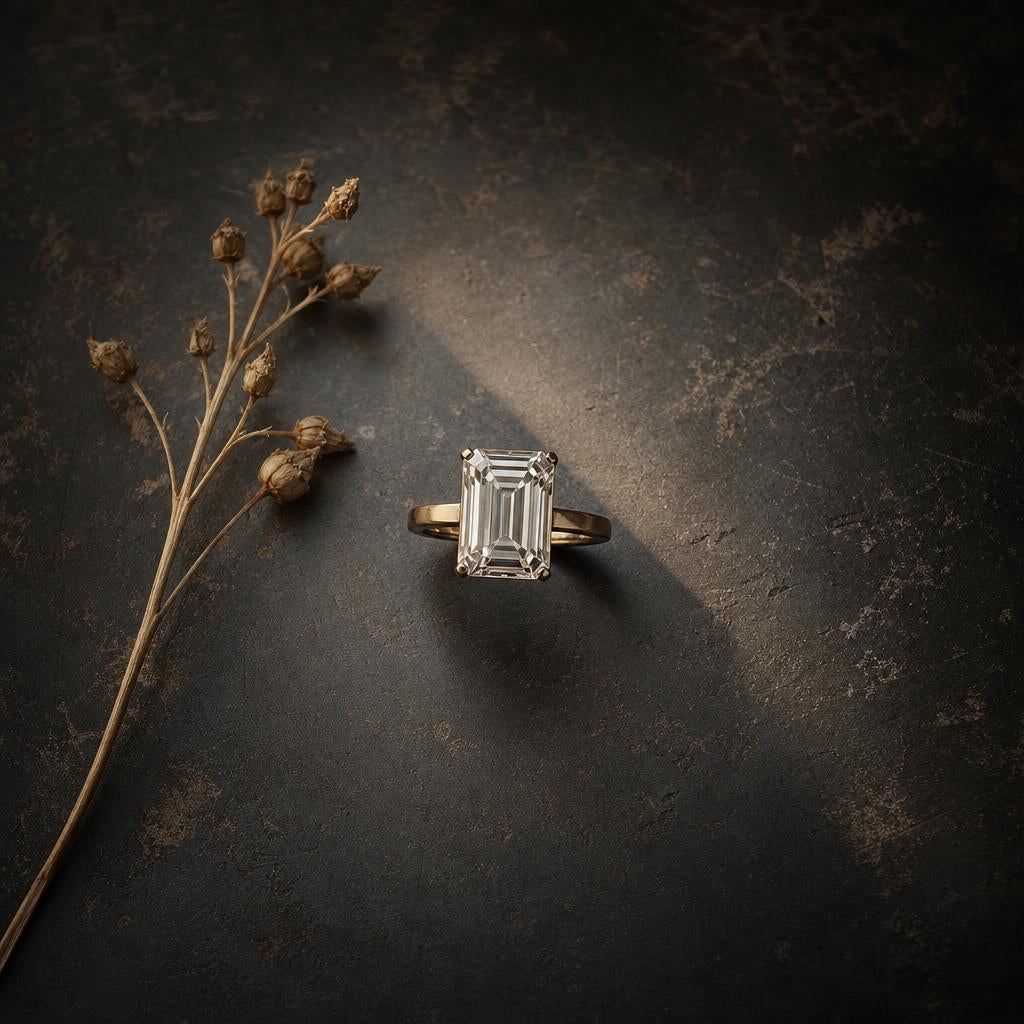
Dark, Moody, Unconventional: The Case for an Engagement Ring That Doesn't Look Like Everyone Else's
The round solitaire is beautiful. That's not the argument here. But somewhere between the Instagram feeds and the engagement ring guides, a particular idea took hold — that wanting something different means settling for less. It doesn't. It means knowing yourself.
The rings that tend to stop people mid-scroll aren't the ones that look like every other ring. They're the ones with a cut that commands attention, a detail that rewards a second look, a silhouette that says something specific about the person wearing it. This is not a guide for the woman who hasn't found the right solitaire yet. This is for the woman who already knows she doesn't want one.
Below, you'll find four rings from the Gemiros collection that sit firmly outside the default — an asscher-cut Art Deco solitaire, a marquise with a twisted band, a radiant-cut statement piece, and a pear cut with unexpected side stones. They share exactly one quality: they don't look like everyone else's ring.


Why the round-cut default is so hard to escape
The round brilliant cut accounts for roughly half of all engagement ring sales worldwide. The halo setting is the next most popular choice. Then the thin pavé band. These things are popular for a reason — they're beautiful, flattering on nearly every hand, and instantly recognised as engagement rings.
But there's a particular feeling that comes from spending hours in ring guides and arriving, every time, at the same thirty suggestions. If the lists have never felt like they were built for you — if the top-pick lists feel like a consensus answer and not your answer — that instinct is worth paying attention to. Taste is specific. The rings that feel like noise are giving you information.
The cuts and settings explored in this guide don't appear on most recommendation lists, which is precisely the point. They're rings for the woman who already knows what draws her eye, who doesn't need to justify a preference for asscher over oval or marquise over round. They exist, they're made well, and they're under $200 — the only question is which one is actually yours.
Worth knowing: Choosing an unconventional ring doesn't mean sacrificing wearability. The cuts explored here are all designed for daily wear — they're just harder to find on the generic recommendation lists because the algorithm favours what most people search for, not what actually suits you.
The cuts that make people stop and look
Cut is where the personality of a ring lives. Before the setting, the band, the metal tone — before any of the decisions that adjust and refine — the cut determines the fundamental visual character of a ring. These four cuts all have a distinctiveness the round brilliant doesn't.
The asscher cut: architectural and completely itself
Of all the cuts in jewellery, the asscher has the clearest aesthetic point of view. Where a round brilliant scatters light outward in every direction — bright, democratic, expansive — the asscher's step-cut facets do something altogether different. They draw the eye inward, into a deep geometric interior that resembles a hall of mirrors at the right angle. The effect is almost hypnotic, and it reads as sophisticated, architectural, and quietly dramatic in a way that no halo addition can replicate.
The asscher was the defining cut of the Art Deco era, and that lineage is visible in every ring that features it. It suits women drawn to clean geometry, to the aesthetic language of the 1920s and 30s, to buildings that have corners rather than curves. If you'd choose a black-and-white photograph over a colour one — if you find vintage film more beautiful than contemporary fashion — the asscher might be your cut.
Paired with geometric baguette side stones, as in the Astrid, the Art Deco character becomes explicit. Nothing about this ring is trying to be contemporary. It's referencing something older on purpose, and the confidence of that choice is part of what makes it striking.

The Astrid Ring
A 3-carat asscher-cut simulated diamond flanked by baguette side stones, set in 925 sterling silver with rhodium plating. The step-cut facets create a deep, mirror-like interior — dramatic in a way that's impossible to replicate with a brilliant cut. 8 × 8mm stone, geometric and completely itself.
Shop The Astrid →The marquise cut: a silhouette that draws a line
The marquise has an unusual power to polarise. People who love it tend to love it completely; it's not a cut that inspires mild approval. Its elongated pointed silhouette is dramatically different from the softer curves of an oval or the uniformity of a round — it draws a line across the finger and does not ask permission.
On longer fingers, the marquise creates an effect that's genuinely striking: the stone almost seems to float. On shorter fingers, it adds visual length in a way the round cut never can. The key, always, is the setting. Paired with a twisted pavé band — as in the Victoria — the cut moves from merely unusual to genuinely unexpected. The band's movement plays against the pointed ends of the stone, and the result is a ring that rewards looking at from every angle.
The marquise also has the unusual property of looking larger than its carat weight suggests, because of how the shape distributes surface area. A 1-carat marquise appears significantly bigger than a 1-carat round. That's not a trick — it's geometry.
The radiant cut: the slow burn
The radiant sits in interesting territory. It has the cropped-corner rectangular outline of a step-cut stone — similar in shape to an emerald or asscher — but its internal faceting is more complex, closer to a brilliant cut. The result is a stone that appears to glow rather than flash; a slower, warmer quality of light that feels entirely different from the sharp brightness of a round. At 4 carats, as in the Statement Ring, it becomes a presence on the hand that's very hard to ignore.
The addition of heart-shaped side stones takes the Statement out of any conventional category. This is a ring that knows exactly how much it wants to say.
The pear cut reimagined
The pear cut has always been slightly divisive — the teardrop silhouette reads differently to different people, from romantic to dramatic to simply unusual. The Juliette takes the pear in an even more unexpected direction by pairing it with heart-shaped side stones: three distinct stone shapes in a single ring, each contributing to a composition that's impossible to mistake for a conventional three-stone design. It's romantic without being predictable, and dramatic without being excessive.
When the setting does the dramatic work
Not every ring that steps outside the mainstream does it through an unusual cut. Sometimes the most striking choice is in the construction of the ring itself — in a detail that changes the entire visual register of the piece without declaring itself loudly.

The Duchess Ring
A 3.5-carat cushion-cut simulated diamond with not one but two hidden halos — an outer halo visible from above, a second beneath the stone that catches light from every direction. Set on a pavé band in 925 sterling silver with rhodium plating. 9 × 9mm stone. The ring that makes no attempt to be understated, and is right about that.
Shop The Duchess →Double halos are inherently theatrical. Two concentric rings of stones around a cushion cut creates a visual weight that is — deliberately, unambiguously — a lot. Worn on a confident hand, it becomes a statement about preference rather than restraint. The maximalist approach to jewellery has always existed alongside the minimal one; it's only the engagement ring conversation that treats restraint as the correct default.
The more interesting argument is this: the woman who genuinely loves drama shouldn't be talked into something delicate. A ring that feels like too much to someone else is exactly the right amount for you if looking at it makes you feel something. Jewellery that provokes a reaction is doing its job.
The detail that earns a second look
Some unconventional rings don't announce themselves. They reveal their character slowly — through a craftsmanship choice that becomes visible on closer inspection, a technique that distinguishes them from every other ring in the room without declaring itself at first glance. These are, in some ways, the most interesting rings of all.

The Beatrice Ring
A 1.3-carat round-cut simulated diamond set on an intricate milgrain bezel band — tiny beaded edges running around the stone and along the band itself, a technique rooted in antique jewellery. 925 sterling silver with rhodium plating. Available in platinum, gold, and rose gold finishes. The ring that looks increasingly interesting the longer you look at it.
Shop The Beatrice →The milgrain bezel is an old technique — the tiny beaded edge that runs around the stone and the band is labour-intensive to execute well, and immediately recognisable to anyone who knows jewellery. It transforms a standard round-cut solitaire into something with a different visual language entirely: less contemporary, more artisan, as if found rather than purchased.
If you're drawn to the idea of a ring that rewards attention rather than demanding it — a ring that feels considered and specific rather than curated for a broad audience — the Beatrice is the answer. The milgrain doesn't shout. It whispers, and the people who notice are the people worth wearing it for.
✦ Styling note: Rings with strong personalities — asscher cuts, marquise shapes, double halos, milgrain details — tend to work best worn alone. A simple plain band or nothing at all keeps the visual clarity that makes these rings interesting. The ring is already saying something; it doesn't need help.
On wearing a ring that needs no explanation
There's a particular freedom in choosing a ring that's unambiguously yours — that couldn't have been selected by anyone following a list, that reflects a sensibility rather than a category. It doesn't require a specific cut or carat weight. It requires knowing what draws your eye and trusting that judgment rather than second-guessing it against what's recommended.
The women who wear the Astrid or the Victoria or the Duchess or the Statement tend to be people who have made peace with the idea that their taste is specific. They've moved past the question of whether something is conventional and arrived at the only question that actually matters: does this feel like me?
That question is harder to answer than it sounds. Most of us spend time looking at rings through the lens of what's expected — what an engagement ring is supposed to look like, what other people will understand, whether a less conventional choice needs to be defended. The rings in this guide are not for that mode of thinking. They're for the moment after it — when you stop asking what you should want and start paying attention to what you actually respond to.
If looking at an asscher-cut Art Deco ring gives you a specific feeling that the round solitaires don't — if the twisted marquise band or the double halo or the milgrain bezel feels like recognition rather than novelty — that's the ring. You don't need a reason. You need to go and find the exact one.
Quick Takeaways
- The asscher cut has a step-cut interior that creates a mirror-like depth entirely different from brilliant cuts — distinctly Art Deco, architectural, and striking on its own terms.
- The marquise silhouette elongates the finger, appears larger than its carat weight, and pairs dramatically with a twisted band setting.
- The radiant cut sits between step-cut and brilliant in character — it glows rather than flashes, and at larger carats becomes a statement ring by default.
- Double hidden halos and milgrain bezel bands are setting choices that define the ring's character as much as the cut does — one theatrical, one quietly artisan.
- Choosing an unconventional ring is not a compromise. It's a preference, and one worth following.
Frequently asked questions
Are unconventional engagement ring cuts harder to wear day-to-day?
Not significantly. The rings featured here — asscher, marquise, radiant, pear — are all suitable for regular wear. The marquise has pointed ends that require slightly more care in very physical contexts, but none of these cuts are more fragile than a round solitaire in a standard prong setting. The Duchess's double halo has a higher profile, which is worth considering if you work with your hands, but the profile is a design choice, not a vulnerability.
Will an unusual cut make my ring harder to stack with a wedding band?
It can make it more interesting to stack, which is a different thing. Asscher and princess cuts work well with straight-edged bands that sit flush against the squared-off stone. Marquise and pear cuts often look best with contoured or curved bands that follow the pointed end. The Beatrice's milgrain bezel band is itself a piece of jewellery — it may or may not want a companion band, and that's a decision worth making intentionally rather than defaulting to.
How do these rings compare to a standard simulated diamond solitaire in terms of sparkle?
Differently rather than less. Step-cut stones like the asscher produce a different quality of light — deeper, slower, more interior — compared to the bright scatter of a brilliant cut. Marquise and radiant cuts produce sparkle that's closer to a brilliant, but the shape changes how and where the light moves. Double halo settings like the Duchess produce significantly more total sparkle because of the multiple stone layers. None of these rings lack presence; they just carry it differently.
What if the ring I want doesn't match the vision I had when I started looking?
That's usually a sign you're paying attention. Most people begin ring shopping with a mental image built from what they've seen most often — which means it's built from what's most commonly recommended, not from their actual taste. The rings that catch you unexpectedly are the ones worth following. If the Astrid keeps drawing your eye and you can't quite explain why, that's enough reason to look more closely.
Whatever your aesthetic — dark and geometric, romantic and dramatic, quietly unusual in a way only the right people will recognise — the only ring that's worth wearing is the one that keeps drawing your eye. Not the one that made the most sense on a list. Yours.


