

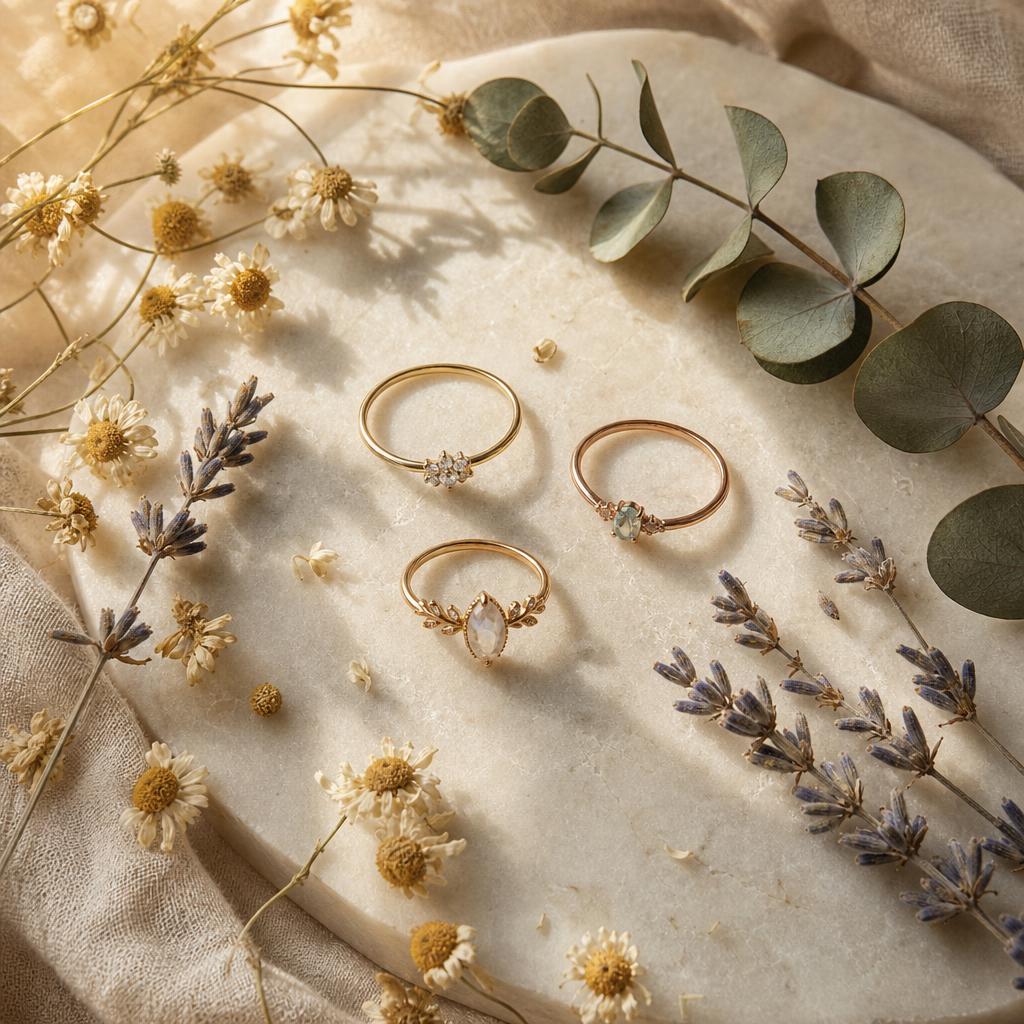
Cottagecore Rings and the Rise of Nature-Inspired Jewellery: What's Driving the Trend and What It Actually Looks Like
There is something happening in the way women are choosing rings right now — a quiet pull toward the soft and organic, the romantic and slightly impractical, the kind of jewellery that looks like it was found in a grandmother's garden rather than a glass display case. Cottagecore didn't begin as a jewellery trend. But it has quietly become one.
If you've found yourself drawn to rings that feel a little weathered, a little wild, a little Victorian — marquise cuts that look like leaves, twisted bands that suggest climbing vines, styles that somehow seem more at home in a meadow than a modern office — you are not alone. This article breaks down the cottagecore ring aesthetic: what it is, why certain shapes and settings embody it, and what to look for when you want this feeling on your hand.


What is cottagecore, and why does it have a jewellery dimension?
Cottagecore is a visual and emotional aesthetic built around the imagery of quiet, unhurried rural life: wildflower fields, worn wooden furniture, linen aprons, homemade bread, books with cracked spines. It is an aesthetic of slowness and softness, and it arrived as a reaction — first to the speed of digital life, then to the clean-line minimalism that dominated the design world through the 2010s.
In jewellery terms, cottagecore translates to anything that feels organic over geometric, romantic over rational, timeworn over polished-new. It is the opposite of the architectural, angular styles that defined a previous decade of ring trends. Where those rings prized exactness and structural clarity, the cottagecore ring aesthetic prizes the feeling of something found, inherited, or grown rather than manufactured.
That does not mean these rings are actually old. Many of the styles that feel most cottagecore are brand-new. What they share is a visual vocabulary borrowed from nature and from history — shapes that echo botanical forms, settings that suggest hand-finishing, bands that move the way branches do.
Worth knowing: The cottagecore aesthetic does not require you to dress like you've stepped out of an English pastoral painting. A cottagecore ring works just as well with a blazer and jeans as it does with a floral dress — the ring carries the feeling without demanding that the rest of your life match.
The ring shapes that feel most botanical
Not all stone shapes read the same way to the eye. Round brilliants are pure and universal — beautiful, but neutral in aesthetic terms. Princess cuts are precise and modern. Cushions are soft but still quite structured. The shapes that carry the most natural feeling are the ones with organic edge profiles: the shapes that suggest something that grew rather than something that was designed.
Marquise: the shape that looks like a leaf
The marquise is the most overtly botanical shape in fine jewellery. Its narrow, pointed oval silhouette mimics a leaf, a petal, or an eye — all forms that exist in nature and that the human eye reads as organic without quite knowing why. When set in a halo of smaller stones, the marquise looks like a flower with radiating petals. Set as a solitaire, it looks like something you found pressed between the pages of a very old book.
The Victoria Ring centres on a marquise-cut simulated diamond surrounded by a pavé halo — and the combination is almost architecturally botanical. The stone and setting together form a shape that suggests a garden, not a showroom.

The Victoria Ring
A marquise-cut simulated diamond sits within a pavé-set halo that amplifies its leaf-like silhouette — one of the most recognisably nature-inspired ring shapes you can wear. Victorian romance, worn on your hand right now.
Shop The Victoria Ring →Pear cut: the teardrop that leans romantic
The pear shape is a hybrid — it combines the round brilliant's high sparkle with the elongating quality of the marquise. The result is a silhouette that is soft at one end and pointed at the other, reminiscent of a water droplet, a fruit, or a bloom at the moment it opens. Pear-cut rings have a natural sense of movement and lean romantic in a way that more symmetrical shapes don't.
The Isabella Ring captures this quality — a graceful teardrop stone in a halo setting that looks simultaneously delicate and intentional. For a cottagecore stack, a pear ring is an excellent anchor: the kind of stone that reads as carefully chosen without being formal.
Oval cut: the elongated solitaire
The oval is perhaps the most accessible entry point into the nature-inspired aesthetic. It lacks the pointed extremities of the marquise and pear, but its softly curved edges and elongated body echo organic forms — a river stone, a seed, a low sun. Oval solitaires set on plain or lightly textured bands have a particularly quiet beauty that suits the cottagecore sensibility without requiring any commitment to the full aesthetic.
Settings that suggest the handmade
Beyond the stone shape, the setting is where the cottagecore feeling lives or dies. The clean, minimal settings of contemporary fine jewellery — bezel settings, tension settings, flush-set stones — are beautiful, but they read as designed. The settings that feel most nature-inspired are the ones that reference craftsmanship: bands that twist, shoulders that carry pavé detail, anything that suggests a hand was involved in making it.
The twist band
A band that twists or crosses beneath the centre stone immediately evokes movement and growth. It suggests a vine, a tendril, a river bend. On a halo ring, a twist shank adds textural complexity without overwhelming the stone — and it is one of the easiest ways to make a conventional ring silhouette feel more organic and romantic without straying into anything that feels costume or overly period-specific.

The Camilla Ring
A round-cut simulated diamond lifted above a gracefully twisted pavé band — the kind of detail that makes a ring look like it grew into its shape rather than being set by machine. One of the most genuinely romantic settings in the Gemiros collection.
Shop The Camilla Ring →Pavé shoulders and vintage band detailing
Rings with detail on the band — pavé accents along the shoulders, carved metalwork, texture that rewards close inspection — carry an heirloom quality that fits the cottagecore aesthetic precisely. The detail does not need to be elaborate. Even a modest band with small pavé stones set into the shoulders beneath a round centre stone suggests care and craft in a way that a plain polished shank simply doesn't.
The Beatrice Ring is the clearest example of this: a round-cut simulated diamond set above a band with decorative detailing that references antique jewellery without ever feeling dated. Paired with a plain band or a slim eternity ring, it reads as a considered, slightly heirloom collection rather than a single modern purchase.
Metal tone and the cottagecore palette
Cottagecore leans warm. The aesthetic is rooted in golden-hour light, autumn harvests, cream linens, and raw wood — a palette that is warm, muted, and a little dusty at the edges. This translates directly to the metal tones that feel most at home in the aesthetic.
Rose gold is the most intuitive choice. Its warm pink undertone reads as soft and romantic without being stark. Against fair skin, it creates a gentle flush. Against deeper skin tones, it glows. Rose gold is also unusual enough to feel considered — it doesn't read as the default choice, which suits the slightly eccentric spirit of the cottagecore look.
Yellow gold carries an additional quality: age. Gold rings from older eras were yellow, not white, and a yellow-gold setting adds a sense of history to any stone without it needing to be actually old. If you want your ring to feel as if it has a story behind it, yellow gold does that work quietly and convincingly.
White gold and sterling silver can still sit within the aesthetic — the Victoria Ring's marquise-in-silver manages to feel organic rather than cool — but they require the stone shape and setting to carry more of the botanical weight. When the metal is neutral, the shape and detail have to do more of the talking.
✦ For the warmest cottagecore feel: pair a rose gold setting with a soft stone shape — pear or oval — and avoid angular cuts and geometric halo arrangements. The rounder and more organic the combination, the more naturally it sits within the aesthetic.
When art deco meets the garden: the geometric-organic crossover
Cottagecore does not require you to avoid all geometry. Art deco — the design movement of the 1920s and 1930s, characterised by symmetrical patterns, stepped silhouettes, and architectural precision — has its own brand of romanticism. It is the romanticism of a different era, but it shares the cottagecore preoccupation with ornament, with handcraft, and with details that reward close attention.
Asscher-cut rings are the clearest example of this crossover. The asscher has a stepped, octagonal silhouette that creates an almost kaleidoscopic effect when you look straight down into it. It is geometric, yes — but it is also deeply vintage, associated with the glamour of an era defined by elaborate decoration and a commitment to the beautiful over the efficient.
For a woman drawn to the cottagecore aesthetic who also has a slightly darker or more literary edge to her style — the woman who loves old books as much as wildflowers — an asscher-cut ring in an art deco-influenced setting is the natural meeting point between the two sensibilities.

The Astrid Ring
A 3-carat asscher-cut simulated diamond with side stones — art deco architecture in ring form. For the cottagecore woman with a moody or literary edge to her aesthetic, this is the natural crossover choice.
Shop The Astrid Ring →How to wear a cottagecore ring without committing to the full aesthetic
One of the most appealing things about the cottagecore ring aesthetic is that it doesn't ask you to change anything else. You don't need a particular wardrobe, a particular lifestyle, or a particular decade-of-birth to wear a marquise-cut ring or a rose gold twist band. The ring carries its own vocabulary — what it communicates is: I notice detail, I value romance, I'm not especially interested in looking like everyone else right now.
That said, there are a few ways to wear it with more intention. A single cottagecore ring reads quiet and considered. A small stack — the cottagecore ring plus a plain band, or a twisted eternity ring beside a marquise solitaire — reads more like a collection. The Isabella Ring pairs beautifully with a slim plain band alongside it; the Victoria Ring sits well with a narrow pavé eternity ring as a companion piece.
If you're testing whether the aesthetic genuinely suits you before committing to a more significant piece, start with a ring that has just one nature-inspired element: a twist in the band, a pear or marquise cut, or a vintage-feeling detail at the shoulders. The Harlow Ring — an emerald-cut stone set in a vintage-influenced halo — is a good starting point: it brings heritage and organic feeling without being overtly whimsical. If it feels right, you'll know quickly.
Quick Takeaways
- Cottagecore rings prioritise organic shapes, vintage-feeling settings, and warm metal tones over modern minimalism
- Marquise and pear cuts carry the strongest botanical feeling — both suggest natural forms without trying to
- Twist bands, pavé shoulder detailing, and engraved shank work make settings feel handmade rather than manufactured
- Rose gold and yellow gold lean warmest within the aesthetic; silver can work when the stone shape carries the botanical feeling
- Art deco styles — asscher cuts, stepped silhouettes — occupy a romantic crossover between geometry and vintage ornament
- The aesthetic requires no wardrobe commitment — a single ring carries the feeling entirely on its own
Frequently asked questions
What makes a ring look cottagecore?
A combination of organic stone shapes (marquise, pear, oval), settings that suggest handcraft or vintage character (twisted shanks, pavé shoulder work, engraved band detail), and warm metal tones (rose gold, yellow gold). No single element guarantees the look — it is a cluster of choices that together suggest something grown or found rather than precision-designed.
Is cottagecore the same as vintage-inspired?
Related, but not identical. Vintage-inspired rings reference specific historical periods — Edwardian, Art Nouveau, Art Deco — quite directly. Cottagecore borrows from that romantic vocabulary without pinning itself to a particular decade. It is more of a feeling than a historical reference: organic, warm, soft, slightly impractical-looking.
What stone shapes work best for a cottagecore ring?
Marquise and pear cuts are the most overtly botanical — both have silhouettes that echo natural forms. Oval cuts are a softer entry point into the aesthetic. Round brilliants can work if the setting carries sufficient vintage or organic detail. Avoid angular, precise shapes like princess cuts unless you are specifically going for the art deco crossover look.
Can I stack a cottagecore ring?
Yes — and stacking often enhances the look rather than diluting it. Pair a marquise or pear halo ring with a slim plain band or a narrow pavé eternity ring for a result that looks considered rather than cluttered. Avoid mixing very angular stacking bands with soft, organic cottagecore styles — the contrast can feel jarring rather than curated.
The cottagecore ring aesthetic is one of the more genuinely romantic directions jewellery has taken recently — not because it is nostalgic exactly, but because it is deliberate. It chooses the organic over the optimised, the old-feeling over the new-looking, the ring that suggests a story over the ring that just performs sparkle. If that sounds like something you want on your hand, you already know where to start.


