

Coloured Stone Engagement Rings: Why Sapphire, Emerald, and Morganite Are Having a Moment
Something shifted quietly in the world of engagement rings. The diamond solitaire has reigned for decades — and it's still beautiful, absolutely. But the women getting engaged today are asking different questions. They want a ring that looks like their personality. They want colour.
Sapphires in deep ocean blue, emeralds in rain-forest green, morganites in the softest blush — coloured gemstones are no longer the unconventional choice. They're becoming the considered one. And if you've been noticing them everywhere recently, you're not imagining it. The shift is real, the appeal is deep, and understanding why each stone is having its moment is the best way to figure out which one, if any, is right for you.


Why Coloured Stones Are Having This Moment
The appeal of coloured gemstones in engagement rings isn't new. Royalty and aristocracy wore sapphires, rubies, and emeralds for centuries — the all-diamond engagement ring is, historically speaking, a relatively recent convention, driven largely by a single century of brilliant marketing. What's changed now is that modern buyers are more informed, more aesthetically independent, and increasingly drawn to pieces that feel personal rather than prescribed.
Three stones in particular are leading this revival: sapphire, emerald, and morganite. Each has its own personality, its own visual character, and its own care requirements. Knowing what draws you to one over another is actually a meaningful step in understanding your broader taste in jewellery — and in deciding whether a coloured stone ring is right for your life as well as your aesthetic.
Worth knowing: Coloured gemstone engagement rings have been the signature choice of royals across history — from Princess Diana's iconic oval blue sapphire (now worn by Princess Kate) to Jacqueline Kennedy's emerald-cut emerald. Their current resurgence reflects a broader appetite for jewellery that feels individual and intentional.
Sapphire: The Stone of Loyalty and Depth
Blue sapphire is arguably the most recognisable coloured engagement stone of our generation — and its renewed popularity traces directly to a single ring. When Prince Charles gave Lady Diana Spencer that 12-carat oval blue sapphire surrounded by a diamond halo in 1981, it became the most famous engagement ring in the world overnight. When it passed to Catherine Middleton in 2010, a new generation fell in love with it all over again.
But sapphires come in a far wider range of colours than most people realise. Beyond the classic royal blue, you'll find them in dusty cornflower, deep navy, pale sky, velvety teal, and even peachy-pink varieties known as padparadscha sapphires. This versatility is exactly what appeals to modern ring shoppers who want something specific to them rather than something generic.
What makes sapphire such an intelligent choice is its exceptional hardness: it rates 9 on the Mohs scale, just one point below diamond. That means a sapphire engagement ring is genuinely suited to daily wear in a way that some other coloured stones are not. The cuts that work best with sapphire mirror its personality: ovals emphasise the depth of colour and elongate the finger beautifully; cushion cuts showcase its natural warmth; rounds maximise brilliance. If a sapphire speaks to you, the oval is almost certainly the shape worth starting with.

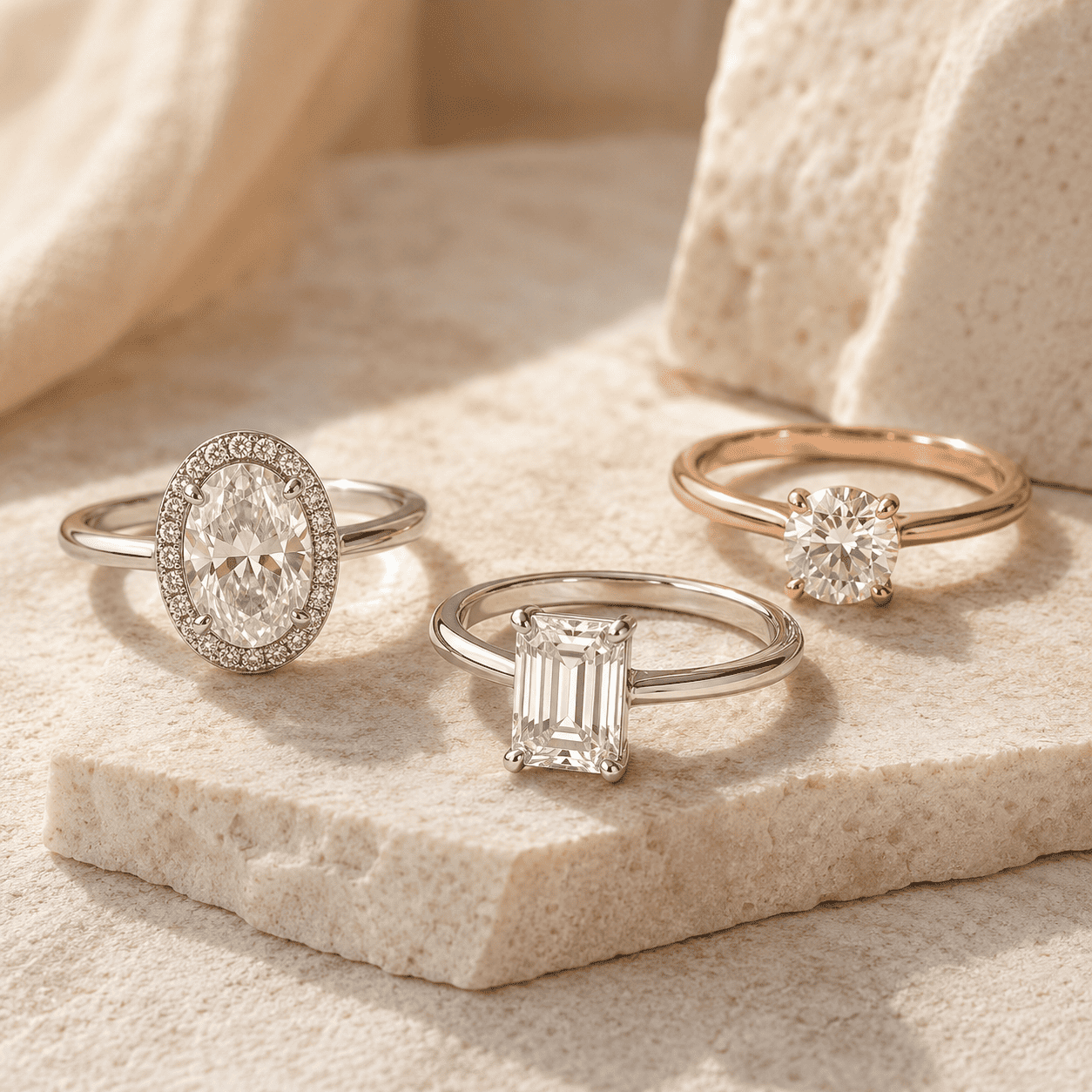
The Ophelia Ring
With its hidden halo amplifying a generous oval center stone, The Ophelia captures the same elongated elegance that makes sapphire ovals so beloved. A beautiful simulated diamond option that echoes the sapphire ring silhouette — whether as a standalone piece or a travel companion for the real thing.
Shop The Ophelia Ring →Emerald: The Stone of Sophistication
Emeralds carry a different kind of weight. Where sapphires feel romantic and classic, emeralds feel intellectual and bold. Their deep, saturated green has long been associated with status, creativity, and a particular kind of quiet confidence — the person who chooses an emerald engagement ring isn't following a trend, they're setting one.
Part of emerald's enduring appeal is that its most flattering cut is named for it: the emerald cut, with its long rectangular facets and open, window-like table, is one of the most elegant shapes in all of jewellery. It's the choice of women who appreciate clean lines, who favour sophistication over maximalism, and who want a ring that looks equally at home on a bare hand or stacked with a slim wedding band.
It's worth knowing that emeralds are among the softer precious stones — typically rating 7.5–8 on the Mohs hardness scale, compared to sapphire's 9 and diamond's 10. They also frequently contain natural inclusions, which gem traders call a "jardin" (French for garden). These inclusions are part of what makes each emerald unique, but they do mean an emerald engagement ring requires more thoughtful handling. Many emerald ring wearers reserve their stone for evenings and occasions, and keep a beautiful alternative for daily wear and travel.

The Harlow Ring
The Harlow captures everything that makes emerald-cut rings magnetic — long, clean lines framed by a halo that lifts the silhouette without overwhelming it. A striking simulated diamond option for anyone drawn to the sharp, architectural character of the emerald-cut aesthetic.
Shop The Harlow Ring →Morganite: The Stone of Softness and Romance
Of the three stones having a moment right now, morganite feels most distinctly of our time. Its blush-peach hue — somewhere between pale rose, warm salmon, and the lightest champagne — photographs beautifully, layers naturally with rose gold settings, and has an inherently romantic quality that resonates deeply with contemporary aesthetics. It's become the stone of choice for women who want something feminine without being conventional.
Morganite belongs to the beryl family, the same mineral group as emerald, and shares a similar hardness rating of 7.5–8 on the Mohs scale. It needs to be stored thoughtfully and removed for high-contact activities, but it's considerably more forgiving than emerald in terms of daily durability.
What makes morganite genuinely magical is its relationship with metal. Set in rose gold, the warm tones of stone and setting create a seamlessly harmonious look that's unlike anything else in jewellery. In yellow gold, it takes on a vintage sweetness. In white gold or silver, the cooler contrast makes the pink hue feel bolder and more modern. If you're drawn to this palette but want something for everyday wear and travel, look for rings in warm-toned settings — rose gold bands with a clear stone echo morganite's signature warmth precisely.

The Stella Ring – Rose Gold
The Stella in rose gold channels exactly the warmth and femininity that makes morganite rings so beloved. A clean round-cut simulated diamond in a warm rose gold 4-prong setting — the ideal travel companion for a morganite engagement ring, or a quietly beautiful standalone piece in its own right.
Shop The Stella Ring – Rose Gold →Choosing Between Them: A Practical Framework
If you're genuinely undecided between sapphire, emerald, and morganite, a few questions help clarify the direction:
- What does your everyday wardrobe look like? Cool blues and whites suit sapphires beautifully. Emerald works exceptionally alongside rich jewel tones and neutral classics. Morganite shines with blush, cream, warm terracotta, and the softer end of the palette.
- What metals do you wear most often? Sapphires are versatile across all gold tones. Emeralds are classically beautiful in yellow gold. Morganite is at its absolute best in rose gold.
- How active is your daily life? Sapphire is the most durable of the three and handles most active lifestyles well. Emerald and morganite both benefit from being removed for the gym, swimming, and heavy manual activities.
- What draws you aesthetically? Romantic and regal? Sapphire. Sophisticated and architectural? Emerald. Soft and feminine? Morganite.
✦ Pro tip: Before committing to a coloured stone, spend as much time considering the cut as the stone itself. The emerald cut is extraordinary with both emeralds and sapphires. Ovals bring out the most depth in blue sapphires. Cushion cuts are beloved with morganite. The shape affects how the colour reads on the hand more than most buyers anticipate.
The Case for a Travel Companion Ring
One of the most practical realities of owning a coloured stone engagement ring is deciding what to wear when you shouldn't be wearing the original. Taking a precious emerald to the beach is asking for trouble. Wearing your sapphire through chlorinated pool water, international flights, and a coastal honeymoon isn't the most careful approach either.
This is precisely where a beautifully made simulated diamond ring earns its place in a jewellery collection. The idea isn't to pretend you have something you don't — it's to give yourself freedom and peace of mind while your real ring stays safe. The most practical travel rings mirror the silhouette and metal tone of your engagement ring: an oval halo in silver if you have an oval sapphire, a rose gold solitaire if your morganite ring is rose gold set, an emerald-cut solitaire if your emerald has a clean, minimal setting.
Choose well, and most people won't notice the difference — they'll simply see a beautiful ring on your finger, exactly as it should be.
Quick Takeaways
- Sapphire, emerald, and morganite are the three coloured stones leading the current engagement ring revival — each with its own personality and care profile.
- Sapphires (Mohs 9) are the most durable and well-suited to daily wear; emerald and morganite (7.5–8) benefit from more careful handling.
- Cut selection matters as much as stone: ovals for sapphires, emerald cuts for emeralds, cushions or rounds for morganite.
- Metal choice changes everything: rose gold transforms morganite, yellow gold warms emerald, and all three metals work beautifully with sapphire.
- A simulated diamond travel ring in the same silhouette as your coloured stone ring offers freedom and peace of mind without compromising on beauty.
Frequently Asked Questions
Are coloured stone engagement rings as durable as diamond rings?
It depends on the stone. Sapphires rate 9 on the Mohs hardness scale and are extremely well-suited to daily wear — nearly as hard as diamond (10). Emeralds and morganites both sit around 7.5–8, which is harder than most household materials but more susceptible to everyday grit and knocks. Both benefit from careful storage and regular breaks from high-impact activities. For daily wear intensity, sapphire is the strongest coloured stone choice.
Can I wear a coloured stone engagement ring swimming or on holiday?
Sapphires handle swimming relatively well, though chlorine over time can affect metal settings. Emeralds are particularly vulnerable — many are treated with oils or resins that chlorine and saltwater can damage. Morganites are more stable but still vulnerable to physical impact in active water settings. The safest approach for any valuable coloured stone on holiday is to leave it secured and wear a travel ring instead.
What is the best metal for a morganite engagement ring?
Rose gold, without question. The warm peachy tones of morganite and the blush warmth of rose gold create a seamless, harmonious combination unlike anything else in jewellery. Yellow gold is a lovely second choice for a more vintage feel. White gold or silver creates a cooler contrast that makes the pink hue feel bolder and more distinctive — worth considering if you want the stone to be the clear focal point.
Is an emerald-cut ring the same as an emerald ring?
No — these are two completely different things. An emerald cut refers to the rectangular step-cut shape of the stone, which can be applied to diamonds, sapphires, morganites, and any other gemstone. An emerald ring means the stone itself is a green emerald gemstone, which can be cut in many shapes including round, oval, pear, or — yes — emerald cut. The confusion is common but the distinction matters when you're shopping.
The quiet revolution in engagement rings isn't really about stones at all — it's about the confidence to choose what genuinely resonates with you rather than what convention says you should want. Whether you're drawn to the deep blue authority of a sapphire, the cool sophistication of an emerald, or the blush romanticism of a morganite, the ring you choose becomes part of how you present yourself to the world every single day. That's worth getting exactly right.


